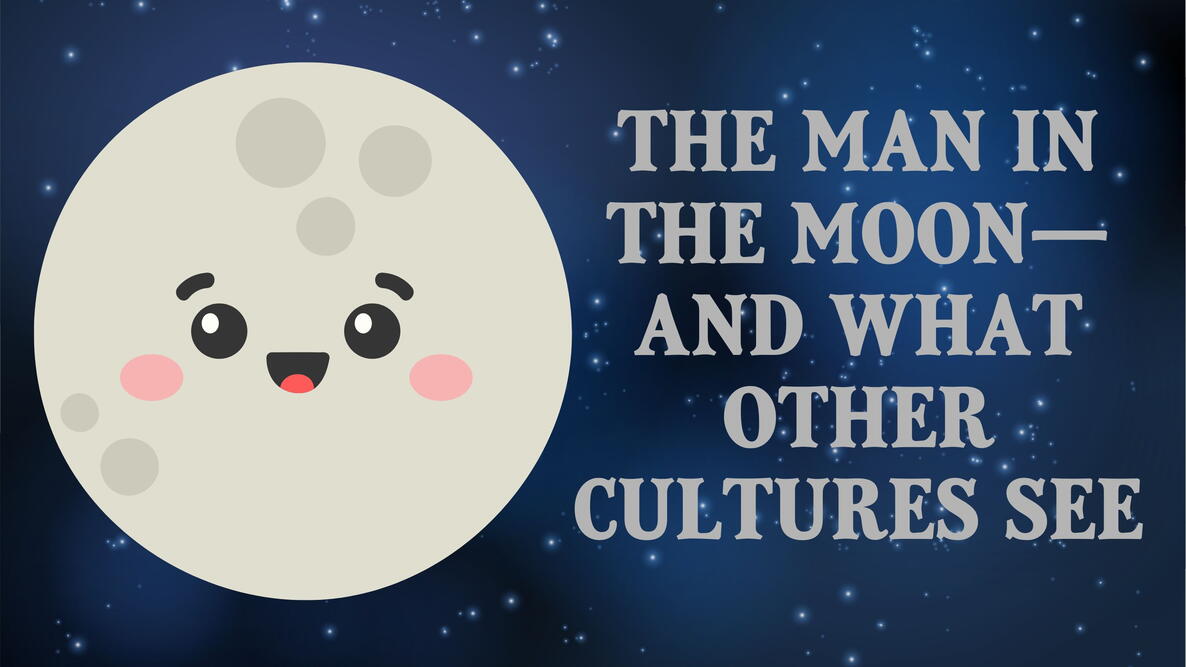
What do you think of when you look at the Moon? For centuries, people around the world have imagined characters, animals, and stories in its light and dark markings. In Western folklore, we often see the Man in the Moon. Other cultures see a rabbit, a woman, or something else entirely.
Why Do We See Shapes in the Moon?
The Moon’s familiar patterns come from its surface. The dark areas, called lunar maria, are broad plains formed when ancient lava filled impact basins. The lighter areas are the lunar highlands. Together, their curves and contrasts can resemble familiar shapes. Our tendency to recognize patterns in ambiguous images is called pareidolia.
What people see depends partly on the stories and images they already know. The Moon’s apparent orientation can also look different depending on where you are on Earth.
The Man in the Moon and Other Moon Images
In Western culture, many people see a face or figure in the Moon’s markings. In parts of East Asia, people see a rabbit. In Chinese tradition, the rabbit is often shown with the Moon goddess Chang’e, preparing an elixir with a mortar and pestle. In Japan, the rabbit is commonly associated with making mochi, or rice cakes.
Some Polynesian traditions tell of a woman named Hina or Sina who lives in the Moon. The stories differ across islands and communities; in some versions, a woman and her child are taken up to the Moon.

Moon Gods and Myths From Around the World
People have also told stories about the Moon’s changing shape, its place in the sky, and the light it shares with the Sun.
In Inca mythology, Mama Quilla was the Moon goddess. One account of Inca belief says a lunar eclipse meant an animal was attacking her, so people made noise to scare it away.
In the Finnish epic Kalevala, the air maiden Ilmatar allows a bird to lay eggs on her knee. When the eggs break, their pieces help form the world: the yolk becomes the Sun, the white becomes the Moon, and other fragments become the Earth, sky, and stars.
In Greek mythology, Selene is the Moon goddess and sister of Helios, the Sun. She crosses the sky in a chariot drawn by white horses.
In Japanese mythology, Tsukuyomi is a Moon god and the brother of Amaterasu, the Sun goddess. One version in the Nihon Shoki says Tsukuyomi was born from a white copper mirror held by the god Izanagi.
What Do You See in the Moon?
The Moon’s markings have inspired stories for generations. Look up at the next Full Moon and see what shapes you can find. Do you see a face, a rabbit, or something else?
Frequently Asked Questions
-
What is the Man in the Moon?
The Man in the Moon is a figure people imagine in the Moon’s light and dark markings. The pattern can look like a face or a person, depending on how you interpret it.
-
Why do people see faces and shapes on the Moon?
People naturally recognize familiar patterns in ambiguous shapes. On the Moon, the contrast between dark plains and lighter highlands can suggest faces, animals, or other figures.
-
Do people in other cultures see different images on the Moon?
Yes. Moon stories vary across cultures. Common examples include a rabbit in parts of East Asia and a woman associated with the Moon in some Polynesian traditions.
Sources
- National Geographic — Total Lunar Eclipse Myths
- University of Hawaii — Hawaiin Legens


Comments