
Image Credit:
samotrebizan/Getty Images
Sponsored Article:
Cummins
Botanical Name
Spinacia oleracea
Grown as
Toxicity
Sun Exposure
Water Needs
Height
Spread
Soil pH
Special Features
Resilience
Plant Type
Harvesting
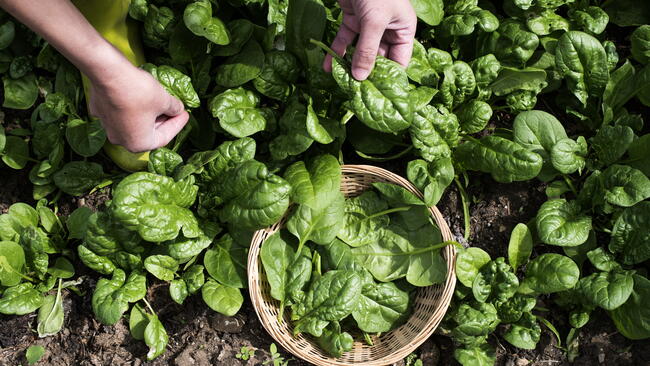
- Harvest a few outer leaves from each plant (so that inner leaves can develop) when leaves reach the desired size or harvest the entire plant, cutting the stem at the base.
- Don’t wait too long to harvest or wait for larger leaves. Bitterness will set in quickly after maturity. Be aware of day length and heat: Increasing daylight (about 14 hours or longer) and warmer seasonal temperatures can cause spinach to bolt (develop a large stalk with narrower leaves and buds/flowers/seeds), which makes the leaf taste bitter.
- If spinach starts to bolt, pull the plant and use the leaves. Or try to slow the bolting: Pinch off the flower/seed heads, keep the soil moist, and provide shade.

Photo by Deyan Georgiev/Shutterstock.
How to Store Spinach
Fresh spinach leaves are good for up to a week. Too much moisture hastens their demise, so store fresh spinach unwashed and don’t wash until ready to use. Pat dry with a paper towel and put in a freezer bag with the towel to absorb moisture.
Given its short shelf life, spinach is perfect for freezing. Wash, trim off ends and yellowing leaves, blanch, and pack into freezer bags. See how to freeze spinach.
Types
There are four main types of spinach suited for spring and fall plantings.
- Baby-leaf-style spinach is tender, with small leaves. The variety ‘Baby’s Leaf’ is good for containers; ‘Catalina’ is heat-tolerant and resistant to downy mildew.
- Malabar spinach (Basella alba), a vine, and New Zealand spinach (Tetragonia tetragonioides), a perennial, are two leafy greens that resemble common spinach; both are heat-tolerant. Grow them in the summer when common spinach can’t take the heat.
- Savoy spinach has curly, crinkled, dark-green leaves—an example is the variety ‘Bloomsdale’. The ‘Winter Bloomsdale’ variety is a crinkled-leaf, fall variety, tolerant to mosaic viruses.
- Semi-Savoy has slightly crinkled leaves and can be difficult to seed. ‘Melody’ is resistant to cucumber mosaic virus and downy mildew; mildew-resistant ‘Remington’ will grow in spring, summer, or fall; ‘Tyee’ can be planted in spring or fall and is resistant to downy mildew.
- Smooth- or flat-leaf (also called plain leaf) varieties have spade-shaped leaves. ‘Giant Nobel’ is a plain leaf variety and an heirloom that is slow to bolt; ‘Nordic IV’ is bolt-resistant.

More Like This



that is an informative post. subwaymenusprice.com
Hi - just a heads up that there is a bullet point about radishes in the “When to plant spinach” section.
Hey just wanted to give you a quick heads up. The text in your
content seem to be running off the screen in Safari.
I'm not sure if this is a formatting issue or something to do with web browser compatibility but I thought I'd post to let you know.
The design and style look great though! Hope
you get the issue solved soon. Cheers
Have a look at my homepage; win at slots - Luigi,
Today i learned something new, I appreciate you
I've come across "page not found" when accessing in various vegetable articles for "health benefits of going green".
At 82, need all the health I can get. Thanks
Tom
Tired of conventional methods? Try cupping for weight loss, which enhances lymphatic flow and encourages fat breakdown. Whitefield Cupping Clinic offers personalized sessions that target problem areas while supporting your body’s internal balance.
Tired of conventional methods? Try cupping for weight loss, which enhances lymphatic flow and encourages fat breakdown. Whitefield Cupping Clinic offers personalized sessions that target problem areas while supporting your body’s internal balance.

Thanks for letting us know the link was broken! Here's the article: https://www.almanac.com/go-leafy-greens
I use some baby spinach, salads only as it has barely any flavor. I prefer full-grown old fashioned regular spinach, which has a full earthy flavor and best for cooking and soups. It is now hard to find in the markets, which is a shame. It is a true dark green leafy vegetable giving great nutrition. I have been able to get it in one supermarket chain. Please tell me where I can get this to plant in my garden.
I had the same problem not finding Curly leaf green Spinach; I found some @ Stop&Shop CT; ask the produce manager; ty; :)
- « Previous
- 1
- 2
- …
- 10
- Next »
📣The Gardening Club Just Got Better! 3 Deliveries, 10% Store Discount, and more!

Comments