

Where Did This Term Originate and What is its Definition Today?

The term “Indian Summer” has been around for centuries. What is an Indian Summer or Second Summer? Where did this term originate, and what is its meaning today? Learn more.
For over two centuries, The Old Farmer’s Almanac has gone by the adage: “If All Saints’ (November 1) brings out winter, St. Martin’s brings out Indian summer.”
“Indian Summer” is not the best terminology, given the history of the term “Indian” in North America. The weather phenomenon is best described using the term that Europeans and British still use: St. Martin’s Summer. This references St. Martin’s Day—November 11—the official start of these unusually late warm spells. Another popular term used by the American Meteorological Society is “Second Summer,” which is indeed appropriately descriptive.
Read Next
In England, Shakespeare used the expression “All Halloween Summer.” Other old terms include the unfortunate “Old Wives’ Summer” and, poetically, “Halcyon Days.”
Definition of Indian Summer, Second Summer
Here are several criteria for this weather phenomenon, according to The Old Farmer’s Almanac:
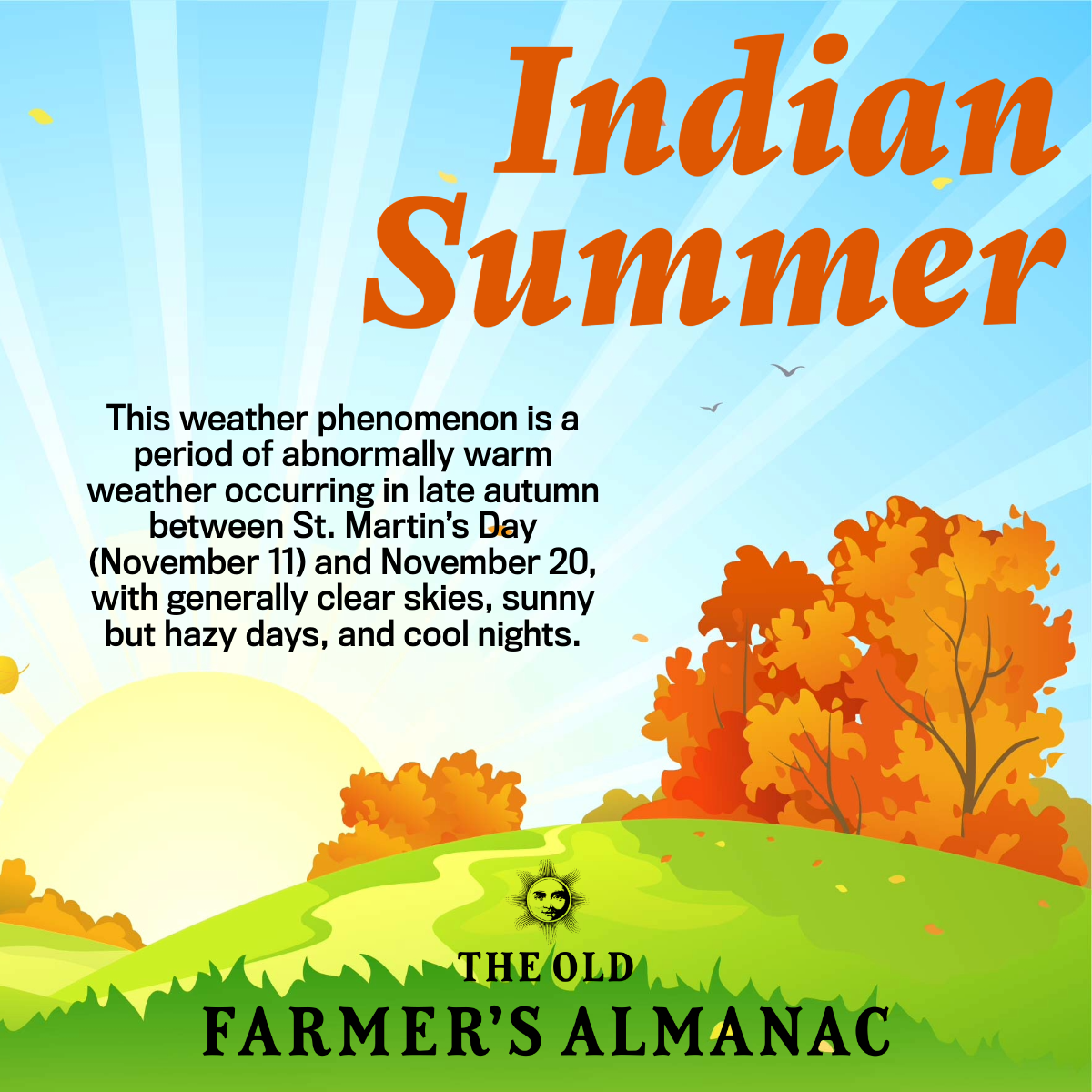
- It’s a period of abnormally warm weather occurring in late autumn between St. Martin’s Day (November 11) and November 20, with generally clear skies, sunny but hazy days, and cool nights.
- The timing is important: It occurs after at least one killing frost but also before the first snowfall; preferably a substantial period of normally cool weather must precede this warm spell.
- As well as being warm, the atmosphere is hazy or smoky, there is no wind, the barometer is standing high, and the nights are clear and chilly.
- A moving, cool, shallow, polar air mass is converting into a deep, warm, stagnant anticyclone (high pressure) system, which has the effect of causing haze and a large swing in temperature between day and night.
Given above criteria, this weather phenomenon does not occur every year and it occurs more than once some years. We rather enjoy this description written by Sandy Griswold for the Omaha Sunday World-Herald in November 1922:
I am enabled to say, however, that the characteristics of the season, when it appears in all its glory, are a mild and genial temperature, gentle southwestern breezes, unusual brightness of the sun, extreme brilliancy of the moon, a clear, blue sky; sometimes half hidden by a veil of gray haze; daybreaks redder than the splotch on the blackbird’s wing, and sunsets laden with golden fleeces, the wooded valleys aglow with the fires of richly tinted leaves, still clinging to the listless limbs, or lying where they have fallen….
What is the Origin of Indian Summer?
So, where did this term come from? The origin is not certain, but dates back as far back as 1778 in Letters From an American Farmer by the French-American soldier-turned–farmer Michel-Guillaume-Jean de Crèvecoeur:
“Then a severe frost succeeds which prepares it to receive the voluminous coat of snow which is soon to follow; though it is often preceded by a short interval of smoke and mildness, called the Indian Summer.”
There are many theories. Here are a few of the more plausible ones:
- Some say it comes from the Narragansett people located in what is now the northeastern United States, who believed that the condition was caused by a warm wind sent from the court of their southwestern god, Cautantowwit (“great spirit”).
- Another theory is that Native Americans would routinely use this brief period of warm fall weather as an opportunity to increase winter stores. November is the time to get one’s last harvest in before winter truly shows its head, so a short period of warm weather would be of note around this time.
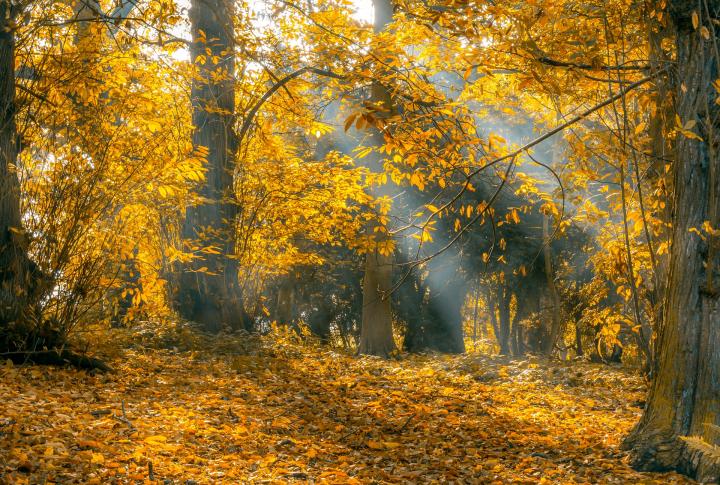
- A third theory suggests that early American settlers mistook the sight of sun rays through the hazy autumn air for Native American campfires, resulting in the name “Indian summer.”
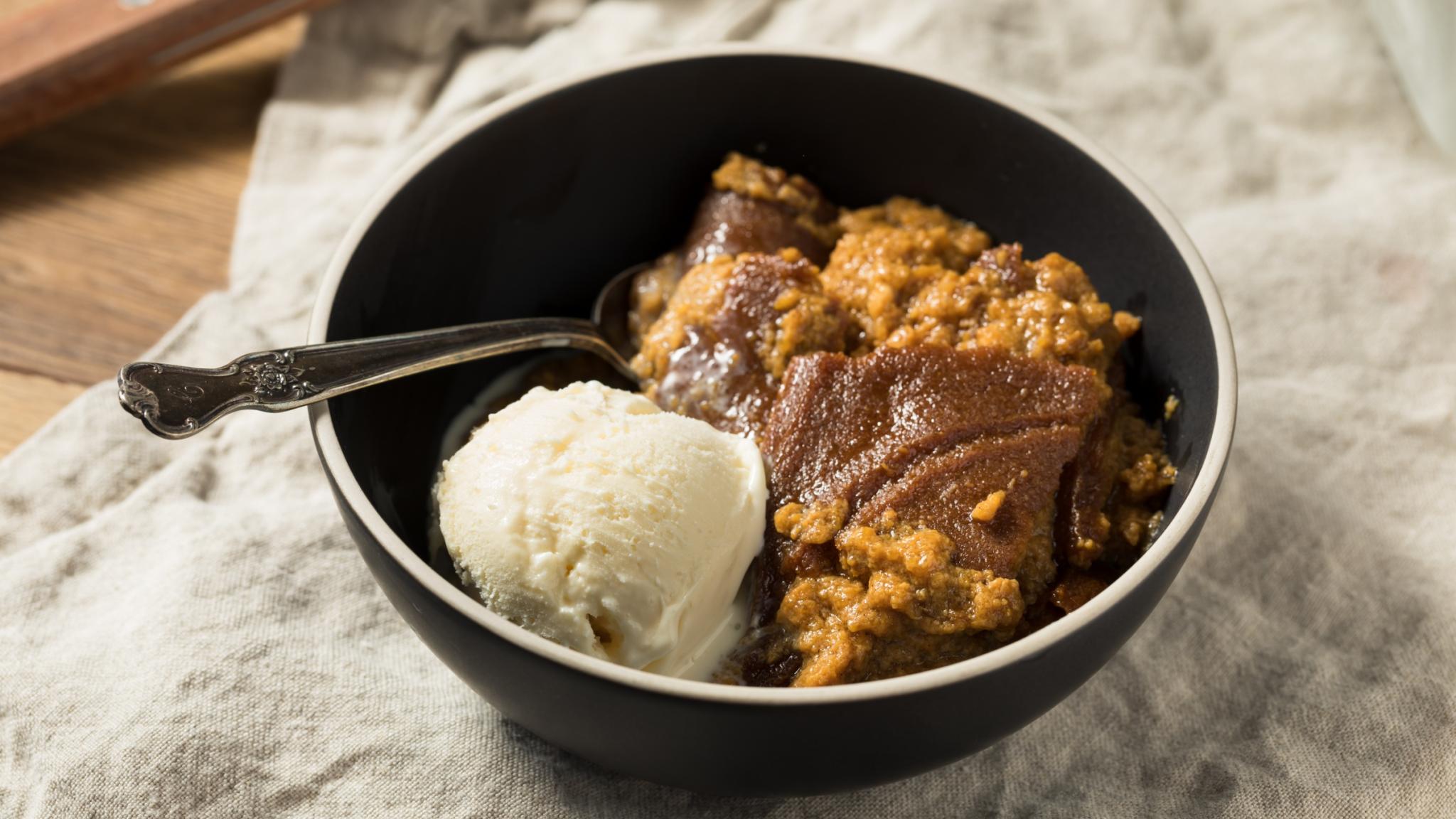
Indian Pudding Recipe
Celebrate November with a delicious, cozy pudding made with native corn! Indian Pudding is a warm baked custard that uses cornmeal, milk, molasses, and cinnamon. The origin of Indian Pudding dates back to the 1700s; it was said to be a favorite dish of Founding Father John Adams! It’s essentially a version of British Hasty Pudding (which was made by boiling wheat flour in water or milk until it thickened into a pudding), but in the New World, the Native Americans made it with cornmeal, which early settlers referred to as “Indian flour.”
Are you experiencing a warm spell in November? Let us know in the comments below.
Catherine Boeckmann

I hope you people know that Indian summers don’t exist. It’s climate change. It’s not supposed to be warm during the fall. Don’t be stupid and do some research.
The terms Indian Summer and Indian Pudding are inappropriate and should not even be mentioned in 2024. We know this history. I don’t have to spell it out for you.
Call it Corn pudding, second summer, acknowledge the contributions of Indigenous peoples to the culture and survival of settlers. Thank you
We are here on the north shore of Lake Erie. The weather is very much the same as Michigan. This year 2024 we are having a lovley second summer, some of my flowers are blooming again, but the nights are getting colder by the day. Some have even reached below freezing, but warming quickly because the warmth of the day is strong. I love this time of year with anticipation of the first snow.
Here in zone 6B in Michigan, we have had a killing frost and a few nights with temperatures below freezing. Although the next 10 days we will see highs in the mid to upper 50s during the day and lows in the mid-30s at night, it certainly won't be what I would consider T-shirt, shorts, and flip-flop weather. We don't want it to get too warm though, as November 15th is the opening day of the firearm deer hunting season. If it is too warm, that freshly harvested meat could spoil before it gets processed. Personally, I am already looking forward to spring and summer!!
I'm also from Michigan, middle of the mitt. Same weather forecast here. Hunters prefer colder Temps for deer harvest, but I agree with you..looking forward to spring and summer weather.
We have had a hard freeze and several very cold days. All Saints Day was quite cold. Our forecast for the next week features highs in the 60s and 70s. I believe this fits the definition of "Indian Summer." I enjoyed reading the passage from the Omaha World-Herald as I live in Omaha. I had read once that the term was used by the Plimoth settlers who were instructed by the Wampanoag to anticipate a warm period to allow them to gather more winter stores and that was part of the origin of the First Thanksgiving. I am a descendent of Mayflower passengers John Howland and Elizabeth Tilley through those who left Massachusetts Bay to settle in Rhode Island, so the Narragansett reference also piqued my interest.
I enjoy your historical articles very much, and tend to learn a little something from every one.
I could do without the apologetic lead-in to these stories on bygone events. While we have different sensitivities today, attempting to explain the past as "unfortunate" tends to distract from the intent of the article.
I agree completely and very well said.
Well said, Stu.
Very well said! My lineage contains Lakota Sioux blood and I do NOT take offense at the term American Indian. It's a term from our country's history, and I am tired of a certain portion of our population trying to extinguish our history! Happy Thanksgiving to all of my Almanac friends!

