


Fungal rust disease infiltrates these spinach leaves.
You Can Prevent Rust Plant Disease!

How to Identify Rust Damage
Rust diseases come in different varieties and can affect a wide range of plants. People often struggle with rust on their roses. It is easy to remember the defining characteristics of this fungus as they match its name. Rust plant disease will look similar to the rust that appears on that old bicycle in the shed.
- Look for yellow or white spots forming on the upper leaves of a plant.
- Look for reddish to orange blister-like swellings called pustules on the undersides of leaves.
- Orange or yellow spots or streaks appear on the undersides of the leaves.
- Within these spots that form are spores.
- Usually, leaf distortion and defoliation occur.
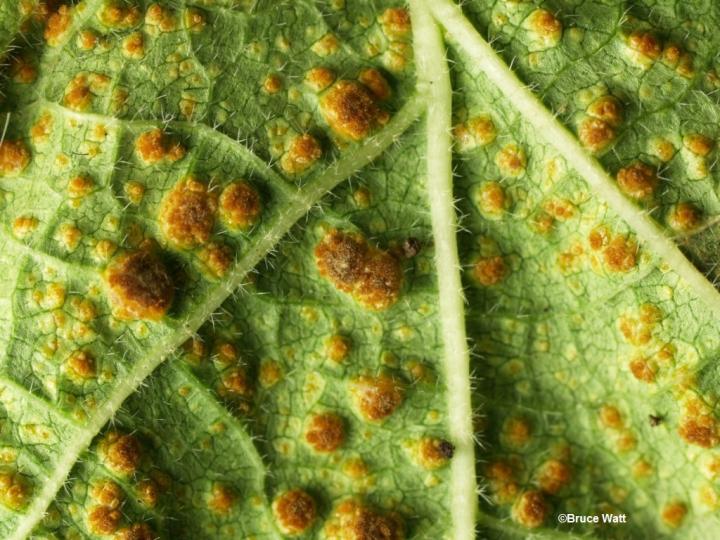
Photo Credit: Bruce Watt, University of Maine.
Catherine Boeckmann


I have rust in my garden beds (veg. & flower). Can the soil be treated for next year to stop it? What can I spray or dust on plants to stop it. Thanks.
Hi Tom,
Sorry to hear about your rust issues. Rust fungi can only survive by feeding off of live plant tissue. While it does not intentionally kill a plant, those infected may have reduced vigor due to the rust’s ability to divert plant resources for its own needs.
Rust is spread by spores that are transferred from infected plants to healthy plants by wind or water. Because it needs live plant tissue to survive, it is best to remove all infected plant parts and destroy them. You will also want to remove all debris in between plants to prevent it from spreading. And when watering, avoid splashing any water on to leaves, making it a point to water at soil level.
Since it needs live plant tissue to survive, it is important to remove all signs of it at the end of the growing season and clear away any plant debris that is in the garden bed. When choosing plants for next year, look for varieties that are rust-resistant and space plants in a way that promotes good air circulation. Since there are many rust varieties, talk to your local garden center or cooperative extension about products that are effective in your area.
I have rust in my garden beds (veg. & flower). Can the soil be treated for next year to stop it? What can I spray or dust on plants to stop it. Thanks.
I have some of the same questions that were already asked, has anyone answered them? I don't see any answers.
I had some useful plants at the corner of my greenhouse and I found rust appearing on the leaves. These are really unstoppable and damaged almost all leaves within 2 months. New leaves also shown some sign of new rust. Later, as the plants are at the corner of my greenhouse some leaves grown outside the greenhouse and surprisingly they are healthy. I moved all the plants to sun, removed the damaged leaves and later 1 month all are with new rust-free
Hello,
I've been trying to find on Google phrased Various different ways..
Is Mallow rust (or any of these rusts) safe to consume? I just learnt a neat Mallow recipe I wanted to try but they've gotten rusty the past couple weeks
I have 4 plants and they all look like they are burning up..all the leaves have dark brown edges that eventually take over the whole leaf..I spray with a fungicide about every 2 weeks but nothing seems to be working..any advice would be much appreciated.
Looks like rust on rose bushes, azaleas and other small plants
Try adjusting the quantity of light. If indoors take them out if outside place a cloth on top as covering you can use a mosquito net.
Try also watering using pipes to avoid splashing fungi from the soil to the plant leaves.
Try mulching with wood ash or dry grass.
I have 2 grape vines and they already have like rust spots on the leaves and they are curling up. The grapes are dying as well. The canes look really dry and a few of the little branches I have snapped off , they were dead. Somebody help. I live in New Bern,NC

