Primary Image
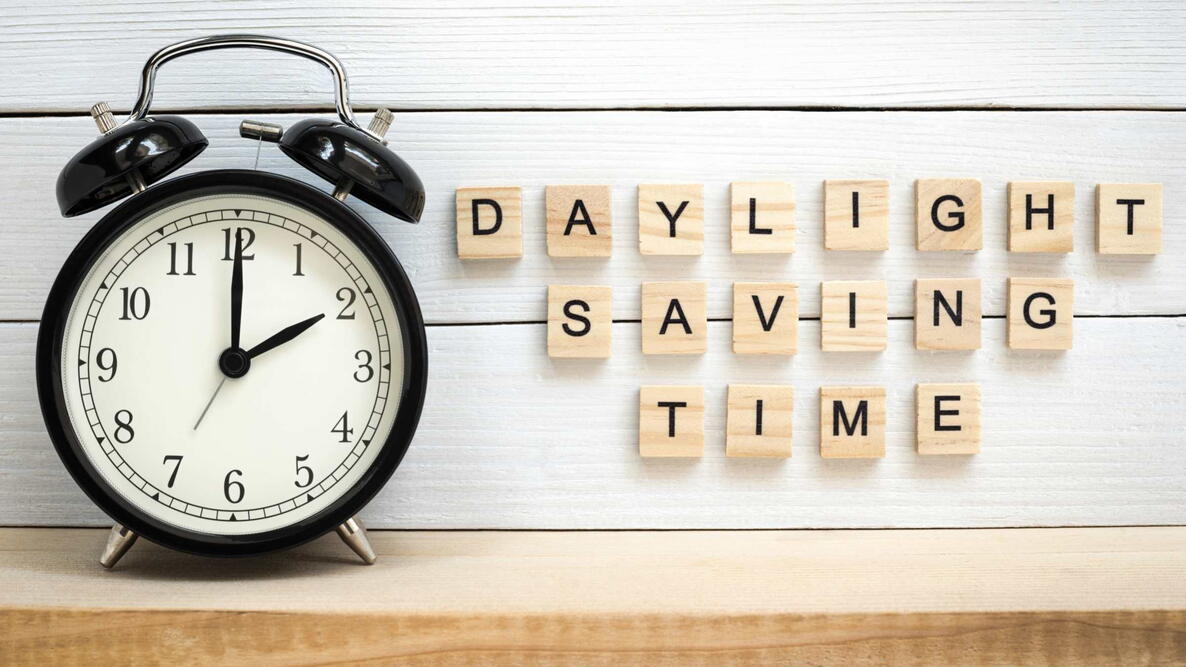
Image Credit:
SIAATH/Shutterstock
Frequently Asked Questions
-
Do we gain or lose an hour during Daylight Saving Time?
When Daylight Saving Time starts in spring, we set the clocks forward and lose an hour. When it ends in fall, we set the clocks back and gain an hour. -
What time do the clocks change?
Clocks change at 2:00 A.M. local time in most of the United States, a time when few people are working, traveling, or doing business. -
Will my phone change automatically for Daylight Saving Time?
Most smartphones, computers, and other devices that are connected to the internet update themselves if you have them set to update date, time, and time zone automatically.You might still need to change the time by hand on things like appliances, cars, or wall clocks. -
Does Canada change clocks on the same day as the United States?
Some parts of Canada still change their clocks on the same schedule as the United States. However, provinces and territories set their own time rules, and several of them stopped changing clocks in 2026.
British Columbia, Alberta, Manitoba, and the Northwest Territories will not turn their clocks back on November 1, 2026. Yukon and Saskatchewan also use one time year-round.
Other parts of Canada, including most of Ontario and Quebec and the Atlantic provinces, continue to observe seasonal time changes.
Sources
- U.S. Navy Office — Daylight Saving Time
- U.S. Department of Transportation — Daylight Saving Time
- U.S. Library of Congress — Daylight Saving Time (DST)
- U.S. Department of Transportation — Uniform Time
- National Institute of Standards and Technology (NIST) — Daylight Saving Time Rules

More Like This



Had they stuck with the end of April, and the end of October, I believe there wouldn't be so much arguing about it. I personally hate DST, my wife and I are morning persons, and get up at 5:00 am and love to drink our coffee and watch the sunrise. We're not going to change our sleeping habits, so we'll deal with it for a month when the sunrises at our coffee time again. Going to sleep when the sun hasn't set yet, is altogether another struggle.
I Do not like it all this time change had to stop right now
You know that Daylight Saving Time is in trouble when a factual article on it focuses so much on the drawbacks (including saying about its detractors "rightfully so", and even suggesting that Benjamin Franklin was just kidding when he proposed the idea).
Keep standard time. Don't fool Mother Nature!
To the Almanac Editors:
Why are you allowing people to advertise here, especially for something like hackers?? These posts should have been removed a year ago!!
I'm a furry and thats offensive😡
There are a lot of differences between this time saving adjustment. I understand both time differences with people, me personally I would love to have more light in the evening because I can get more stuff done when it's lighter in the evening and more light makes me and my body would be happier and not depressed. The kids get more time after school to get out and play and enjoy some daylight from being stuck inside of school for the day. I see it where nobody is going to agree on either of the time change so in my opinion I would say do a half hour instead of the hour change so it works for everybody.
Personally I just think we should pick one time set and stay there. It’s the constant stress of the time change that irritates most Americans
Why were those particular dates chosen in USA. In UK, for example clocks change on the last sat/sunday of March & back last sat/sunday of October?
Daylight saving time is stupid. It's stupid to change what a clock says. Changing what a clock says does not make the time any earlier or any later. Daylight saving time does not have an extra hour of daylight and does not save daylight or time. Daylight saving time does not allow us to use natural daylight better, but has no effect on the use of natural daylight. Daylight saving time does not grant more daylight during summer evenings and does not grant more daylight during winter mornings either. Daylight saving time is just stupid people setting clocks wrong, which is just a unit conversion, no different than changing between Celsius and Fahrenheit, or changing between centimeters and inches. Daylight saving time does not mean that daylight occurs later. In fact, daylight does not occur later. People do not have to go to school and work in the dark. People can and should continue to go to school and work at reasonable times. Changing what a clock says does not mean doing things at a different time. It only means numbering the times differently. Sunrise and sunset are never both an hour earlier or an hour later than they were the day before. Daylight saving time has no effect on how the sun moves. Denoting the time by a different number does not make the time any earlier or any later, just as changing between Celsius and Fahrenheit does not make the temperature any colder or any hotter. Daylight saving time does not end in November. Halloween is October 31 and specifically is when it is because it gets dark so early, so it's obvious that it does not get dark a lot earlier right after Halloween. Halloween is definitely in the dark part of the year. Also, the amount by which the time of sunset changes significantly slows down by Halloween. Daylight saving time has no effect on how the sun moves.
- « Previous
- 1
- 2
- …
- 10
- Next »
📣The Gardening Club Just Got Better! 3 Deliveries, 10% Store Discount, and more!

Comments