


Sign up for our daily newsletter to get gardening tips and advice.
Planting, Growing, and Harvesting Basil

Basil will grow best in a location that gets 6 to 8 hours of full sun daily, though it can perform well in partial sun, too.
Soil should be moderately fertile and moist but well-draining. Basil works great in containers or raised beds, as these allow for better drainage. The pH of the soil should ideally be in the range of 6.0 to 7.5 (slightly acidic to neutral).
If you plan on cooking with these plants, plant in clean soil, don’t use insecticides, and grow them away from driveways and busy streets so exhaust won’t settle on the plants.
When to Plant Basil
- To get a jump on the season, start the seeds indoors 6 to 8 weeks before transplanting outside. (See local frost dates.)
- To plant outside, wait until the soil has warmed to at least 50°F (10°C)—preferably around 70ºF (21°C) for best growth. Nighttime temperatures shouldn’t drop below 50°F (10°C).
- Don’t rush basil. Without heat, the plant won’t grow well!
How to Plant Basil
- If you are sowing seeds directly into the ground, sow no more than 1/4-inch deep. Seeds should germinate within 5 to 7 days. Once they have developed 2 to 3 pairs of true leaves, transplant them.
- If you are planting the germinated seedlings or starter plants in the ground, spaced 10 to 12 inches apart; basil should grow to about 12 to 24 inches in height.
- A 2- to 3-inch mulch of compost or ground-up leaves retains soil moisture and minimizes weeds around the plants.
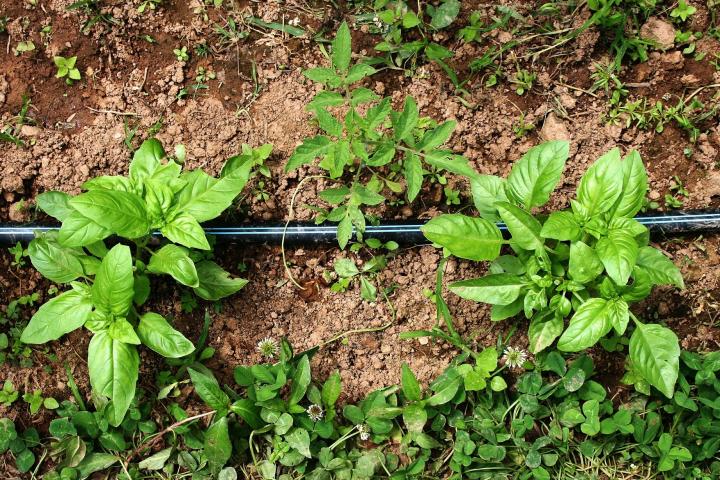
- Tomatoes make great neighbors for basil plants in the garden—and on the plate—so many gardeners will plant the two warm-weather friends around the same time.
How to Grow Basil
- Make sure that the soil is moist. Basil plants like moisture.
- If you live in a hot area, use mulch around the plants (the mulch will help hold in moisture and suppress weeds).
- During the dry periods in summer, water the plants freely.
- After the seedlings have produced their first six leaves, prune above the second set. This encourages the plants to start branching, resulting in more leaves for harvest.
- Every time a branch has six to eight leaves, repeat pruning the branches back to their first set of leaves.
- Fertilize sparingly throughout the season with a 5-10-5 fertilizer.
- After about 6 weeks, pinch off the center shoot to prevent early flowering. If flowers do grow, just cut them off.
- If the weather is going to be cold or if a sudden frost is imminent, be sure to harvest your basil beforehand, as the cold temperatures will destroy your plants.
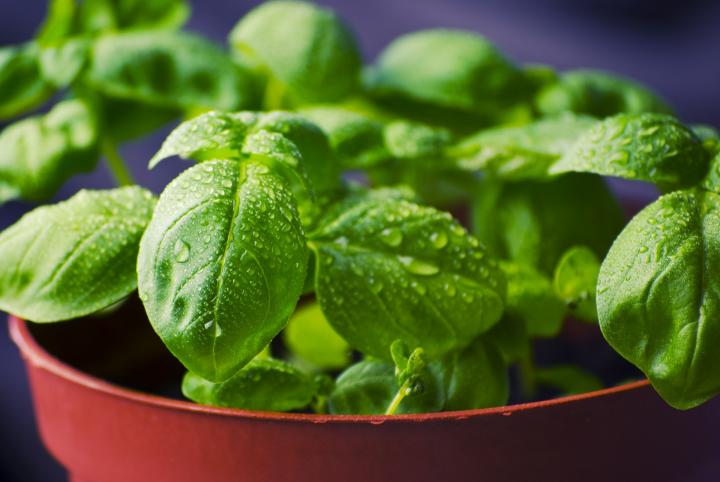
Make herbal vinegar using basil; it retains the flavor and makes a great gift! See how to make herbal vinegar.
Catherine Boeckmann



ADVERTISEMENT
HI, I have been buying basil from my local market. These come in plastic containers in the vegetable section. Most of the leaves are lovely green , but several have purpleish or brownish portions, some in mid-leaf , some barely at the edges. I usually pluck these spots off before eating, but I am wondering if they are safe to eat, or safe but maybe a little bitter. What do you advise? What is the cause? This is organic basil harvested leaves-- not plants.
Hi, Pam. It is possible that the basil is being damaged in transport and/or packaging. If the basil does not have an “off” smell, feel slimy, or look moldy, it should be safe to eat. But you are correct that it may taste bitter.
Hello, I don't understand what this means: "After the seedlings have produced their first six leaves, prune to above the second set. This encourages the plants to start branching, resulting in more leaves for harvest.
Every time a branch has six to eight leaves, repeat pruning the branches back to their first set of leaves."
What is the "second set"? And then what is the "first set"? Are you saying that once there are six leaves, to cut right above the 6th leaf? And then, when it has 6 leaves again, cut the stem off above that 6th leaf? Which leaves do you harvest if you are cutting it off above 6?
Hi! I found this site by accident, and enjoyed reading about Basil, so when I saw all your questions, I thought I’d validate the pruning process. Basil grows upright, 2x2 leaf sets at a time. Therefore, the plant gets really lanky and falls over! So keep pruning to keep the plant growing in a bushy way; do use what you prune off that day, or glean out any dusty bits and freeze good leaves and stems in a small sealable baggie. Basil is a lovely plant and so tasty!
I always companion plant, basil and tomatoes. But I also let a couple plants flower. The tiny flowers attract parasitic wasps, that will take care of any tomato horn worms, that you might have.
Great tip!
So good to know! Wow! Thank you!
I take tender cuttings from my basil before the end of the season and root them in a small custard dish, then i plant them in a good seed starting mix. EZ Peazy
Funny, but less than a week ago, I sent the Old Farmers Almanac a real easy way to dry basil w/o the use of a microwave, oven, dehydrator or by tying a bunch of basil branches together with string and let them air dry in a cool area of one's home. My quick and easy way: Cut off desired branches; Rinse under cool running water or swish in a sink to clean off the basil; Place basil on paper towels until the majority of the moisture has evaporated; Put the basil onto a rimmed cookie sheet (leaves only); Place in a hot car warmed by the sun; Remove basil from car once leaves are dried; and place in air tight containers -- so easy ! Note: You can either crush the crinkly leaves or store whole.
I used the back of my capped truck to do blueberry leaves and yes it works well!
