


Sign up for our daily newsletter to get gardening tips and advice.
Planting, Growing, and Harvesting Onions

Select a location with full sun, where other plants won’t shade your onions. The more energy they can get from the sunlight, the larger their bulbs can grow. Mix aged manure or compost into the soil in the fall or early spring to improve texture. Ensure there are no rocks or debris. Soil needs to be well-draining and loose; compacted soil affects bulb development.
When to Plant Onions
- In spring, plant onion sets outdoors as soon as the ground can be worked, usually in late March or April, when temperatures are no longer likely to dip below 28°F (-2°C).
- In spring, start onion seeds indoors for about 6 weeks before transplanting to the ground (once the soil is at least 50°F).
- A fall-planted crop of onions needs at least 4 to 6 weeks of warm temperatures to become established in the ground. They will remain dormant during the cool season; as the temperatures and soil warm again in early spring, the onions come back to life.
How to Plant Onions
Onion plants are heavy feeders and require constant nourishment to produce big bulbs. At planting time, add nitrogen fertilizer. Many organic gardeners will add an inch of compost to the bottom of each row before planting. Or, dig a trench in the soil about 2 inches deep and 3 inches wide, and then fill the trench back in with about an inch of compost.
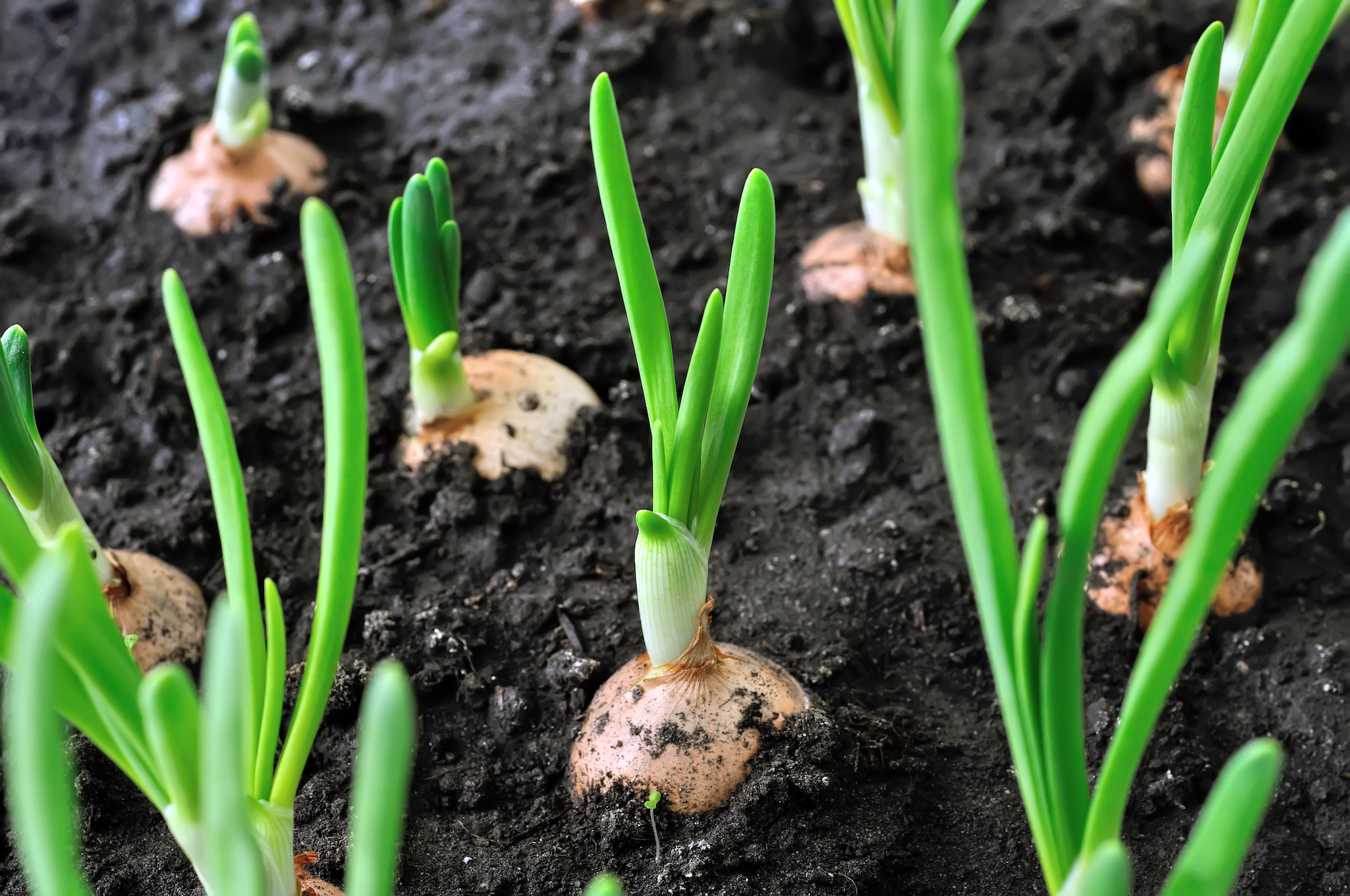
- Bury onion sets 2 to 6 inches apart, gently pressing them 1 to 2 inches deep into loose soil. (Use the closer spacing if you want to pull immature onions as scallions.)
- Space transplants 4 to 5 inches apart and rows 12 to 18 inches apart.
- Set the bulbs with the point end up. Again, don’t bury them more than 2 inches under the soil. It’s critical that onions aren’t planted too deep, as this can affect bulb development.
- Mulch with straw between rows to help retain moisture and stifle weeds.

Pull any onions that send up flower stalks. This means that the bulbs have stopped growing. These onions will not store well but can be used in recipes within a few days.
- Spring-planted onions tend to be ready for harvesting by mid-summer.
- When onions start to mature, the tops (foliage) become yellow and begin to fall over. At that point, bend the tops down or even stomp on the foliage to speed up the final ripening process.
- Loosen the soil around the bulbs to encourage drying.
- Harvest by late summer in dry weather. (Wet-harvested onions do not cure well and might rot in storage.)
- When the tops are brown, pull the onions. Handle them carefully, as the slightest bruise (now and in storage) will encourage rot.
- Cut the roots and trim the tops back to 1 or 2 inches (but leave the tops on if you are planning to braid the onions together).

How to Store Onions
- Set onions on dry ground for a few days to cure, weather permitting, or in a protected place such as a garage or barn.
- Once cured, hang onions in a mesh bag or nylon stocking; spread up to two layers deep in a box; or braid and hang them in a cool, dry, well-ventilated area. The ideal temperature range for storage is 40 to 60°F (4 to 15°C). Do not store in a refrigerator, as conditions will be too damp.
- Check periodically for sprouting or rotting onions and remove them.
- Don’t store onions with apples or pears, as the ethylene gas produced by the fruits will interrupt the onions’ dormancy. Onions may also spoil the flavor of these fruits (as well as potatoes).
- A pungent onion will store longer than a sweet onion. Sweet onions have a high water content and do not keep well. Eat the sweet varieties first and save the more pungent onions for later.
Check out this video to learn how to harvest and store onions.
To make onions taste milder, soak them in milk or pour boiling water over the slices and let them stand for 20 minutes. Rinse with cold water.
Chopping onions can sometimes look daunting: There’s the skin and the layers… Where to begin? Check out our tips for chopping onions in four easy steps. Onion skins actually have several health benefits, too, so don’t throw them out!
Check out more tips on using onions in the kitchen and cooking them correctly.
Catherine Boeckmann




ADVERTISEMENT
In your article about growing onions you mention planting sprouted onions only for their greens but I have had lots of success growing multiple onions from one sprouted onion. You just have to carefully peel away the layers and separate each little sprout (I usually get 3-5 per onion) then plant them. Tip: I like to let the individual sprouts sit in a shallow dish of water for a day or two to boost the root growth before I sow them. I have about a dozen onions in my garden currently that came from only 3 onions. I hope this helps your readers to take advantage of a veggie that might otherwise end up in the trash!
Great tip! Thanks for sharing your personal recommendations, Kimberly!
Can you cut the green stems above ground and allow the bulb to continue to grow?
The bulb gets its food from the leaves, so one needs to wait until the leaves brown (and are no longer providing food) before harvesting the bulb, or the bulb won’t reach its full size.
If a flowering stalk appears, however, you can cut off that green stem. Unfortunately though, if an onion bolts (forms flowers) the first year, it will no longer focus on bulb growth, even if one removes the flowering stem. It is best to immediately harvest an onion that has bolted, as the longer it sits in the soil, the more chance its flavor and texture may change and rot may occur. However, you can leave the bulb in the soil for a few days, if needed, before harvesting.
Hope this helps!
I am in zone 8a, Arkansas. I have had some success growing in a 5 gallon bucket. Maybe this would be a alternative for those with fungus/worm problems?
If you get onion maggots, we’d suggest planting in raised beds versus the ground or even containers. The worms prefer slow-draining soil. Use floating row covers after the onion seeds are first planted until harvest.
I have a beautiful lush garden; I plant everything according to the Farmers Almanac - thank you so much! I’m a organic gardener. Last year my onions were rotting early in the season...I thought it was because I used wood ashes to prevent worms. I planted onions sets in a different area this year. Same problem, greens start turning yellow and die...the small onion bulb is rotting. They are definitely not overwatered - I never had this problem before, some of my friends are experiencing the same thing. Are we buying infected onion sets?
Sadly, this sounds like white rot pathogen. It’s probably nothing you did, certainly not knowingly. The cooperative extension tells us that it’s the fungus, Stromatina cepivorum Berk. The pathogen persists as small, dormant structures (sclerotia) in the soil. Sclerotia remain dormant in the absence of a suitable host (garlic, onion, or other Allium crops), and can survive in the soil for over 20 years. There is not much you can do that you’re not going; see here https://extension.umaine.edu/publications/2062e/ for more detail. Sorry it’s not better news.
I did my onion in the fall , now they are in full bloom and very tall and the green tops are hard tuff like,
Question is the top bloom are they seeds, onion bulb , if so how what do I do now ! Thank you all in advance for your advice ! Happy gardening
Diane
Last year I had to replant my onions 3 times because of the worms. Overnight the worms would get ahold of the green part and suck it down their holes, leaving the white part sticking straight up in the air. Do you have any suggestions other than checking onions every morning and replanting as necessary? I thought worms were good for the garden, but man replanting gets old fast when you plant 300 feet of onions!
