


Sign up for our daily newsletter to get gardening tips and advice.
Planting, Growing, and Harvesting Beets

Choose a planting site that gets full sun. Beets should ideally receive at least 6 hours of direct sunlight per day.
Beets grow best in well-prepared, fertile soil, but will tolerate average to low soil fertility. A soil pH between 6.0 and 7.0 is best, and slightly alkaline (7.0+) soils can be tolerated. Beets will not tolerate acidic soils (pH below 6.0). To allow the round beetroots to develop properly, the soil should be free of rocks and other obstacles.
Avoid planting beets where Swiss chard or spinach has recently been grown, as they are cousins of beets and are susceptible to similar pests and diseases.
When to Plant Beets
- Start your first round of beets in early spring, as soon as the soil is workable. Make successive plantings every 2 to 3 weeks until mid-summer.
- Successive plantings are possible through summer as long as daytime temperatures don’t exceed 75°F (24°C).
- In soil that’s at least 50°F (10°C), germination takes place in 5 to 8 days. In soil colder than that, germination may take 2 to 3 weeks.
- Tip: To speed up germination, or when planting in areas with low moisture and rainfall, soak the seeds in water for 24 hours before planting.
- For a fall harvest, sow beet seeds from mid-summer through early fall, starting about 4 to 6 weeks before your first fall frost.
- Winter crops are a definite possibility in Zone 9 and warmer. Plant beets in early to late fall for a winter harvest.

How to Plant Beets
- We prefer to sow beets directly in the garden so that we don’t have to disturb their roots. However, beets—unlike many root crops—do generally tolerate being transplanted while still young. Since they are cold tolerant, beets typically have no trouble being started outdoors, though.
- Sow seeds ½-inch deep and 1 to 2 inches apart in rows that are about 12 to 18 inches apart. After sowing, cover the seeds with a thin layer of soil.
- Make sure the soil remains moist for optimal germination. Soak seeds for 24 hours prior to planting to speed up germination.
Beet seeds are actually capsules that contain several seeds, so you may get two or three sprouts from each one.
Check out this video to learn how to plant beets:
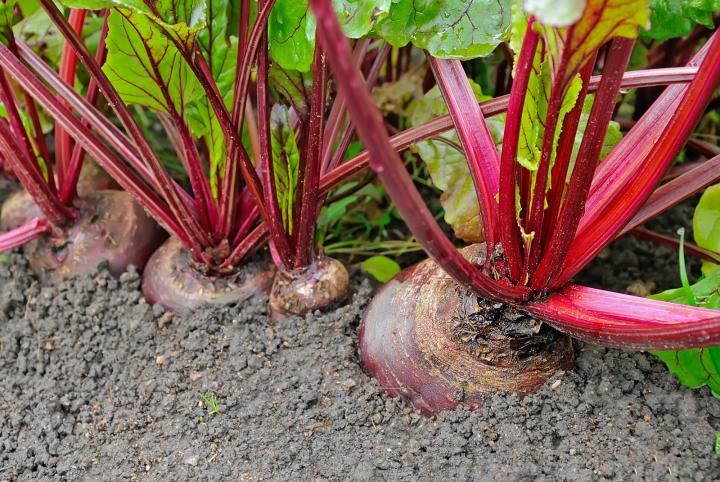
Beets come in quite a few shapes and a rainbow of colors. Deep red is typical, but yellow and white varieties are also available, as are red-white ringed ones (pictured below)!
- ‘Chioggia’: red skin; when sliced open, reveals red and white concentric rings.
- ‘Detroit Dark Red’: Sturdy, traditional variety. Round, red root.
- ‘Formanova’: Long, cylindrical beets that grow in the same fashion as carrots. Excellent for canning.
- Yellow varieties include ‘Bolder’ or ‘Touchstone Gold’
- White varieties include ‘Avalanche’ or Dutch heirloom ‘Albino’

- Days to maturity tend to be between 55 and 70 for most varieties. In other words, plan to harvest beets about 2 months after planting.
- Harvest roots when golf ball-size or larger; very large roots may be tough and woody.
- Loosen the soil around the beet and gently pull it from the earth.
- Harvest the beet greens at almost any time, beginning when thinning seedlings. Take one or two mature leaves per plant, until leaf blades are more than 6 inches tall and become tough. (Roots will not fully form without greens, so leaving some is necessary for proper development.) The leaves can be twisted off and cooked like spinach. Or, see our recipe for Beet Greens Salad.
- If you experience mild winters, you can leave roots sown later in the season in the ground to dig up as you need them. Or, store roots in boxes of dry sand in a cool, frost-free place.
How to Store Beets
- Fresh beets can be stored in the refrigerator for 5 to 7 days.
- Tip: Clipping the tops off beets will keep them fresher for longer. Leave about 1 inch of stem on each beet, and store the greens separately.
- For long-term root cellar storage, make sure you brush off any soil clinging to the roots, then bury them in layers (but not touching) surrounded by dry sand or sawdust.
- Store in a cool, dry place. An unheated closet might do, or put them in a cooler in your basement. Read more about a new way to store beets in the root cellar.
- Sprouting is a sign of poor storage and leads to decay.
- Beets can be frozen, canned, and pickled, too!
- You can also freeze beet greens to use at a later date!
Beets are a nutrient-dense food considered especially beneficial for health. Learn more in “Beets: Health Benefits!”
Catherine Boeckmann



ADVERTISEMENT
1 tablespoon 3% hydrogen peroxide and 1 cup of water for 24 hours. Place a paper towel in a container fold it over pour mixture over paper towel until damp unfold the towel and spread seeds. fold towel again and add enough solution to keep damp over night.
So where can you grow them anywhere?
Choose a planting site that gets full sun. Beets should ideally receive at least 6 hours of direct sunlight per day.
Beets grow best in well-prepared, fertile soil, but will tolerate average to low soil fertility.
In the summer I am suddenly bombarded with Japanese Beetles on my beautiful grape vines what will get rid of them and not harm my pets?
Japanese beetles are mature grubs that are in your soil. Use milky spore on your grass and soil (it’s organic). Spring is a great time to apply. It will kill the grubs and eliminate the Japanese beetles. There are some milky spore brands that only require one application
Japanese beetles fly long distances from where they hatched in grassy areas. All they care about is mating & eating. Treating your yard for them will not stop the ones flying in from golf courses & other folks' yards. They love Linden trees, birch & crab apple trees, grapes, rose blossoms & respberries, among others. Brush them off into a cottage cheese container that has water, a couple drops of dish soap & a quick spray of flying insect spray. Some fly back out, but once they've been in the insect spray & soap they will die quickly. Dispose of them in your garden, compost bin or flower beds. I sometimes spray large clusters of them with flying insect killer. Don't ever use the beetle traps. They draw in thousands of beetles from far away. I did that once & gathered 5 gallons of them daily from the 3 traps I set out. A full time job!
Japanese beetles fly long distances from where they hatched in grassy areas. All they care about is mating & eating. Treating your yard for them will not stop the ones flying in from golf courses & other folks' yards. They love Linden trees, birch & crab apple trees, grapes, rose blossoms & respberries, among others. Brush them off into a cottage cheese container that has waster, a couple drops of dish soap & a quick spray of flying insect spray
Wee had a pet duck. He loved them. We hold him and aim him at the beetles and they were gone. He would eat 150 or more a day. In a few days they were hard to find.
Your Pet Duck ate 150 Beetles a day; good for him; ty~Quack-Quack~
If you have time & not too many grape plants, you can hold a cottage cheese container that contains water & a drop of dish soap (about half full) under the beetles. Touch them & they will usually roll off the leaves & into the water. If you have too many for that, Raid flying insect spray works well on beetle clusters. Seven or Eight spray works well also. I always spray some Raid into my soapy water when I start just to make sure they don't escape. After you're done catching them, spray them again & after a few minutes they make great fertilizer in your flowerbed or compost bin.
