


Planting, Growing, and Pruning Hydrangea

The Almanac Garden Planner - Use It Free for 7 Days!
Plan your 2025 garden with our award-winning Garden Planner.
Planting
Most hydrangeas prefer partial sun with full sun in the morning, followed by some afternoon shade. This is especially true for the Bigleaf hydrangea (H. macrophylla). Some varieties are more tolerant of full sun. Most hydrangeas will thrive in fertile, well-draining soils that receive plenty of moisture. PennState suggests adding mulch to the soil if your soil drains too quickly. Add compost or aged manure to enrich poor soil.
When to Plant Hydrangeas
Autumn is the best time to plant hydrangeas, followed by spring. Plan to plant in the fall before the first frost or in the spring after the last frost. This shrub should have plenty of time to establish a healthy root system before the heat of summer or the extreme chill of winter, which makes the cooler shoulder seasons the best times to plant.
Plant the shrubs in the early morning or late afternoon. It’s generally cooler then, and the plant is less likely to wilt due to extreme heat.
How to Plant Hydrangeas
- Space hydrangeas anywhere from 3 to 10 feet apart, depending on the type. Always space plants based on their expected size at maturity!
- Gently remove the hydrangea from its container and inspect the root ball, snipping off any dead or rotting parts. Roberta Clark of the UMass Amherst suggests, “Before planting, check the root quality of container-grown plants and loosen the roots if they appear pot bound or to be circling the container.”
- Dig a hole as deep as the root ball and 2 to 3 times as wide. The base of the plant (where the stem meets the soil) should be level with the top of the planting hole.
- Set the plant in the hole and half-fill it with soil. Water generously. After the water is absorbed, fill the rest of the hole with soil and water again.
How to Grow Hydrangeas from Cuttings
Hydrangeas can easily be grown from cuttings. They root readily, and the process makes for a great lesson in propagation. Here’s how to do it:
- Find a new branch on a well-established hydrangea—a branch that has not flowered and bears three or more pairs of leaves. (New growth will appear lighter in color than old, and the branch will not be as rigid.)
- Cut 5 to 6 inches from the tip of the branch. Discard the bottom piece.
- If the tip cutting has at least two pairs of leaves, remove the lowest pair of leaves flush to the stem or at the node. If the remaining leaves are large, cut them in half, removing the tip half. Dust the cutting’s end with rooting hormone and, if desired, an antifungal plant powder. This will encourage rooting and discourage rotting.
- Fill a small pot with moistened potting mix. Plant the cutting, sinking it up to the first pair of remaining leaves. Water lightly to eliminate any air gaps around the stem. Cover the pot and the cutting loosely with a plastic bag (to maintain humidity). If necessary, use chopsticks or kebab skewers to prop up the bag so that it does not touch the leaves; if it touches the leaves, they might rot. Place in a warm area, sheltered from direct sunlight and wind. Water when the top layer of soil is dry.
- After a week or so, gently pull on the cutting. If you feel resistance, roots have formed. If there is no resistance, check for rotting.
Layering Hydrangeas
For bigleaf hydrangeas, in summer, dig a trench next to the plant, near a branch that easily reaches beyond the trench. Where the branch contacts the soil, remove an inch of the outer bark all around it. Bury the bared portion, pinning it with a florist’s pin or a gentle weight, leaving 6 to 12 inches of the end of the branch tip uncovered. Water regularly. In early spring, the branch should be ready to be removed from the mother plant and transplanted!
Growing
Watering Hydrangeas
- For the first 2 years after planting and during any drought, be sure your hydrangeas get plenty of water. If possible, water in the morning to prepare hydrangeas for the heat of the day and to avoid disease.
- Water at a rate of 1 inch per week throughout the growing season. Deep soaks 3 times a week (with a soaker hose or the like that keeps moisture off flowers and leaves) encourage root growth more than frequent sprinkles.
- All varieties benefit from consistent moisture, but bigleaf and smooth hydrangeas require more water. If the soil is too dry, leaves will wilt and flowering will be hampered.
- Add organic mulch underneath your hydrangeas; this will help keep the soil moist and cool, add nutrients over time, and improve soil texture.
Fertilizing Hydrangeas
Hydrangeas in rich soil seldom need fertilizer: Too much encourages leafy growth over blooms. The best way to determine your fertility needs is by using a soil test.
Apply fertilizer based on your specific hydrangeas. Each variety has different needs and will benefit from different application timing.
- Bigleaf hydrangeas can benefit from several light fertilizer applications in March, May, and June.
- Oakleaf and panicle hydrangeas do best with two applications in April and June.
- Smooth hydrangea plants only need fertilization once, in late winter.
Winter Protection
- In the fall, cover plants to a depth of at least 18 inches with bark mulch, leaves (not maple), pine needles, or straw. If at all possible, cover the entire plant, tip included, by making cages out of snow fencing or chicken wire and loosely filling the cages with leaves. (Do not use maple leaves, as they tend to mat when wet and can suffocate the plant.)
Pruning Hydrangeas
Many of our readers’ questions involve pruning hydrangeas. And no wonder—it’s confusing and depends on the variety of hydrangea. Luckily, as long as you know which type you’ve got, it’s easy to figure out what sort of pruning technique to employ. (The more common garden hydrangea shrub is the bigleaf variety) Learn the essentials below.
| Hydrangea Type | When to Prune | Where Flowers Appear |
|---|---|---|
| Bigleaf (H. macrophylla) | Summer, after flowering | On old growth |
| Oakleaf (H. quercifolia) | Summer, after flowering | On old growth |
| Panicle (H. paniculata) | Late winter, before spring growth | On new growth |
| Smooth (H. arborescens) | Late winter, before spring growth | On new growth |
| Mountain (H. serrata) | Summer, after flowering | On old growth |
| Climbing (H. anomala ssp. petiolaris) | Summer, after flowering | On old growth |
Bigleaf (H. macrophylla), oakleaf (H. quercifolia), mountain (H. serrata), and climbing hydrangeas (H. anomala spp. petiolaris) are pruned AFTER the flowers fade in the summer. These varieties bloom on the previous season’s stems (“old wood”).
- Flower buds actually form in the late summer and flower afterward in the following season, so avoid pruning after August 1.
- Only cut away dead wood in the fall or very early spring.
- To prune, cut one or two of the oldest stems down to the base to encourage branching and fullness.
- If the plant is old, neglected, or damaged, prune all of the stems down to the base. You’ll lose the flowers for the upcoming season but also rejuvenate the plant for future years.
- It’s best not to deadhead (remove faded blooms) on the big mopheads; leave them over the winter and cut them back in early spring (to the first healthy pair of buds). It’s fine to deadhead the lacecaps; cut down to the second pair of leaves below the flower head.
- When growing H. macrophylla (and H. serrata) varieties in Zones 4 and 5, do not prune unless absolutely necessary, and then do so immediately after blooming. Otherwise, remove only the dead stems in the spring.
Panicle (H. paniculata) and smooth (H. arborescens) hydrangeas are pruned BEFORE flower buds are formed. These varieties bloom on the current season’s stems (“new wood”).
- Prune in the late winter when the plant is dormant. This means that if the buds are killed during the winter, the plant will produce new buds in the spring, which will produce blooms.
- In general, prune only dead branches and do not prune to “shape” the bush.
Read more about how to prune hydrangea types.
How to Change the Color of Hydrangea Flowers
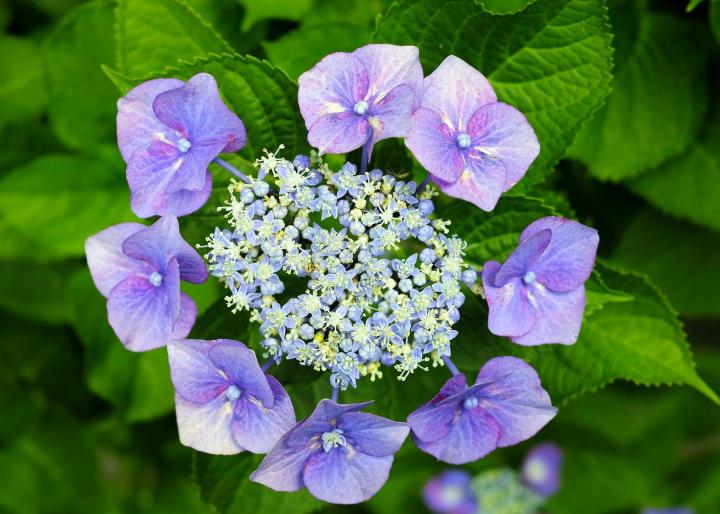
The colors of hydrangea flowers can be changed, but not instantly. Color correction takes weeks or more, and not every cultivar is changeable: White flowers are not affected by soil pH, the condition that imparts the blue and pink hues. Some bigleaf hydrangeas—especially mophead and lacecap types—and mountain hydrangea cultivars change color based on the soil pH.
Acidic soils with a pH of less than 5.5 produce blue flowers; soils with a pH greater than 6.0 produce pink flowers. Do a soil test to determine the existing pH and amend as indicated to change it.
A plant should be at least 2 years old before undergoing a pH change; this will give it time to recover from the shock of its original planting. Also, note that it’s easier to change blue flowers to pink than pink to blue.
See How to Change the Color of Hydrangea Flowers for more information.

Types
For a more detailed overview of the many types of hydrangeas, check out Hydrangea Varieties for Every Garden.
There are two main groups of hydrangeas:
Group 1: Plants that Bloom on New Growth (This Year’s Stems)
The following hydrangeas, which form their buds in early summer on new growth, will flower reliably each year, requiring no special care.
- Panicle hydrangeas (Hydrangea paniculata)
- ‘Grandiflora’ and ‘PeeGee’ are large old-fashioned, floppy varieties; ‘Tardiva’, ‘White Moth’, and ‘Pee Wee’ fit the scale of small gardens. ‘Limelight’ produces cool-green flowers and grows to a height of 6 to 8 feet.
- Smooth hydrangeas (H. arborescens)
- Look for the cultivars H. arborescens ‘Grandiflora’ and ‘Annabelle’, which produce many large (up to 14 inches across), tight, symmetrical blooms in late summer.
Group 2: Plants that Bloom on Old Growth (Last Year’s Stems)
If you live in Zone 8 or warmer, choose plants from this group. Gardeners in cool climate zones will find many of them a challenge, because they set flower buds in the fall. Although hardy to Zones 4 and 5, the buds are prone to damage by an early frost in fall, a late frost in spring, or excessively cold temperatures when dormant in winter. This, along with untimely pruning, can result in inconsistent or no flowering.
- Oakleaf hydrangeas (H. quercifolia)
- You can expect an exceptional fall color from ‘Snow Queen’, ‘Snow Flake’, and ‘Alice’.
- Bigleaf hydrangeas (H. macrophylla)
- We love ‘All Summer Beauty’ (mophead), which has profuse, dark blue flowers that turn pinker in soils with near-neutral pH. If buds are winter-killed, the plant will form new ones in spring and still bloom.
- ‘Nikko Blue’ (mophead) is vigorous, with large, rounded, blue flowers.
- ‘Blue Wave’ (lacecap) produces rich blue to mauve or lilac-blue to pink flowers.
- ‘Color Fantasy’ (mophead) has reddish or deep purple flowers and shiny, dark green leaves. It grows to about 3 feet tall.
- Mountain hydrangeas (H. serrata)
- ‘Bluebird’ and ‘Diadem’ are early bloomers. In acidic soil, ‘Preziosa’ produces blossoms of an extraordinary blend of pale shades of blue, mauve, violet, and green.
- Climbing hydrangeas (H. anomala ssp. Petiolaris)
- ‘Firefly’ boasts variegated foliage.
Harvesting
Cut fully mature hydrangea flowers in the morning after you have watered the plant.
Immediately place fresh stems in cold water to prevent wilting.
- Recut the woody stems at a slant underwater.
- Remove the lower leaves on the stems.
- Arrange them in a vase and place them in a cool location, out of direct sunlight.
- Check the water level and quality daily. Change the water if it becomes cloudy.
- Mist the blooms with water. Soak wilting blooms in cool water for 10 to 15 minutes to revive them.

Use dried hydrangea flowers to create a wreath or other decorations around the house:
- Cut the flower heads when the flowers have matured and developed a papery consistency.
- Remove leaves from stems, and hang them upside down in a warm, dry, dark, airy room.
- When completely dry (usually a couple of weeks), store in a dry location out of direct sunlight.
- To enhance flower color, spritz dry flowers with diluted fabric dye.
Here are four alternative ways to dry and preserve your flowers.
Catherine Boeckmann



ADVERTISEMENT
wHEN PRUNING IN FALL DO YOU CUT OFF ALL THE LEAVES ON STEMS
Root bound hydrangea please tell me how to replant into the ground.
It is in a pot but not doing well.
I live in New Zealand temperate climate.
My Endless Summer hydrangea bloomed beautifully until the polar vortex winter several years ago. It still grows and has lovely healthy foliage, but it won’t bloom no matter what I try. Should I just take it out and plant a different one?
Have you tried a phosphorous fertilizer or epsom salt? A master hydrangea gardener I know told me that epsom salt is the best fertilizer for hydrangeas. You can just sprinkle a handful around the base of each plant and water like crazy to keep the soil moist and help the salt gradually continue to nourish it.
My plant has black spots on the leaves what do I need to do.
Black spots on hydrangea leaves may be caused by a number of diseases by fungal, bacterial, and viral pathogens. Common diseases include the Cercospora leaf spot (a fungal disease common in moist conditions) and Anthracnose (a fungal disease which also favors high humidity or precipitation). Remove infected leaves and all plant debris, including fallen leaves, regularly throughout the growing season. Remove any nearby weeds. Prune out any dead/diseased branches, and be sure to disinfect any tools that you use to prune, etc. Provide good air circulation and drainage and avoid overhead watering. Fungicides may help as an early application in spring when symptoms first appear, but would not help this late in the season. Check with your local Cooperative Extension https://www.almanac.com/cooperative-extension-services for advice for the best fungicides to use for your area and purpose. Here’s an article on anthracnose, in case it helps: https://www.almanac.com/pest/anthracnose.
We planted 3 macrophylla, may not be spelled right, lol with big green leaves. The nursery & tag says shade. I set up a sun shade and water every other day making sure the soil is wet to depth off one inch but not soaking wet. My problem is the leaves are curling or spotting a light tan color. It still has a lot of green but I fear it's spreading. What is the problem and how can I take care of it?
My hydrsndra looked sad so I cut it way back would I be best to did it up
Plant new one in spring .
My stems were rot Tom could break off with my hands. Feedback please
Thank you
Are you watering the roots or leaves? Water on leaves may cause curling or sun can burn leaves with water on them.
I bought a hydrangea plant that was obviously a rooted cutting (it was very inexpensive!) and had 2 stems coming off of it. Within a week one stem withered and died, but the other is doing fine, so I have a flourishing single stem hydrangea plant. Is there a way to persuade it to branch out horizontally?

