Botanical name: Citrullus lanatus
Plant type: Fruit
USDA Hardiness Zones: 3, 4, 5, 6, 7, 8, 9, 10, 11
Sun exposure: Full Sun
Soil type: Sandy
Everyone seems to love juicy watermelon in the summertime. Native to Africa, melons need warm temperatures (up to 80 degrees during the day) and a long growing season. Gardeners in colder climates can still have success in growing watermelon by starting seeds indoors and choosing short-season varieties. Days to maturity range from 70 to 90, depending on the variety.
Planting
- Amend soil with aged manure or compost before planting.
- Growing the vines in raised rows, known as hills, ensures good drainage and will hold the sun’s heat longer.
- If you are in a cooler zone, start seeds indoors about a month before transplanting. Watermelon vines are very tender and should not be transplanted until all danger of frost has passed.
- If you live in warmer climes, you can direct sow seeds outdoors, but wait until the soil temperature warms to at least 65 degrees to avoid poor germination.
- Space the plants about 2 feet apart in a 5-foot-wide hill.
Care
- Watermelons like loamy, well-drained soil. Handle them gently when you transplant. Add lots of compost to the area before planting and after planting.
- Mulching with black plastic will serve multiple purposes: it will warm the soil, hinder weed growth and keep developing fruits clean.
- Row covers are a good idea to keep pests at bay.
- While melon plants are growing, blooming, and setting fruit, they need 1 to 2 inches of water per week. Water in the morning, and try to avoid wetting the leaves. Reduce watering once fruit are growing. Dry weather produces the sweetest melon.
- Pruning isn't necessary, but vine productivity may be improved if you do not allow lateral (side) vines to grow and stick to the main vine. When the plant is young, just cut off the end buds as they form (before the side shoots become vines). You can also pinch off some blossoms to focus the energy on fewer melons (though it's a challenge to kill off a potential fruit!).
- Vines produce male and female flowers separately on the same plant. They often begin producing male flowers several weeks before the females appear.
- Blossoms require pollination to set fruit, so be kind to the bees!
Pests
- Aphids
- Cucumber Beetles
- Squash Vine Borer Moths
- Fusarium Wilt
Harvest/Storage
Watermelons don’t sweeten after they are picked, so harvest time is important. Dr. Bill Rhodes, professor of horticulture at Clemson University, offers the following advice on how to tell if watermelons are ripe:
- Thump it. If the watermelon sounds hollow, it's ripe.
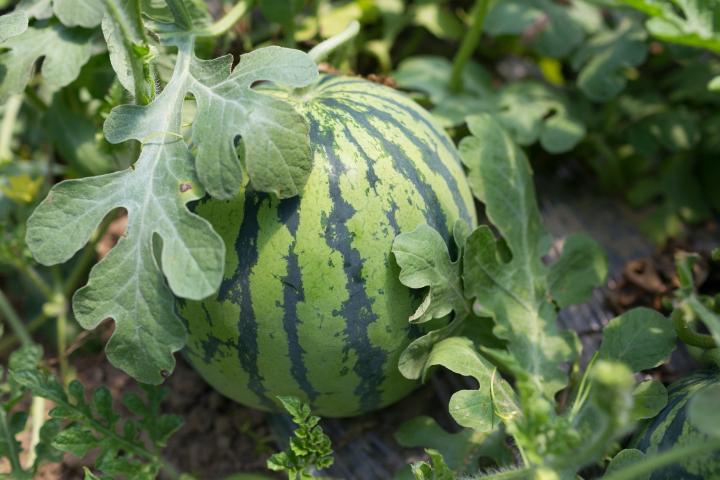
- Look at the color on the top. The watermelon is ripe when there is little contrast between the stripes.
- Look at the color on the bottom. A green watermelon will have a white bottom; a ripe melon will have a cream- or yellow-colored bottom.
- Press on it. If the watermelon sounds like it gives a little, it's ripe. (Rhodes doesn't like this method because it can ruin the quality of the fruit.)
- Check the tendril. If it's green, wait. If it’s half-dead, the watermelon is nearly ripe or ripe. If the tendril is fully dead, it's ripe or overripe; it’s not going to get any riper, so you might as well pick!
- Stems should be cut with a sharp knife close to the fruit.
- Watermelons can be stored uncut for about 10 days. If cut, they can last in the refrigerator for about 4 days. Wrap tightly in plastic.
Recommended Varieties
- ‘Sugar Baby’ 80 days to maturity. Produces 10-pound melons with bright red flesh.
- ‘Sweet Beauty’ 80 days to maturity. A 2004 All-America Selection. Bears 6-pound, oblong melons with red flesh.

- ‘Golden Midget’ 70 days to maturity. Bears petite, yellow-skinned 3-pound melons with pink flesh. Good for Northern gardeners.
Recipes
Wit & Wisdom
What’s in a name? Watermelon is 90% water.
The pumpkin vine never bears watermelons.


From The Old Farmer's Almanac: Sign up to receive a FREE guide (A $4.95 value!) plus updates from Almanac.com.

Comments
how fast will my watermelons
- reply
By dave evans on May 23
how fast will my watermelons grow once they come out of the ground. when will they start to vine etc. pleasegive me a month . update on what I am looking foe.
first time grower
Hi, Dave, It's not possible
- reply
By Almanac Staff on May 24
Hi, Dave, It's not possible for us to give you this kind of schedule. There are too many variables. Ask around where you got your seeds or transplant; someone there may have grown this variety of watermelon in the past and can draw on their experience. Even with that, you have to consider weather, the quality of your soil, your growing season (number of days of optimum conditions) vs the growing time needed for your chosen variety...among other things. Good luck!
Can I add compost on top Of
- reply
By Anonymous on May 19
Can I add compost on top Of the planted seeds? Or will it affect it?
Check you package directions
- reply
By Almanac Staff on May 24
Check you package directions to see how deep the seeds should be planted. You don't want to pile on and make the seed struggle unnecessarily. You could spread compost near the seeds, or better: Wait for the seedings to become established (several inches tall) and sprinkle compost around them then.
Sugar baby watermelon question
- reply
By Anonymous on May 19
I just planted My sugarbaby watermelons outside. But I forgot to add compost to the mixture. Do you think it will be alright and grow big and healthy? It is my first time growing this and I just read the instructions on the back of the seed package. I hope they will be alright.
Compost is only one of the
- reply
By Almanac Staff on May 24
Compost is only one of the factors involved in your plants growing big and healthy. Once the plants firmly establish themselves in the soil, you can sprinkle compost around the stems. Do that a few times during the growing season, increasing the amount each time.
Next time, put down and mix compost into your soil FIRST. (Have you started a compost pile? are you aging manure in a pile for use next season?? These are things you can do year round--and so always have healthy soil for your plants.)
First time watermelon grower
- reply
By Anonymous
OK, I am a first time watermelon grower. My question is #1 I don't have compost can I use regular potting soil ,if not can I use regular garden soil ? I live in central Fl. and the soil here is very sandy #2 I'm only growing some for me and my husband and maybe a couple of neighbors so can I plant my seeds along my fence? #3 Can I make the hills a little closer than 3 to 7 feet apart? Is there anything else other than whats on the package that I should know?
first-time watermelon
- reply
By Almanac Staff
You can use the soil you describe but you probably will not have great results. Sand does not hold water; water filters through it. "Water"melon plants need quite a bit of water as they grow; if there is no soil to hold the water around the plant's roots, you will be watering all the time (almost literally).
If you are going to buy regular potting soil, as you describe, ask at the place you buy it if they have compost. It usually is available in 20- to 40-pound or so bags. (You do not have to use fresh from the farm compost.) You can mix the compost with potting soil. How much?? Maybe 50-50. The goal is to have "soil" with ingredients that hold moisture. (This is desirable for almost any plant, certainly edibles. Many tropicals or types of plants that you see thriving around you in the sandy soil would not do well in compost because they like the dryness that sand enables.)
As to the fence and hills, sure. Those decisions are secondary to the soil. And, by the way, sun. Do not plant the watermelon in shade. It needs about 8 hours of sun per day.
We hope this helps. Good luck!
is it okay
- reply
By Anonymous
is it okay to plant it on a base ?
Your question is not clear,
- reply
By Almanac Staff on May 24
Your question is not clear, but by "base" if you mean a stump or other firm surface, no. The roots need some place to go.
Pink Flesh
- reply
By Anonymous
I have had a garden for two years. Planted Crimson Sweet both years,have gotten 5 melons last year 4 this year. I look for the bottom side to turn yellow or cream, I had 2 that were almost the same green color all over. But when I cut them open, only 3 of all of them were red inside, all the others were pink. What did I miss to know when to pick the ripe ones.
how to tell if it is ripe...
- reply
By Anonymous
The main ways to check and see if your watermelon is ripe is by checking the tendril (the one little vine that looks like a piggy tail closest to the watermelon). The tendril should be completely brown. Also there is another leaf that you should check on the vine. It is called the spoon leaf. This leaf is just a small cup shaped leaf and if it is also located near the watermelon. This leaf should also be brown and dead. If both of those leaves/vines are dead then the watermelon should be ripe. I hope this helps :)
Lots of gardeners have a
- reply
By Sarah Perreault
Lots of gardeners have a difficult time determining when watermelons are ripe. Use a combination of the following tips:
light green, curly tendrils on the stem near the point of attachment of the melon turn brown and dry
the surface color of the melon where it was once powdery or slick takes on a dull look
the skin resists penetration by a fingernail and is rough to the touch
the bottom of the melon (where it lies on the soil) turns from light green to rich yellow
concerned
- reply
By Anonymous
We are first timers and have a beautiful watermelon plant. There are blooms, and some fruit has started. The only problem is, our fruit will get about thumb size, and the bloom will turn brown, and a few days later the fruit starts to turn black. This has happened with all 6 watermelons. We are in a severe drought this year, and I water my plant 3 times a day. Am I over watering or is it something else? Is there a way to save future fruit that may come on this plant? Nothing else is planted, just this one plant. We are hoping to get at least 1 watermelon off this plant since our daughter brought it home from school in early April.
Several folks have had this
- reply
By Almanac Staff
Several folks have had this problem this year (read some below). Your plant probably has a fungus. This can be brought on/introduced several ways; one common one is failure to rotate crops. Curcubits, such as watermelon, should be rotated properly with other crops and not return to the same place/soil in the garden for at least 3 years.
So,okay, you say, you’ve rotated or maybe this is your first year with watermelon. The fungus overwinters in the soil from a previous vine crop. It might be carried by a cucumber beetle. And frequent rains (or watering; you might be giving it too much) can help to spread the fungus. Some sources suggest spraying plants. Certainly some fertilizer—chemical or organic—can help a struggling plant; try it. Can’t hurt. (BTW, I recently heard a farmer observe: If we all drank just water, we’d grow some but we’d be thin and unhealthy.)
If possible, in future, grow cultivars that are resistant to fungus, and control weed growth.
We hope your daughter is not discouraged by this experience. Next year, try a few more kinds of plants. The chance of having greater success is more likely.
Then go to a farmer’s market and buy one, and ask the local grower what he would do or thinks was the problem, too. Sometimes, local conditions indicate more than we can know from here.
watermelon black spot and drying up
- reply
By Anonymous
I am new to this but I have some water melon that are about the size of a football but some are shrivleing up at the end not where the stem is but the opposite side and another one has a black spot in the same place at the very end what is this from and what can I do to save my plants please help.....
it sounds like flower end rot
- reply
By Anonymous
it sounds like flower end rot to me. I had it really bad on my tomatoes last year. it's aparently common to tomatoes, peppers and some squash. my research told me it was due to a calcium deficiency, and that in most cases the soil has enough calcium, but the plant is unable to absorb it usually due to not enough watering, or irregular watering. I've watered my garden more consistantly this year and have not come across any black spot, or flower end rot so far.
Bite marks
- reply
By Anonymous
I'm a first time grower and have been anxiously waiting for my watermelon plants to produce but every time I get a fruit it gets bite marks within a few days. The fruit then turns black and dies. I'm trying to figure out what the pest could be. I have eggplants and cucumbers that haven't had this problem. Also I have some watermelons that are off around level that are doing fine. Please help!
Bite marks
- reply
By Almanac Staff
What type of bite marks? Small, insect holes or canine tooth marks? Animal pests might include racoons, deer, crows, and coyote. They like fruits and melons. Look for tracks near the garden.
If your fruit is turning black and dying, this is usually a different problem called blossom end rot. Usually, the reason is dry weather and lack of water. Watermelon needs adequate moisture, especially as it matures.
bite marks
- reply
By Anonymous
Go to your local dollar store or costco and buy crushed red pepper and put it on the outside of your planter box or about 6-12 inches from your plant.. It will keep and of the large animals away
Definitely not an animal
- reply
By Anonymous
I have a fence surrounding the garden so I'm assuming it's an insect. It does turn black and shrivels but only the fruit that has the bites. I live in the northeast so I don't think it's aphids which are normally south.
This site suggests cucumber
- reply
By Almanac Staff
This site suggests cucumber beetles: http://urbanext.illinois.edu/tog/insect.cfm
This site suggests ticks: http://www.princeton.edu/~lawrapts/gardeningtips.html
This site suggests pickleworm: http://www.clemson.edu/extension/hgic/pests/plant_pests/veg_fruit/hgic2207.html
The best thing might be to camp out in the garden and keep an eye on it. And consult your local extension service. It might be something local and the experts there might be hearing about this from several people. Here's our handy list of Cooperative Extension links: http://www.almanac.com/content/cooperative-extension-services
Black and mushy watermelon
- reply
By Anonymous
This is our first time growing watermelon, hopefully we didn't start too late. We are just getting fruit. We recently had a lot of rain in the past week and my husband just noticed that our biggest watermelon (about the size of a ping pong ball) is black and mushy on the bottom. Does anyone know if this was maybe caused by the rain we got or a possible disease? Thanks!
Sounds like black rot (unless
- reply
By Sarah Perreault
Sounds like black rot (unless it is at the blossom end of the fruit, in that case it would be blossom end rot). It is a fungus that affects much of the cucurbit family. Immediately remove the infected melon. Ensure proper drainage so that when wet weather strikes, your melons are not sitting in water. Treat the remaining plants with fungicide. Good luck!
newb
- reply
By Anonymous
can a watermelon grow well in 55 degree weather year round ? What can I do to help it along.
No. Pumpkins need warm soils
- reply
By Almanac Staff
No. Pumpkins need warm soils (65°F at 2” soil depth) to germinate or transplant.
turning black and drying up
- reply
By Anonymous
I was excited to see 5 small watermelons starting on 3 different plants a few weeks ago, but most of those turned black and dried up. Two of them are growing, but still small like a baseball. I have seen more start, but turn black and shrivel up as well. Today I noticed a few more starting, so I am hoping they survive. What causes them to turn black and dry up? I was surprised, since some of them had been golf ball size, though most are very small, like marbles.
Thanks for your help!
turn black and shrivel
- reply
By Anonymous
Few things are as disappointing as seeing fruit shrivel and die on the vine. Hearing about it is almost as bad. Sorry to say, your watermelon is infected. The disease that your fruit appears to have is Anthracnose. It is a fungus that occurs most often when the season has been warm and there has been a lot of rain (or, possibly, watering). There are numerous steps to take to avoid this—but nothing you can do now. In future, rotate your crops (did you plant this in the same place in last year or in recent years? That is a common mistake.). Do not cultivate or touch the plants when they are wet. If, possible, grow cultivars that have a resistance to this disease. In a move to eliminate any traces of the fungus, you should completely clear the area of this plant——now or at harvest time.
Sorry the news is not better . . .
–Almanac editors
When to Harvest
- reply
By Anonymous
My watermelon has rough skin is dull and the tendril is dead as well as the tendril on both sides of it. However, the bottom of it is still white. It is growing on black weed blocker could that keep the ground spot from turning yellow. I do not want it to get to ripe
Pick it!
- reply
By Anonymous
If the tendril is dead, the melon is ready ripe. As we suggest above:
• If the tendril is green, wait.
• If it’s half-dead, the watermelon is nearly ripe or ripe.
• If the tendril is fully dead, it's ripe or overripe; it’s not going to get any riper, so you might as well pick!
It is not uncommon for the bottom to be white; it doesn't get any sun!
Enjoy your fruit.
–Almanac editors
Post new comment