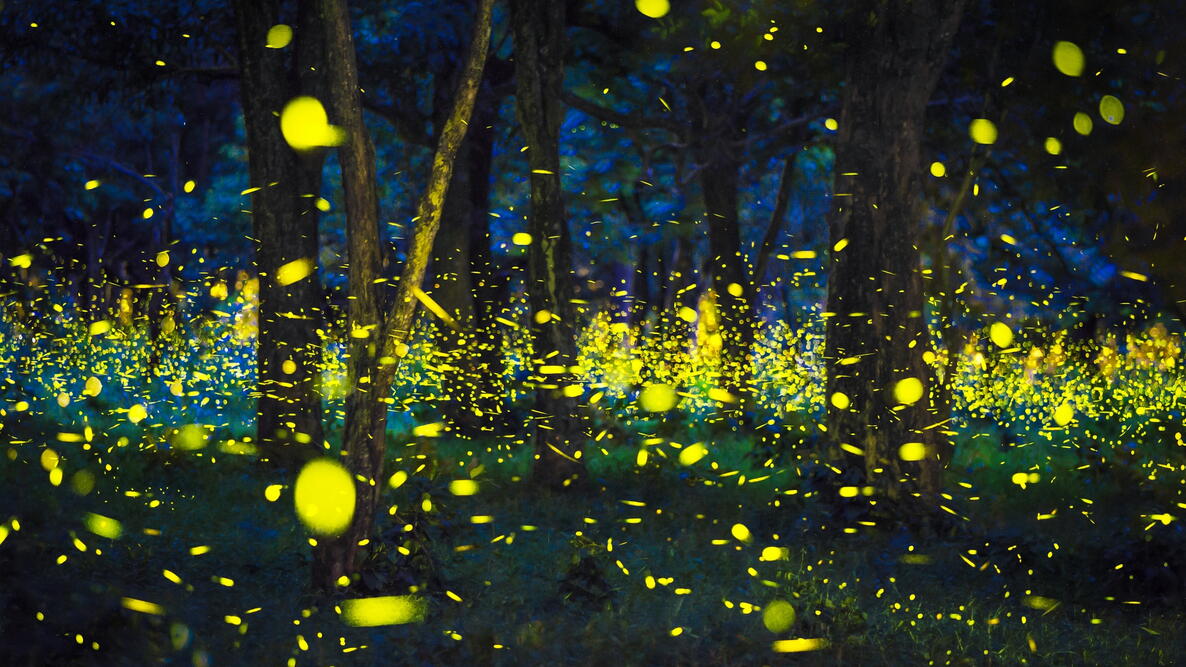
Fireflies—also known as lightning bugs—have been captivating humans for centuries with their beautiful lights on summer nights. What makes fireflies glow the way they do?
The nearly 2,000 species of fireflies worldwide inhabit every continent except Antarctica. The firefly isn’t actually a fly at all but rather a beetle from the family Lampyridae, which in Latin means “shining fire.” This “fire” that makes fireflies so fascinating is really a method of communication for the insects.
What’s most fascinating is that this living organism can produce light (called bioluminescence), which is relatively rare. And they form a beautiful language with light (as opposed to many animals’ languages of sound and scent). What signals are they sending? Let’s explore …
Why Do Fireflies Glow?
The main purpose of a firefly’s light show is to attract a mate. The males fly around while turning their lights on and off, hoping to get the attention of a flightless female waiting in low vegetation. They try to flash very quickly because this is what attracts females.
If a female is impressed by a male’s flickering, she will flash back a response to the twilight glow. The brighter the female’s response, the more interest she has in the male.
Each species of firefly has its own unique flash that is characteristic of its sex and species. Carnivorous females of the genus Photuris are known to entomologists as “femmes fatales.” These fireflies mimic the flashes of females of other firefly genera; the unsuspecting courting male flies in (expecting romance) and is promptly eaten.
A firefly’s light can also serve as a warning to predators. In the same way that bees scream “Danger!” with their black and yellow stripes, fireflies show their toughness with their light. Fireflies even have an advantage over bees because their warning can be seen in the dark!

Photo Credit: Wesleyan University.
How Do Fireflies Glow?
Photocytes, or light cells, in the insect’s abdomen, are where the glow is produced.
This light, the result of the chemical reaction of bioluminescence, occurs when two substances, luciferin and luciferase, react with one another when exposed to oxygen. The firefly regulates the flow of oxygen into its abdomen, which allows it to turn its taillight on and off.
This cold, living light is almost 100 percent efficient, losing only a fraction of its energy to heat. By comparison, a standard incandescent light bulb is less than 10 percent efficient, and an LED ranges between 40 and 50 percent efficient!
How to Find Fireflies
Fireflies are most abundant in the eastern half of the continent, from Florida to southern Canada, but different species can be found anywhere in North America.
- They like meadows and marshes and fields and prefer cool, damp, dim conditions.
- They rely on that habitat remaining undisturbed for a year or more—that’s how long it takes them to complete their life cycles, which is why their habitat can be easily disrupted by logging and development. Unfortunately, many wingless species can’t disperse any further than they can walk, so they can’t easily re-establish. Habitat destruction is one of the greatest threats to fireflies.
- Try to find an area with very little light pollution: a meadow, the edge of a forest, or even your backyard if you don’t live in an urban area. Also, keep the outdoor lighting at your home dim.
- Go out to look for fireflies soon after sunset. If you stand still and watch carefully, you just might see a few!
- Fireflies don’t come out until the warmth of spring, so wait until the spring and summer months of May, June, and July to search for them.
One downside to firefly watching is that mosquitoes also like the same conditions. Unfortunately, some common methods of deterring mosquitoes (like using a pesticide) also kill fireflies, another reason for their decline.
How to Attract Fireflies to Your Yard
The best way to attract these blinking bugs is to turn your yard or garden into the ideal firefly environment:
- Fireflies appreciate shrubs and low trees for daytime shelter, so consider planting some to keep them around.
- Fireflies like to hang out in grassy meadows, so if you want them to visit your property, let some parts of your lawn grow out, or plant tall ornamental grasses. They enjoy perching on the tips of long blades of grass while searching for a mate.
- Place bird baths in grassy areas or near shrubs; fireflies will appreciate the water source.
- Don’t use mosquito-repelling chemicals in your garden, as these will also repel fireflies.
More Fun Firefly Facts
- Fireflies taste horrible to predators like birds and mice. When eaten, they release a bitter defensive chemical that helps to keep predators away.
- All fireflies are bioluminescent as larvae (which is why the larvae are often called glowworms), but not all of them shine as adults. The fireflies that lose their ability to make light use scent to find mates instead.
- Even though a firefly’s light is triggered by oxygen, fireflies do not have lungs. Instead, they inhale oxygen through tubes called tracheoles.
- A lightning bug’s flash can be yellow, green, or even blue!
- Fireflies are only about 1/2 inch long, and they have very big eyes so that they can see the flashes of other fireflies.
- Fireflies (as well as their larvae) help to control garden pests like snails, slugs, cutworms, and aphids, so be sure to keep them around if you have them in your garden.

Photo Credit: Clemson University.
Though many people love to catch fireflies in jars and keep them around, fireflies can be much more beneficial in your yard than in your house. Even if you keep them in a jar for a few hours, be sure to release them again.
Let your love light shine with these dazzling garden friends, and let us know in the comment section if you’ve found lightning bugs in your garden!

More Like This



We do offer a few tips on attracting fireflies above, such as planting shrubs and trees, as well as keeping your outside lights dim (or off) and not using mosquito-repelling chemicals. We've created a new section to make this information easier to find!
The best way to attract fireflies is to make your yard and garden into their ideal environment: They appreciate long (at least knee-high) grasses, as well as low shrubs—anything that acts as a good shelter, essentially. They'll also appreciate bird baths as a water source.
The most commonly-known fireflies live in the Northeast and Midwest. You commonly see them flying across meadows and lawns. Fireflies are less common as you go west, however, because they prefer humid environments. The ones you do see tend to be smaller and their glow is more faint. However, there are MANY species of fireflies and 18 in California alone so they do exist!
- « Previous
- 1
- 2
- …
- 10
- Next »

Comments