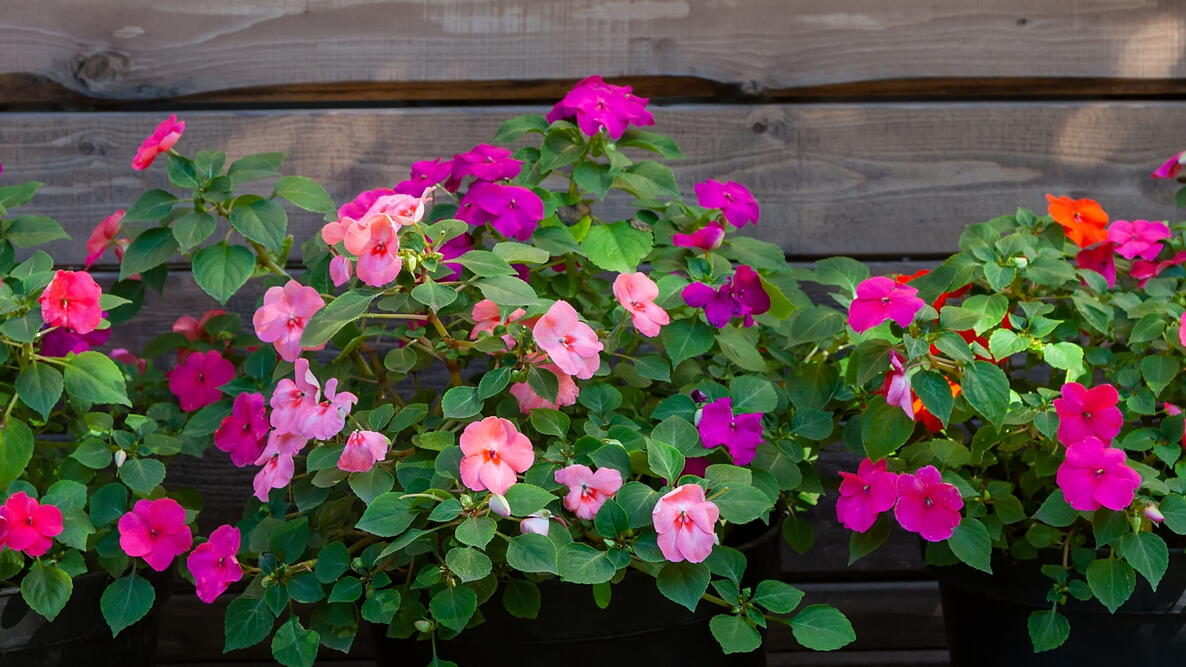
Caption
Colorful impatiens!
Looking for a flower that thrives where others fade? If you want nonstop color in shady spots, it’s time to learn how to grow impatiens. These easy-care annuals light up porches, hanging baskets, and garden beds with vibrant blooms all season long.
Whether you’re planting impatiens in containers or filling in a shaded border, this guide will walk you through everything you need to know for healthy, happy plants.
Impatiens are very popular as both a bedding and a hanging plant. Also called Busy Lizzies, these beauties are low-maintenance and don’t even need pinching!
Of short to medium height, most impatiens varieties grow 8 to 15 inches tall, although some types reach 30 inches. They are perennials in frost-free areas but are grown as annuals or houseplants everywhere else.
Use impatiens for a splash of all-season color in any area that receives partial shade. Because of their shallow root system and low height, impatiens are ideally suited to containers like hanging baskets, window boxes, or deck railing planters. They also work well in the filler role in larger containers.

Growing
Impatiens are not fussy and, if planted in the correct location, will thrive with little effort—one of the reasons they are popular.
- The most important thing to remember about impatiens is to water them regularly. Keep the soil moist but not too wet. If the plants dry out, they will lose their leaves. If you over-water the plants, it encourages fungal diseases.
- Container-grown impatiens will benefit from fertilizer applied every 2 weeks when watering.
- Deadheading, while not strictly necessary, will improve their appearance and encourage more blooms.

Overwintering Impatiens
Impatiens are hardy in Zones 10-12, but even a light frost will kill them. If you have a favorite color you’d like to overwinter, either take cuttings or dig up the plant and bring it inside. Depending on your available sunlight and day length, a grow light may be necessary.
Propagating Impatiens
Impatiens can be easily propagated from stem cuttings—a great way to get more of a favorite color or gift it to a friend. At the end of the growing season, taking cuttings and growing them over the winter may be easier than digging up entire plants and trying to keep them alive in the house.
- Inspect your plant to make sure it is pest-free.
- Sanitize your shears with alcohol.
- Choose several strong stems and snip them 4–6 inches below the bloom.
- Remove the flower and all but the upper one or two pairs of leaves.
- Place the cuttings in a clear glass container filled with clean water. If your water is treated by your municipality, let the water sit on the counter for 24 hours first to allow most of the chemicals to dissipate.
- In a week or two, when fine white roots appear, transition the cuttings to the soil in one of two ways:
- Plant them in individual pots filled with moist potting mix.
- Add a bit of potting mix to your glass container daily until it is completely filled with soil after a week. After filling the jar with soil, remove the plants and repot.
Types
Ornamental impatiens are primarily from two groups, Impatiens walleriana and New Guinea impatiens, Impatiens hawkeri. The two look different, but growing them is pretty much the same. I. wallerina cultivars are less tolerant of sunshine than the New Guinea hybrids, and the latter has larger foliage.
- Lollipop series (I. walleriana) ‘Fruit Punch Rose’ is a compact, well-branched variety with superbly vivid colors.
- Tom Thumb Series (I. balsamina) is a dwarf variety with large, double, brightly colored flowers.
- Beacon® impatiens are highly resistant to downy mildew and will keep blooming reliably until frost.
- Swirl Series (I. walleriana) has pretty pink and orange flowers with petals in red.


Diseases, pests, or too much fertilizer may cause curling leaves. In Hawaii, impatiens are often attacked by broad mites. These suck sap from leaves (especially young leaves), causing crinkling, puckering, curling, and/or wilting leaves. Corky, brown areas may be evident. The mites also may attack flower buds, and are especially troublesome during the cool, wet, winter season. Broad mites are very tiny and hard to see; they usually feed on the leaf undersides. Mite predators help to control them. For more information, you might try contacting your local Cooperative Extension:
http://www.ctahr.hawaii.edu/Site/counties.aspx
Impatiens do best in Zones 10 and 11 for overwintering. In Zone 8, it would probably be best to pot them up and take them indoors for the winter. Place them in bright indirect light and reduce watering for the winter season. For more advice, we'd recommend contacting your county's Cooperative Extension service; they'd be most familiar with plant care in your area. You can find contact information at:
http://www.almanac.com/content/cooperative-extension-services
Also, please be aware that Impatiens walleriana and cultivars (and the wild jewelweed) are experiencing more and more trouble with downy mildew, including in the Pacific Northwest. Garden centers are beginning to offer more alternatives, including New Guinea impatiens (Impatiens hawkeri), which doesn't seem to be affected at this point. You might look into that species instead, to avoid problems.
Were these planted in a bed? Impatiens like a soil pH of about 60 to 6.5, but can tolerate it a bit higher. Adding lime to the soil raises the pH (makes it more alkaline). Depending on what pH the gardener was aiming for in the lawn, the impatiens may or may not have been happy.
However, unless you are having other changes to the landscape that would change the cultural conditions of the impatiens (light, water, soil, etc.), such as planting a shrub that would change the lighting, or installing a sprinkler system right where the impatiens were, then it's puzzling why they'd need to be removed if they were still flowering. Our suggestion is to ask your gardener about it.
Yes, it sounds as if you have a fungus.Remove infected plants and see if you can control further disease development with a regular fungicide spray application. Check with your local garden center.
- « Previous
- 1
- 2
- …
- 10
- Next »

Comments