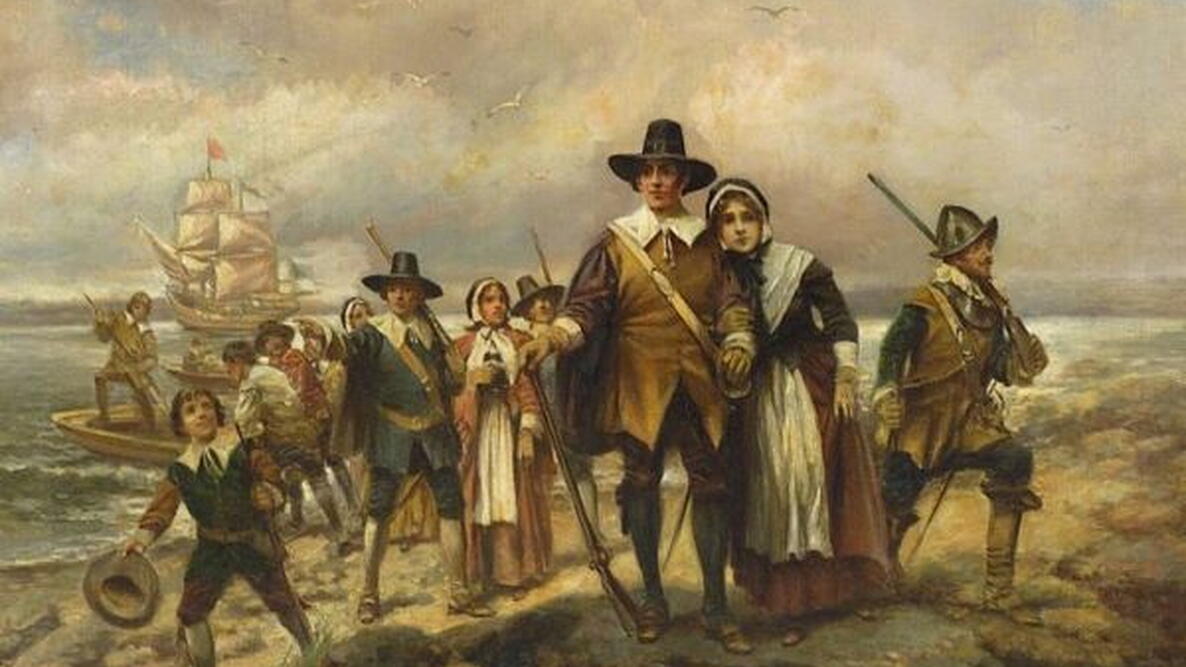
Have you ever wondered what weather the Pilgrims and Wampanoag encountered at the first Thanksgiving? While we know something about the harvest celebration, its weather remains a mystery. No temperatures or descriptions of sunshine appear in the surviving eyewitness account.
When Was the First Thanksgiving?
The feast held by the Pilgrims of Plymouth Colony and the Wampanoag in 1621 took place in autumn, rather than on the November holiday we observe today. No exact date was recorded, although we know it was a harvest celebration. Plimoth Patuxet Museums places the gathering sometime between September 21 and November 9.
Celebrating a fall harvest was a popular English tradition at the time—a celebration sometimes lasting several days. The Wampanoag people had their own longstanding traditions of giving thanks, including celebrations associated with the harvest.
What Do We Know About the Weather?
As new arrivals, the Pilgrims frequently described the harsh local climate; weather conditions and weather survival were common topics for the colonists.
However, Edward Winslow’s account of the harvest celebration describes the food, company, and activities without mentioning the weather. That silence might suggest that conditions did not seem remarkable to him, but it cannot tell us whether the days were sunny, rainy, warm, or chilly. Sunny weather and temperatures in the 60s are possibilities, not recorded facts.
Without an exact date or a weather record from the gathering, we cannot confidently reconstruct the conditions around the Thanksgiving table.

A Harvest After Hard Times
Most history books record how difficult the previous year had been for the Pilgrims. After a much-delayed, stormy sea voyage, the colonists arrived in New England late in 1620. Their first winter brought sickness and many deaths, but the following autumn brought a successful harvest.
The Wampanoag people had also endured devastating losses. From 1616 to 1619, an epidemic swept through coastal Native communities, including Patuxet, where the English later established Plymouth Colony. The losses weakened Wampanoag communities and changed their relations with neighboring nations. In these difficult circumstances, Ousamequin, also known by the title Massasoit, and his council formed an alliance with the English colonists.
For 3 days during the harvest celebration, Ousamequin and about 90 of his men joined the English for feasting and recreation. Winslow recorded that the Wampanoag contributed five deer. His brief account leaves many questions unanswered, including how the Wampanoag participants understood the gathering.
Whatever the weather, the harvest provided an occasion to gather after a difficult period for both communities.
Planning your own Thanksgiving gathering? See this year’s Thanksgiving forecast, or read about historic Thanksgiving storms and see if you remember any of them!





Comments