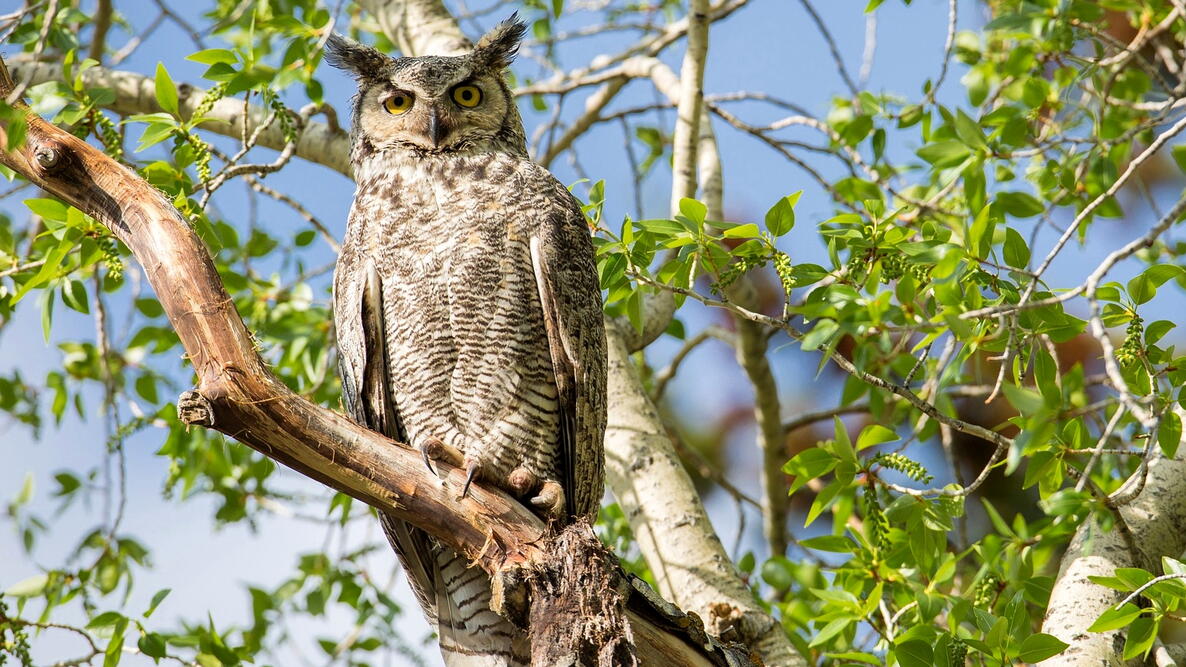
Spotting a great horned owl (or a couple!) camouflaged in the tree canopy is a great treat. To some, hearing the deep hoot of a great horned owl signifies the coming of good news. Take a look at some breathtaking photos of—and have a listen to—the famous owl of our storybooks.
What Does a Great Horned Owl Look Like?
Capable of growing to over 2 feet in height with a wingspan of up to 5 feet, the great horned owl is big. Yet, this size is deceptive: Feathers compose the majority of its volume. While a heavier great horned owl may reach up to 5-1/2 pounds in weight, most are only around 3 pounds; the females are usually bigger than the males.
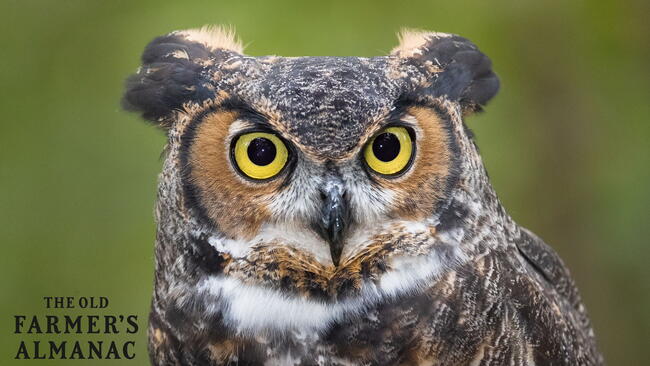
In typical owl fashion, the great horned owl sports huge, round, yellow eyes inset into a cinnamon- or gray-colored face. Instead of having eyes on the sides of its face, like most birds do, its eyes are on the front, like ours. This gives them a human expression, doubtlessly contributing to their wise reputation. And have you ever wondered why owls swivel their heads? They swivel because they don’t have eyeballs—instead they have elongated eye tubes, which are nearly immobile.

The rest of the great horned owl’s plumage is often a mix of cinnamon, gray, and black, with white feathers dusting its neck. However, the overall color of the owl varies regionally.
Why Are They Called Great Horned Owls?
While their name suggests otherwise, the great horned owl doesn’t actually have horns. Instead, tufts of feathers sprout from atop its head, giving the illusion of horns or even large ears. In actuality, their ears are asymmetrical slits behind their facial disks.

What Do Great Horned Owls Eat?
The great horned owl has earned the nickname “Tiger of the Air” or “Tiger Owl” due to its fierce hunting talent, so don’t expect one to visit your bird feeder anytime soon: They are carnivorous predators, classified by biologists as general feeders. This means that they are capable of hunting and eating almost any animal that whets their appetite. For the most part, great horned owls enjoy a diet of mammals and sometimes birds, snakes, scorpions, frogs, and insects. They favor small rodents (like mice and squirrels), rabbits, and even some small marsupials (like opossums). The further north these owls live, the more likely they are to eat other birds (and even smaller owls).
As large as their eyes may be, great horned owls are farsighted, so they have to back away from close objects to see them clearly. But don’t underestimate them: Because the great horned owl hunts live prey, they need better vision than songbirds. Their eyes are powerful for things far away, providing them with binocular vision that helps them judge depth and distance swiftly. Although their ears are small slits, great horned owls also have excellent hearing and have been known to hunt almost entirely by sound.

The great horned owl flies with grace, power, and speed, unlike the hesitant, wavering flight of other, smaller owls. Not to mention its powerful grip: When hunting, this owl will swoop down to capture the intended prey in its talons. Its clutch is so strong that practically nothing can loosen it.
Where and When to Spot Great Horned Owls
One of the most common owls in North America, the great horned owl can survive in almost all habitats and can even be found in some parts of South America.

Since they are nocturnal, hunting mostly at night, dusk is the best time to look for them. That being said, great horned owls may also hunt on dark, overcast days in the winter if they are in great need of food.
The best place to look for them is on a perch—like a fence or branch—at the edge of an open space, awaiting the chance to swoop down to catch a meal.
Great Horned Owl Nests and Babies
Great horned owls don’t usually make their own nests. Instead, they repurpose the abandoned ones of other large birds, and the appearance of their nests varies depending on the species that originally constructed them.
You might even consider putting up a nest box to attract a great horned owl couple. Because most do not migrate, they can begin nesting as early as late winter—be sure your box is ready by then. And they aren’t particular about nest box location; the owls are known to nest in places as varied as empty buildings, cliff ledges, trees, and even the ground. However, once they’ve found a nesting area they like, they will often return to the same area year after year. This is due in some part to their size—it’s hard to find suitable cover for a bird as big as they are, especially if the trees have lost their leaves.

Their clutches can range in size from one to six eggs, most commonly two, taking 28 to 37 days to incubate. Though the fuzzy, white young may climb out of the nest as early as 5 weeks after hatching, they don’t often fly until 9 to 10 weeks of age.
Then, great horned owl parents—who pair for life—share the duty of feeding the owlets, sometimes up to several months after hatching. This is why great horned owls nest as early as February: Their young are seldom prepared to hunt for themselves until September or even October.
See our article on owl nesting season.

How Long Do Great Horned Owls Live?
The oldest recorded wild great horned owl was 28 years old, but they don’t usually live that long despite having no natural predators when fully grown. If a great horned owl makes it to adulthood, they are likely to live around 13 years on average.
What is the Great Horned Owl’s Call?
Listen to the haunting call of the Great Horned Owl. (Bird sounds courtesy of The Macaulay Library at The Cornell Lab of Ornithology.)
Unlike songbirds, great horned owls don’t use their call to mate—they use it to notify other owls of their territory. Their call is rather rhythmic; the initial, short “hoo” is followed by a staccato “h’” just before a lower, longer “hoo.” It then finishes off the call with two short “hoo” sounds, similar to the first.
If you get a chance to hear a pair perform their duet, you’ll find that the female’s voice is noticeably higher than the male’s. They can also make barking sounds in order to alert each other, and the young screech when begging for food.
Listen to the calls and sounds of more birds!
What Does It Mean To See a Great Horned Owl?
Different owls are associated with different meanings given the cultural context: The great horned owl’s call is particularly symbolic in indigenous cultures. To the Catawba, a Native American tribe whose territory can be found in South Carolina, hearing the cry of a great horned owl signifies the coming of good news. However, Choctaw Native Americans associate it with sudden death—like a murder—approaching.
The Lillooet people of British Columbia, Canada, use the great horned owl as a bogeyman to keep children quiet at night. They tell the story of a young girl who is married to the great horned owl against her will. The story goes that once she has learned self-reliance and to refrain from crying, the owl plans to release her. But she ultimately escapes.
While great horned owls are common, their nocturnal nature and plumage keep them well hidden from human eyes. You’re much more likely to hear one than you are to see one. Have a listen to the recording on this page, and keep your ears open!
Find more fascinating facts about owls.
Have you heard the call of a Great Horned Owl? Add your comments below. Be sure to let us know where you live or where you’ve heard this bird sound before!

More Like This
- « Previous
- 1
- 2
- …
- 10
- Next »

Comments