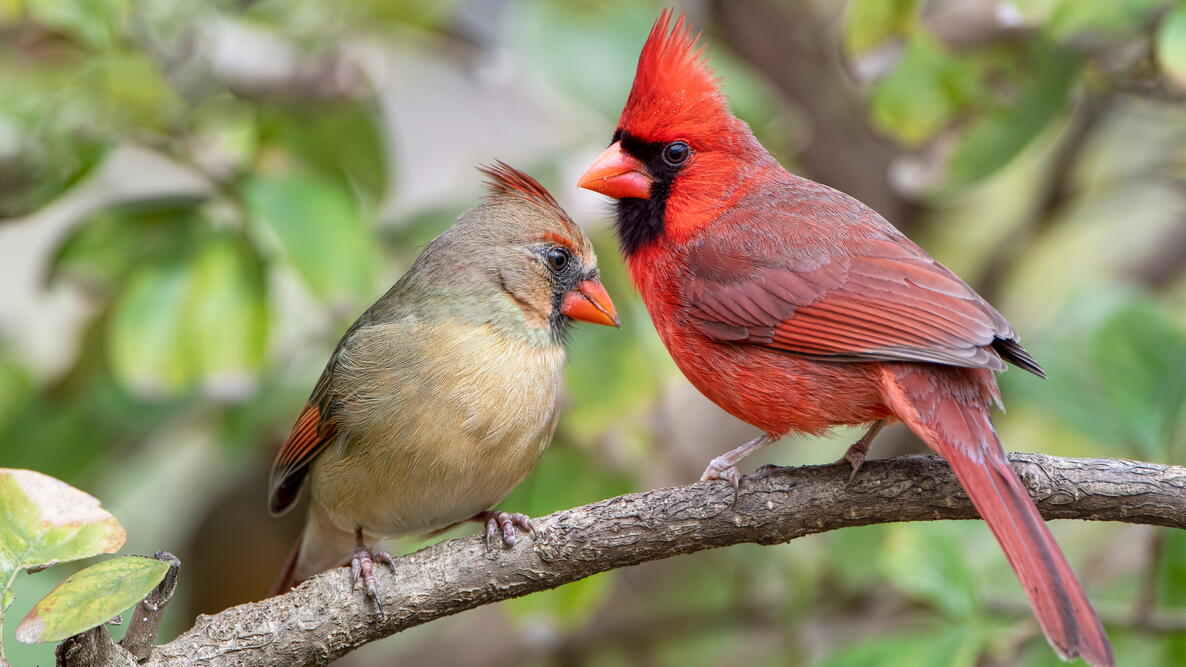
Caption
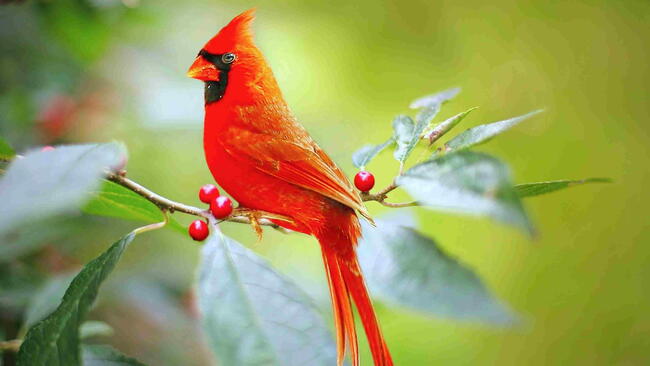
Vibrant cardinals in Louisiana winter
Why do northern cardinals sport such vivid red colors? Here are fun facts about one of North America’s most easily recognizable birds—plus, hear the cardinal’s sweet bird song!
Members of the finch family, northern cardinals are about 9 inches long with a wingspan of 12 inches. Both males and females sport a crest on top of their heads and long tails. The male is a flashy red color with a black face around its thick red bill; the female cardinal is a pale brown with attractive warm reddish tinges in the wings, tail, and crest.
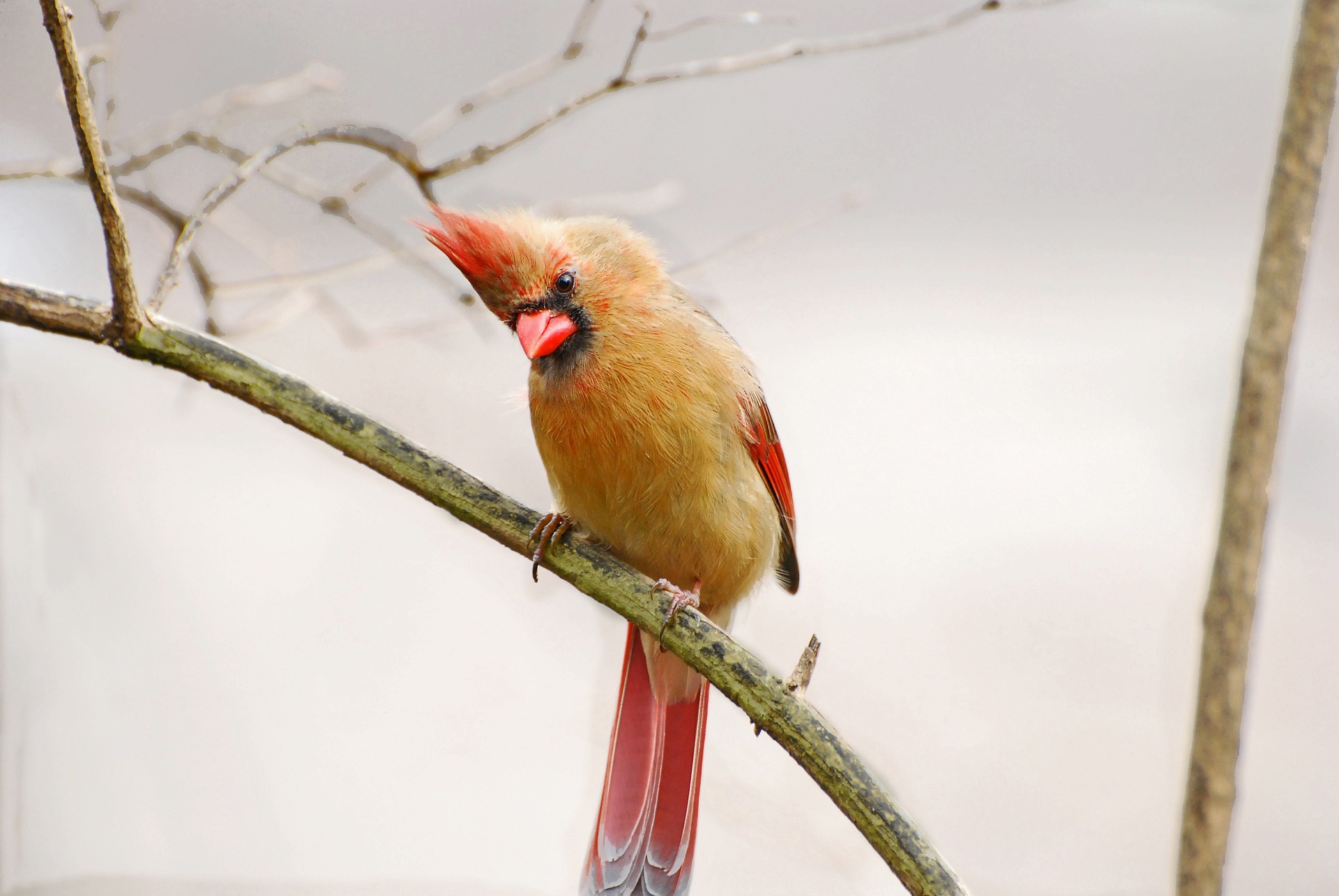
Why Are Cardinals So Red?
The cardinal’s plumage color is due to its diet during molt, which is rich with foods containing carotenoid pigments found in plants, insects, seeds, and some fruits such as blackberry, hackberry, wild grape, sumac, and dogwood. Current research indicates brighter males have increased reproductive success.

Where to Find Cardinals
A highly adaptable species, cardinals are found in eastern/central North America, southern Canada, parts of Mexico, and Central America.
Interestingly, the cardinal was once known as a Carolinian species but has dramatically expanded its range over the past 50 years. The breeding range has expanded north since the mid-1800s for three reasons:
- Clearing of forests, increasing edge habitat
- Warmer climates
- Winter feeding stations
It is not a bird of the forest and has advanced north following the clearing of forests, which provided tangles in shrubbery and city parks. It is believed that cardinals moved from the south of Ohio, then to southern Canada, then east to New England. They’re now a common bird in brushy areas near adjoining woodlands, often located in suburban areas.
What Do Cardinals Eat?
Cardinals particularly love seeds, especially black oil sunflower seeds. Their short, strong beaks are great seed and nutcrackers! Due to their fondness for seeds, cardinals will often forage on the ground around feeders.
That said, cardinals are not especially picky eaters. As well as plant matter (seeds, berries, and fruit), the birds eat insects (29%)—such as beetles, cicadas, grasshoppers, leafhoppers, moths, flies, butterflies, and crickets.
See the Almanac’s chart of what different wild birds eat.
Here’s a fun fact: Ever noticed that cardinals are often the last birds to visit the bird feeder in the evening? While their bright colors are suitable for mating, the birds are probably less visible to predators as the light dims, plus they avoid competition for food from bigger birds.
Why Are the Birds Named Cardinals?
The name “cardinal” reflects the bird’s bright red plumage, the same color as the clothing worn by cardinals of the Catholic clergy.
Interestingly, these non-migrating birds operate as a flock in the winter to better forage, and this is called a “Vatican of cardinals.”
Why Are Sports Teams Named the Cardinals?
The “Cardinals” are a popular name for sports team mascots. Think of the NFL’s Arizona Cardinals football and MLB’s St. Louis Cardinals baseball teams. Also, the Cardinals’ mascot represents many college teams. Why? Perhaps it’s related to the male cardinals’ aggressiveness, similar to the blue jays.
Male cardinals are very defensive of the nesting territory. They are close to their mates and help raise the chicks so they will defend their family at all costs.

Cardinal Nests and Baby Cardinals
Cardinals do not migrate; they spend the year where they breed. Females construct the nest after both adults select the site. Often, it will be found in honeysuckle shrubs, blackberry briars, or multiflora roses. The nest is a bowl-shaped structure of four layers, including a rough outer layer of twigs crushed together, a leafy mat, grapevine bark, and then a lining of fine grasses.
The average clutch is three eggs, buffy greenish-white with medium brown spots. The last egg laid is always more lightly spotted. The eggs hatch in 11 to 13 days, and the young birds fledge in 9 to 10 days.
The babies need to eat soft-bodied insects such as caterpillars. Ensure your garden includes butterfly host plants such as dill, fennel, hollyhock, mustard greens, and snapdragon! See which shrubs and trees attract and support birds.
How Long Do Cardinals Live?
The life span of most cardinals is 3 to 5 years, on average, with the longest wild female living to 15 years old. These birds have to deal with a lot of predation, disease, accidents, and hunger.
The birds are predominately monogamous and will often mate for life, though they’ve also been known to “break up” and look for new mates, especially if their mate dies.
A Strange Cardinal Story
A cardinal participated in one of the strangest bird behaviors ever observed. A female cardinal once fed worms to a goldfish in an ornamental pond where people had fed goldfish! Both the goldfish and the cardinal became an attraction. A photograph of this appears in Joel Carl Welty’s The Life of Birds.

What is the Cardinal’s Bird Sound?
At the top of this page, you’ll find the audio file of a cardinal’s song. Cardinals are unusual in that they are one of the few non-migratory songbirds. The bird makes a clear, repetitive whistling that you’ll often hear first thing in the morning. Listen for the “cheer, cheer, cheer” or “birdy, birdy, birdy.” Aside from its song, a cardinal’s most common call is a loud, metallic chipping sound that you’ll hear during breeding when the birds defend their territory from predators.
Here’s a cool fact: Both males and females sing! For most songbirds, it’s just the male. Even more surprising is the way that cardinal couples sing as a pair to each other as they are very close partners and parents. The cardinal’s duets seem to strengthen their bonds. The female sings from the nest while incubating eggs and communicates to the male when to bring food to the nest; the male will sing during courtship but also signal a predator to the female when she’s in the nest.
You won’t see cardinals as often as you might expect despite their bright color because they hide in dense tangles. The best way to find them is often by listening to their sounds.
If you’ve seen or heard cardinals, please share below. Be sure to let us know where you live or where you’ve heard this bird sound before!
And go here to hear the sounds of other birds, compliments of The Macaulay Library at The Cornell Lab of Ornithology.


- « Previous
- 1
- 2
- …
- 10
- Next »

Comments