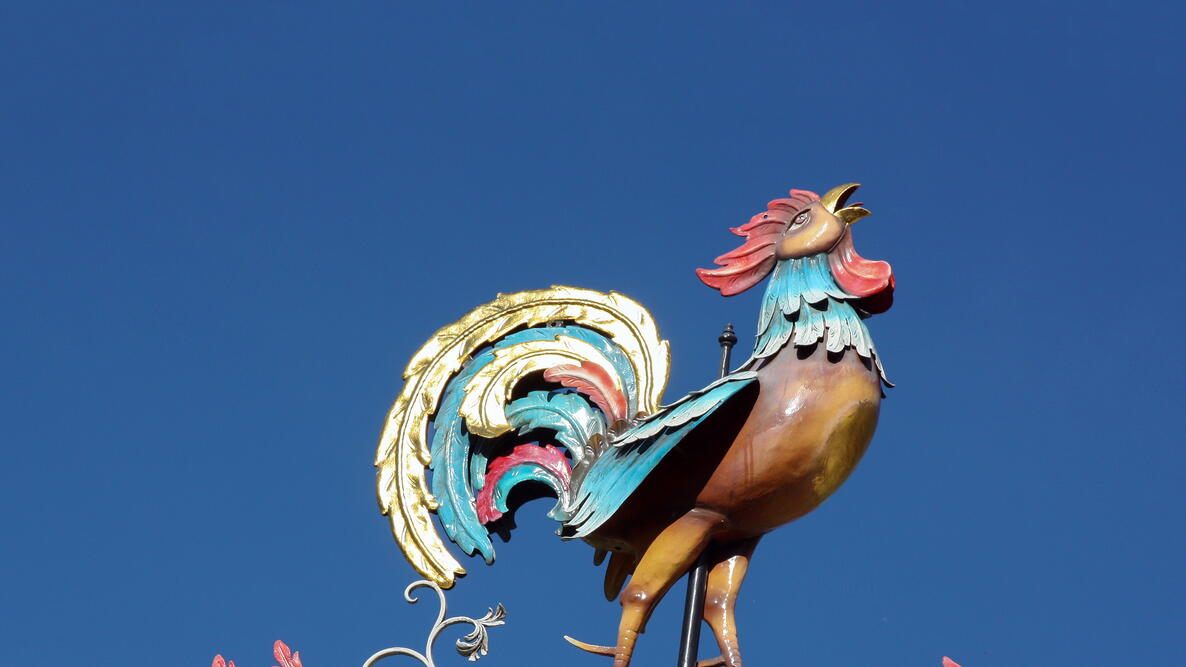
Caption
Cock weathervanes hold a variety of meanings in folklore and especially stand as Christian symbols.
The cock, or rooster, has stood as a symbol in folklore for centuries. A familiar figure on weathervanes and church steeples, it is associated with light, watchfulness, and the coming of dawn. Its crow has also inspired stories about night watches, wandering spirits, and changes in the weather.
Why does this barnyard bird hold such a lofty position? Here is a look at the traditions behind roosters, cockcrows, and weathercocks.
Why Are Roosters on Weathervanes?
A weathervane shows the direction from which the wind is blowing. When shaped like a rooster, it is traditionally called a weathercock.
The rooster’s association with dawn and watchfulness makes it a fitting figure to stand above a rooftop. On churches, it also carries Christian meanings, including the story of Peter’s denial of Christ and the promise of resurrection.
What Does the Cock or Rooster Symbolize?
Since ancient times, the cock has been associated with light and the coming of day. In Christian symbolism, its connection with dawn has also linked it to Christ and the Resurrection.
For many, the cock stands for the pastor who leads and watches over the parish, and for the position of the church in the community.
Another meaning comes from the biblical account of Peter’s denial that he knew Christ. Christ foretold that Peter would deny him before the rooster crowed. The cock atop a church can therefore serve as a reminder of that story.
Some church roosters also hold sacred religious relics. At Notre-Dame Cathedral in Paris, a new rooster was installed atop the reconstructed spire in December 2023. It contains relics of Saint Denis and Saint Geneviève, a fragment of Christ’s crown of thorns, and the names of those who contributed to the cathedral’s reconstruction.

Photo Credit: Thinkstock.
What Does the Cockcrow Symbolize?
Cockcrow is commonly associated with early dawn. However, roosters do not crow only at sunrise, and their nighttime calls have long held a place in folklore.
In old accounts, successive cockcrows helped mark the passing of the night. These calls became associated with “night watches” and the approach of daylight.
According to folklore, evil spirits walked abroad in the darkness, and the final cockcrow before dawn sent them back to their shadowy habitats. The rooster’s voice announced the return of light and the end of their wanderings.
Shakespeare preserved examples of these beliefs. In King Lear, Edgar describes a fiend who “begins at curfew and walks till the first cock.” In Romeo and Juliet, a household preparing for a wedding hears that “the second cock hath crow’d,” followed by the observation that it is three o’clock.
The unseasonable crowing of cocks has also been reckoned ominous in traditional accounts, sometimes as a warning of war or misfortune. These are folk beliefs rather than reliable predictions.
The crow of a rooster appears in weather proverbs, too. Listen up—but enjoy these sayings as folklore!
Why Do Roosters Crow Before Dawn?
Folklore gives the cockcrow many meanings, but science offers an explanation for its timing. Research shows that predawn crowing is regulated by a rooster’s internal biological clock. The bird does not simply wait for sunlight before announcing the morning.
Famous Rooster Weathervanes
New England has a long tradition of weathercocks on steeple tops.
One notable example is the “Bird of Dawning” associated with Old South Church in Newburyport, Massachusetts. The original gilded copper rooster was mounted on the spire in 1759. It was discovered missing in April 1987, stolen from its lofty perch; a copy replaced it.
Another excellent example belongs to First Church in Cambridge, Massachusetts. Created in 1721 by coppersmith Deacon Shem Drowne, the great gilded rooster stood above the Cambridge church for about 150 years. Drowne also made the famous grasshopper vane on Boston’s Faneuil Hall.
The Cambridge rooster was taken down for protection after concerns about its condition. The church’s report for its January 2026 annual meeting stated that the original remained in safe storage while plans for a replica were considered.
Whether silhouetted against a church steeple or turning above a barn, the weathercock combines useful craftsmanship with centuries of symbolism. Next time you spot one, look up—and listen for the cockcrow.
More Like This



Comments