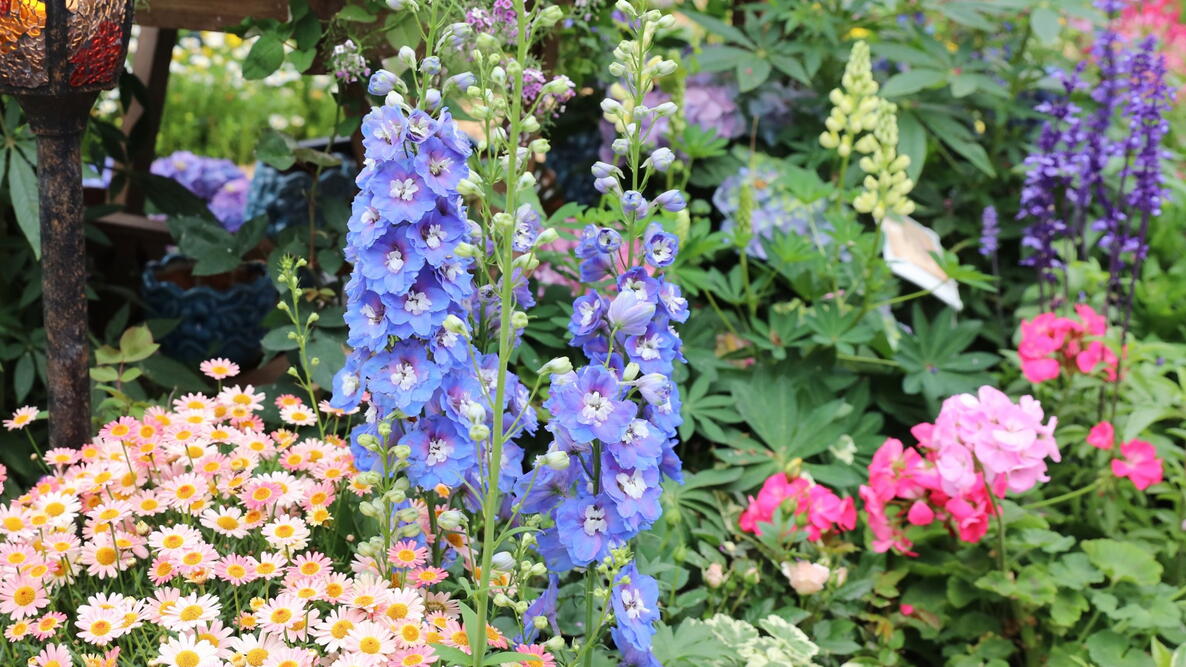
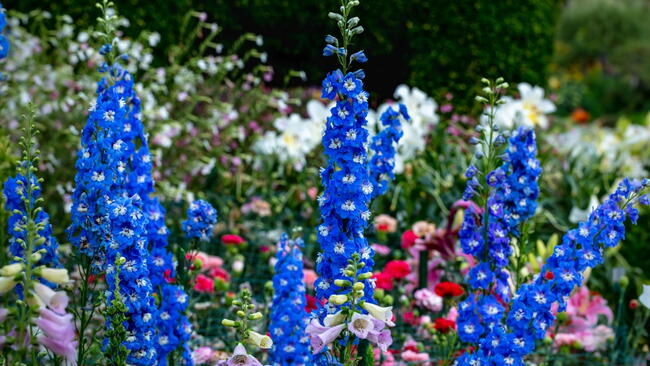
Oh, the delightful delphinium! The stalwart of many summer flower gardens, these showy perennials are grown for their long, colorful spikes in blue and other gorgeous hues.
Flowering all summer, delphiniums are butterfly and hummingbird magnets, too! Learn how to plant, grow, and care for delphiniums.
Delphinium is a genus in the Ranunculaceae family. (They’re often confused with larkspur, which are a different plant species.) There are more than 300 delphinium species, so there is quite a variety of heights, from dwarf hybrids to 6-foot tall beauties, so they can be planted in the front, middle, or back of a perennial border. The blue delphinium is most common, but varieties also come in gorgeous shades of violet, pink, white, red, and purple. They are popular in both cottage-style and cutting gardens.

Most delphiniums are short-lived perennials, lasting 2 or 3 years in the garden. Some varieties will bloom throughout the entire summer if the plants are cut back regularly. Other hybrids bloom from early to mid-summer and will produce a second flower display in late summer or early fall if you cut off the old flower stalk.
What’s important to know about delphiniums is that they will thrive if you meet their specific conditions. Delphiniums prefer moist, cool summers; they do not fare well in hot, dry weather or sudden wind or rain, which can knock them down. Most varieties will need staking. See more details below.
Are Delphinium Poisonous?
Yes, delphiniums are highly poisonous. If seeds and seedlings are ingested, they can cause nausea, twitching muscles, paralysis, and even death. This is mainly a concern for grazing animals such as cattle, horses, and sheep, and it is also a caution to gardeners with small children.
Growing
- Delphiniums are heavy feeders. Apply a balanced liquid fertilizer starting in early spring every 2 to 3 weeks.
- Insert sturdy stake supports no later than mid-spring or when the plants reach 12 inches high.
- Do not allow the soil to dry out, but avoid puddling. Water plants during the summer if rainfall is less than 1 inch per week.
- For ideal flower spikes, thin side shoots at 3 inches high, leaving 2 or 3 shoots on young plants and 5 to 7 shoots on mature, well-established ones.
- Deadhead by cutting spent flower spikes back to small, flowering side shoots.
- After delphiniums have finished blooming, cut flower stalks to the ground, and new, though smaller, flower stalks will develop. The flowers will survive the coming cold days and even light frosts. (See local frost dates.)
- Every 3 to 4 years, divide plants in spring: Remove and replant the new little plants growing around the outside of the clump. Discard the hard old heart.

Types
- Belladonna Group: blue flowers native to North America; easier to grow and longer-lived than varieties in the Elatum Group (below); upright, loose, and branching perennials; secondary flower spikes extend bloom period into autumn; 3 to 4 feet tall. ‘Blue Donna’ has clear, blue flowers.
- Elatum Group: tallest varieties in shades of violet, blue, pink, and/or white; short-lived; reach 6 feet tall or more. ‘Aurora Deep Purple’ has purple flowers with a white center.
- Pacific Hybrids: 3-inch violet, blue, and pink flowers; short-lived; tolerate warm/hot climates as annuals; giant (3- to 6-foot) heirlooms and dwarf hybrids. ‘King Arthur’, 5 to 6 feet tall, has plum flowers with white centers.

More Like This

We really enjoyed your post and hearing about your gardening experience. Congrats on the phlox success. In terms of the delphiniums, perhaps it's just wilting with the heat. Be sure to deadhead delphs after blooming, too. All the best!
Delphiniums like moist soil, not soggy and not dry. Try to water deeply a couple of times a week. Adding mulch around the plants will help to keep the soil moist and the roots cool. Deadheading spent flowers will promote new growth and maybe more flowers before the end of summer.
Since the leaves are turning brown after just a month, in addition to the flowers (which might fade just as part of their life cycle), it might be the heat. If the temperatures have been very hot (around 90F or above), with the full afternoon sun on them, it could stress the plant enough to dry it out. Provide partial shade during the afternoon hours. Another season, if hot temps are frequent in your area, you might try planting your delphiniums where they would get morning, rather than afternoon, sun. You might also try heat-tolerant varieties. Mulch is great, and will help to keep the soil cooler.
Also check your watering. Over- or underwatering can cause browning foliage. Water deeply and provide about 1 inch per week, adjusting for any rain or hot weather you might have; during hot spells, increase to every other day. Don't let the soil dry out, but don't let the soil get soggy either.
We're not sure, Melissa, but here are two coop ext site in which you might find a match with your plants' conditions:
• http://extension.psu.edu/pests/plant-diseases/all-fact-sheets/delphinium-diseases
• http://www.gardening.cornell.edu/homegardening/scene09de.html
We hope this helps.
- « Previous
- 1
- 2
- …
- 10
- Next »

Comments