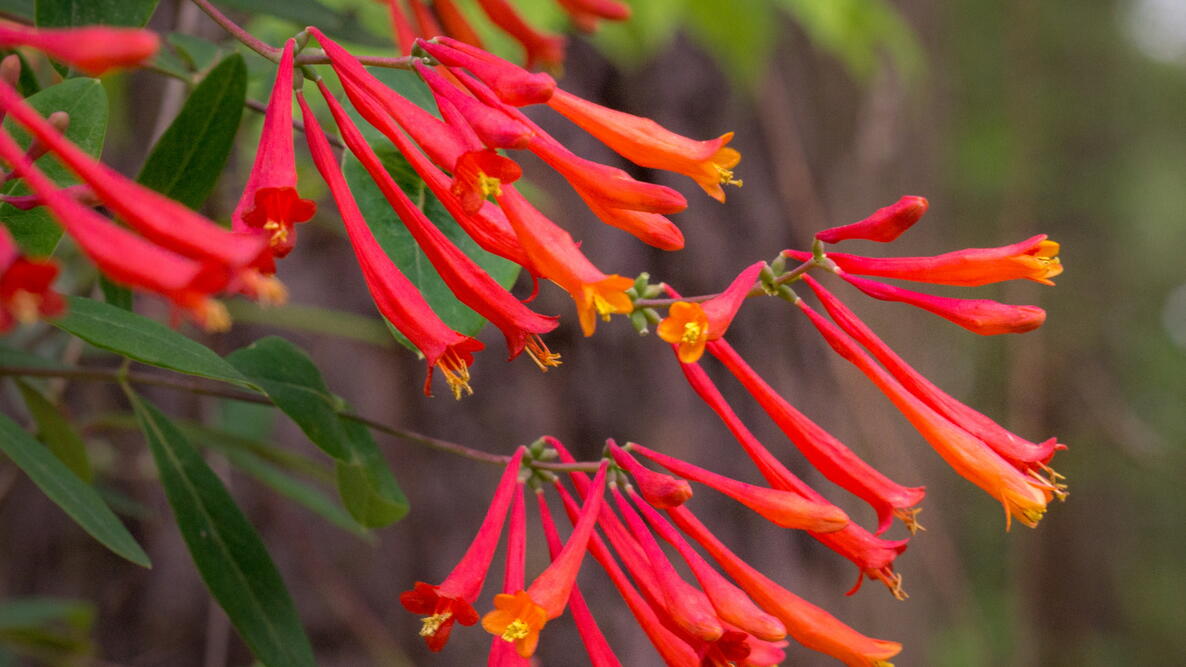
Caption
Coral honeysuckle (Lonicera sempervirens)
Planting
Honeysuckle is planted much like other perennial shrubs. Full or partial sunshine, some fertile soil, and mulch are the keys to remember when planting this vine.
When to Plant Honeysuckle
You can’t go wrong with planting honeysuckle in spring or early summer. Doing so will offer maximum time for your new plant to root and settle before the cold weather arrives. However, fall planting can also work, depending on your location and the variety you choose.
If you garden in an area where the ground freezes, plant your honeysuckles at least six weeks before the frost.
Where to Plant Honeysuckle
Honeysuckle will grow in both full sun and light shade. You’ll get more blooms if you plant in a location with 6 hours per day of sunshine, however. Many honeysuckles are hardy in USDA Zones 4–9, but check the cultivar you intend to plant to be sure.

How to Plant Honeysuckle
Select a location with adequate drainage. Honeysuckle appreciates moist soil but not soggy conditions. If your soil is heavy, poorly draining clay, consider making a large raised berm to plant your honeysuckle in.
- Dig a hole twice as wide as the rootball and the same depth. The hole should resemble a shallow bowl, not a coffee cup.
- When setting the plant in the hole, the crown should be at the same height in the soil level as it was in the nursery pot. Don’t bury it several inches deep like a tomato.
- Work some compost into the soil and plant your honeysuckle. If the roots are heavily circled or overgrown, you may need to loosen them first. Use a handheld garden tool to cut any girdling roots and loosen up the root ball.
- Set your honeysuckle in the hole and begin backfilling with the soil you removed. Be sure to firm the soil to eliminate air pockets around the roots.
- Make a shallow ring around the plant with the leftover soil to help the water infiltrate into the root zone and not run off. Water your new plant well.
- Mulch around the base, but don’t mound the mulch around the stem. Mulch touching the stem can sometimes lead to rot and disease. Read more about using mulch.
Growing
If you intend for your honeysuckle to climb a fence, arbor, or other support, give it a hand. Use some biodegradable twine and loosely tie the vine to its support. Use a loop about the size of a golf ball. When the vine gets large, it will have attached to the structure independently, and the string will decompose.
Many Lonicera spp. prefer to have their roots shaded, but the vines enjoy the sunshine. Mulch at the base of your vines if they are climbing a trellis or arbor.
You can also plant low-growing ground cover plants around the base or tuck the vine behind another shrub to shade your honeysuckle’s roots.

- Provide water weekly when newly planted. After the first growing season, honeysuckle should only need to be watered during prolonged dry periods.
- Fertilize if desired in spring with a slow-release general-purpose fertilizer.
Types
- Coral honeysuckle (L. sempervirens) is a native species. Its large, 10–20 foot long vines are perfect to create a climbing and flowering display.
- ‘Major Wheeler’ (L. sempervirens) has a long blooming period and gorgeous red flowers with yellow-orange centers.
- American honeysuckle (L. canadensis) is a shrub-formed bush honeysuckle with pale, cream-colored flowers native to the New England area.
- Goldflame Honeysuckle (L. x heckrottii) is a fragrant bloomer that makes a stunning display of purple, pink, and yellow on a trellis or arbor.
Avoid the Invasives
In some regions of North America, invasive honeysuckles have become a considerable problem. They can choke out native trees and cover large patches of land with nearly impenetrable ground cover. Their spread is aided by the birds that feast on the fruit and then drop the seeds in new locations.
To avoid unintentionally causing an infestation, avoid planting these commonly available species:
- Japanese honeysuckle – Lonicera japonica
- Morrow’s honeysuckle – L. morrowii
- Amur honeysuckle – L. maackii
- Bell’s honeysuckle – L. x bella
Several other Lonicera sp. are also considered invasive based on your location. Search online for “Lonicera + invasive species + your state’s name.” Here is an example of a site found with an invasive honeysuckle search for Vermont. Your state likely maintains a list to help people avoid inadvertently planting and spreading invasives.

More Like This



Yes! Honeysuckle is one of the easiest bushes to propagate through cuttings. Wait until early spring flowers has tapered off. Then—or anytime thereafter until, say, midsummer—the plant will make vigorous non-flowering branches appropriate for softwood cuttings; there should be no sign of floral buds. With a sharp knife, sever a stem just below a pair of leaves, yielding a tip cutting 3 to 6 inches long. The lowest one or two pairs of leaves should be removed. Honeysuckle grows so vigorously that application of rooting hormones is optional. The cut end of the stem should then be inserted about one inch deep into a container with rooting media such as natural clean sand, coconut coir, and horticultural products like perlite, vermiculite, and rock wool—anything that holds water to keep plant hydrated but is loose enough to get air to the roots (versus compacted). Once the cuttings have been inserted into the rooting medium, they just need time, moderately humid air, and moderately bright light in order to establish their new roots.

Comments