Planting
When to Plant Hostas
- Buy hostas as dormant, bare-root divisions or potted plants and plant them in the spring or fall.
- Hostas can be planted during the summer growing season but will need extra attention (mostly watering) to ensure that they do not succumb to the heat of summer.
Where to Plant Hostas
Hostas’ large leaves do not lend themselves well to full sun; they do best in partial sun or dappled shade but will grow in deep shade, too. Once established, they can take the summer heat and withstand mild droughts.
Hostas prefer soil that is well-draining and fertile (amend the soil with compost or rotted manure if your soil is poor). They do not like to sit in wet soil, so plant in a raised area or where the soil doesn’t stay saturated (especially in winter). Ideally, the soil should have a pH between slightly acidic and neutral (6.5 to 7.0), although hostas are forgiving.w
How to Plant Hostas
- Dig a hole that’s about twice the width and depth of the root ball of the plant. Loosening the soil in the planting area will benefit the hosta’s roots as they expand outward.
- If planting multiple hostas, space them out according to their expected size at maturity. Hostas are adept at filling empty spaces!
- Set the plants in the hole so that the crown (base) of the plant is even with the surrounding soil and any emerging leaf tips are visible at the soil surface.
- If buying potted hostas, plant them at the same soil level as in the pot.
- Gently dampen the soil around the plants and water until the soil is moist to settle the roots.

Types
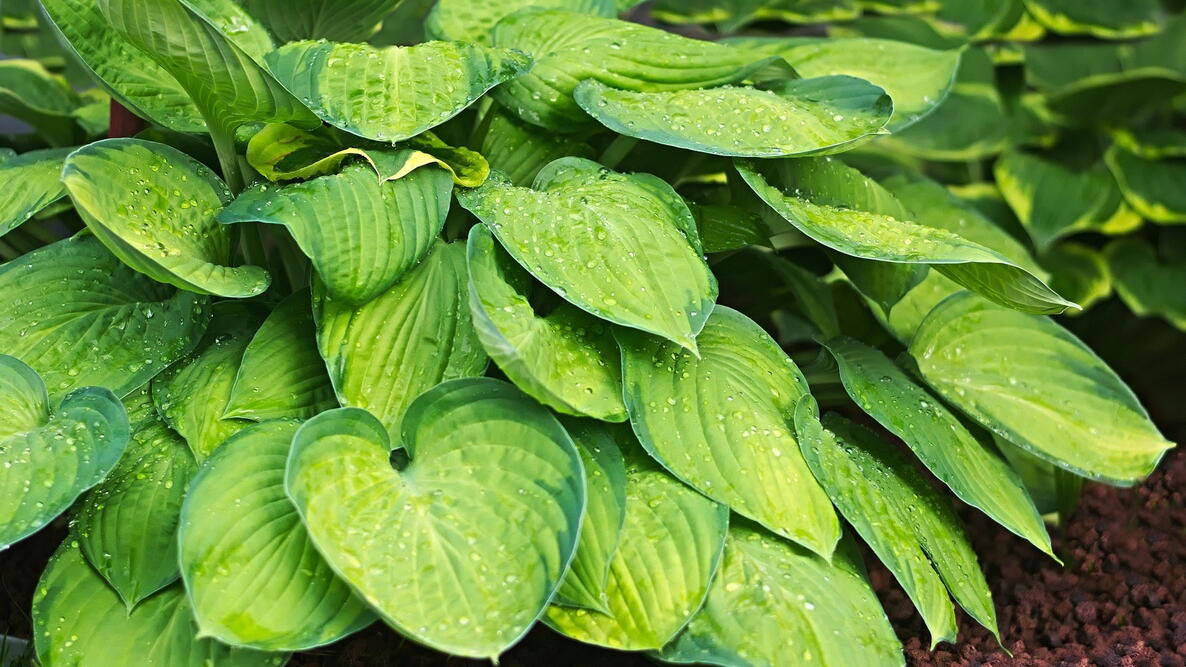
Most varieties tend to have a spread and height of between 1 and 3 feet, but larger or smaller varieties are readily available. Leaf colors include variegated white, lime green, and blue-green, to name just a few. The texture and shape of hosta leaves are also diverse, ranging from smooth and narrow to ridged and heart-shaped.
Once you start exploring hostas, you’ll find they get rather addictive! From 4-inch miniature hostas to 6-foot-wide giant hostas, there’s a hosta variety to fit any situation from large borders to tiny rock gardens. Here are just a few:
- H. fortunei ‘Aureomarginata’: Deep-green oval leaves accented by a golden edge.

- H. x ‘Blue Cadet’: A small hosta with heart-shaped, bluish leaves. It makes for a nice edging plant. In mid-summer it blooms with mauve-blue flowers.

- For sunnier spots, select plants from the Hosta plantaginea group. These plants also tend to have fragrant flowers in late summer. ‘August Moon’, ‘Honeybells’, and ‘Sum and Substance’ are a few of the varieties in this category.



Hello, Miami! Thank you for your enthusiasm for the Almanac! Many plants, most hostas included, require a winter dormancy period. For most hostas, that minimum 30 days at temps below 43°F. (The need is genetic, so specific to the species.) A few species have lower requirements; these include Hosta clausa, Hosta gracillima, Hosta kikutii, Hosta longipes, Hosta montana (southern forms), Hosta nakaiana, Hosta plantaginea, Hosta rupifraga, Hosta sieboldii,Hosta ventricosa, Hosta venusta, and Hosta yingeri (thanks to plantdelights.com). However, these may fail to thrive and eventually deteriorate.
Your best bet is to visit a nursery in the area and ask them for recommendations. They would be most familiar with the conditions and so knowledgable about the options.
It's hard to say for sure what the root issue is without knowing where you're growing. Hostas naturally die back with the arrival of cooler temperatures in the fall, so you could be seeing that. Unless you live in a dry area, hostas don't normally need extra water once they're established, so if you are already getting regular rain, you may be overwatering. Especially at this time of year, when hostas aren't actively growing, they can be susceptible to too much water. Luckily, they're hardy and don't have trouble bouncing back in the spring!
Slugs do love hostas. See our Slug page on how to get rid of slugs: https://www.almanac.com/pest/slugs
- « Previous
- 1
- 2
- …
- 10
- Next »

Comments