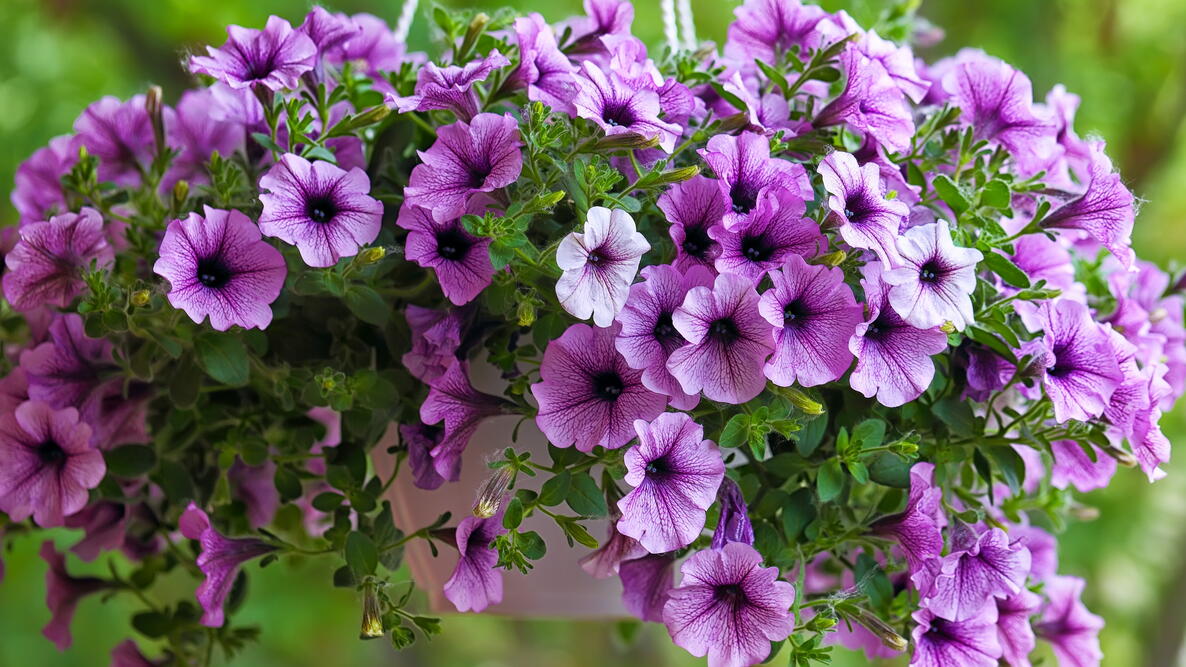
Pretty petunias are popular because of their exceptionally long flowering period. As with most annuals, they get leggy by midsummer, so you’ll want to prune the shoots back by half. See more tips on planting and caring for petunias to keep them blooming.
Petunias are treated as annuals in most areas but can be grown as tender perennials in Zones 9 to 11. The flowers come in many colors and patterns and bloom from spring until frost!
These colorful annuals can really add pop to a front lawn and are often used in borders, containers, hanging baskets, or even as seasonal ground covers. Some even have a slight fragrance. Their height can vary from 6 inches to 18 inches, and they can spread along the ground anywhere from 18 inches to 4 feet.

Planting
When to Plant Petunias
- It’s easiest to buy young plants from a nursery that sells petunias in flats. Look for plants that are short and compact. Leggy petunias with tons of flowers already won’t settle in as fast.
- If you want to grow petunias from seed, start the seeds indoors 8 to 10 weeks before your last spring frost date. (See your local frost dates.)
- Plant young petunias outdoors after your last spring frost date, but keep a close eye on the weather forecast and protect young plants from late frosts.
Where to Plant Petunias
Petunias need full sun, or they will become spindly. They don’t tend to flower well in shade.
The soil should drain well and not stay overly wet, especially in containers. It should also be moderately fertile to promote the best growth. Amend poor soil with finished compost prior to planting.
How to Plant Petunias
- Petunia seeds are very small (dust-like!) and need lots of light in order to germinate.
- When the young plants have three leaves, plant them outside.
- Space the plants about 1 foot apart.
- If you’re planting petunias in containers, use a container potting mix that will drain well.

Types
Types of Petunias
Petunias are divided into different groups, mainly based on flower size:
- Multiflora petunias are the most durable and prolific. They have smaller but more abundant flowers and are ideal for summer bedding or in a mixed border (because they are more tolerant to wet weather).
- Grandiflora petunias have very large flowers and are best grown in containers or hanging baskets (because they are more susceptible to rain damage). These large petunias often do not fare as well in the south because they’re prone to rot during humid, hot summers.
- Floribundas: Floribundas are intermediate between the grandiflora and multiflora groups. Like the multiflora varieties, they are free-flowering and produce medium-sized blooms.
- Millifloras: Milliflora petunias are much smaller than any other petunias on the market. The flowers are only 1 to 1½ inches wide, but they are prolific and last all season!
- Spreading or Trailing Petunias: These are low-growing and can spread as much as 3 to 4 feet. Because the flowers form along the entire length of each stem, they form a beautiful, colorful ground cover. They can be used in window boxes or hanging baskets.

More Like This
Comments

If you remove the dead flowers, it will prevent those spent flowers from developing seeds. This helps the plant to focus its energy on producing more flowers (instead of seeds). When deadheading, make the cut about 1/4 inch below the base of the flower (along the stem), or you can pinch it back to just above the nearest leaf junction. Do not remove just the petals -- the entire flower structure, including the base connected to the stem (usually a little swollen area, with several tiny straplike "leaves" surrounding it, called the calyx) needs to be removed.
This can happen to petunias without proper pruning. To prevent it, cut back 1/3 of the stems every 10 days. This should keep the leaves from getting oversized and promote flowering on all the stems.
Are your flowers getting enough sun? They grow best in full sun. Let the soil dry between waterings. Petunias do not need a lot of water. You can give them some diluted liquid fertilizer now to see if that will help.
- « Previous
- 1
- 2
- …
- 10
- Next »

To deadhead simply means to pinch a blossom that is withered or browning. Take off the blossom only, and this should keep your petunia plant healthy for a longer period.