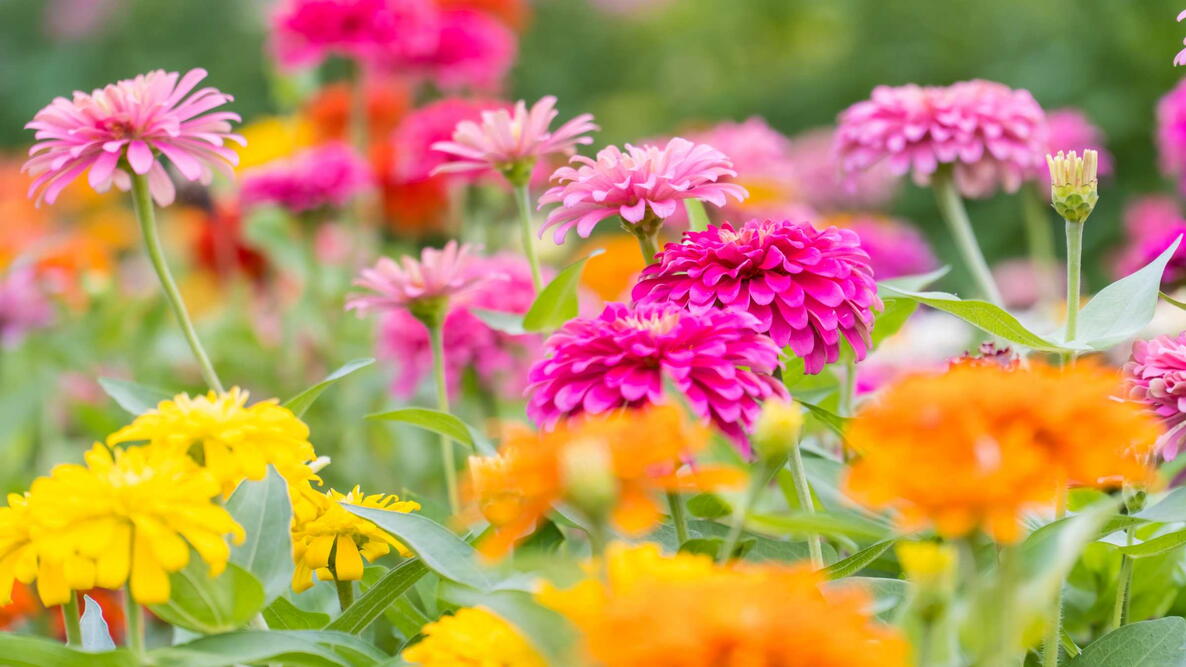
Caption
Zinnias bloom nonstop from summer to frost in bright, cheerful colors.
Looking to add a punch of color to your garden with zero fuss? Zinnias are fast-growing annual flowers that thrive in full sun and bloom nonstop from summer to frost. In this guide, you’ll learn when to plant, how to grow, and how to keep them blooming beautifully all season long.
Zinnias are often the first flower beginners grow—and they rarely disappoint. Easy, colorful, and generous, they’re also among the very best flowers for cutting and filling summer bouquets.
Most varieties grow 1 to 3 feet tall, depending on the type, and branch freely once established. Bloom size and form vary widely—from simple daisy shapes to full, dahlia-like doubles—but all benefit from full sun, warm soil, and good spacing for airflow.

Planting
When to Plant Zinnias
Zinnias are true heat lovers. Do not plant until all danger of frost has passed in your area. Use the Almanac frost date tool to determine your average last frost date.
For best results, wait an additional 1 to 2 weeks after your last frost date so the soil has time to warm. Zinnias germinate and grow best when soil temperatures are consistently around 70°F. Planting into cool soil often leads to stalled growth or seed rot.
There is no advantage to rushing the season—once warm weather settles in, zinnias grow quickly and bloom all summer.
Where to Plant Zinnias
Choose a location with full sun—at least 6 to 8 hours of direct sunlight daily. The more sun they receive, the stronger the stems and the more abundant the blooms.
Good airflow is essential. Avoid tight planting areas or spots where humidity lingers, as crowded conditions increase the risk of mildew.
Zinnias perform well in garden beds, borders, cutting gardens, and large containers—as long as drainage is good.
How to Plant Zinnias
Zinnias are best grown from seed. They germinate quickly and generally do not transplant well once established, so direct sowing outdoors into warm garden soil is the simplest and strongest method. Do not use nursery plants.
Zinnias are not heavy feeders, but healthy soil makes all the difference for strong stems and abundant blooms. Prepare the soil before sowing. Simply work some organic matter, such as compost, into the bed before planting to support strong stems and abundant blooms. I use diluted organic fertilizer, such as fish emulsion, at planting time.
- Sow seeds about 1/4 inch deep in warm soil.
- Space plants about 12 inches apart in home gardens to encourage branching and airflow.
- Water gently after sowing and keep the soil lightly moist until the seeds sprout.
Spacing is often the number one issue. In my own garden, I prefer a full foot between plants so they have room to breathe, stretch, and branch properly.
Seeds typically germinate in 4 to 7 days under warm conditions.

Types
Zinnias come in three main bloom styles: single (daisy-like), semi-double, and fully double or dahlia-like. All are easy to grow when planted in warm soil and given full sun.
If your flowers don’t look like the dramatic, layered blooms you see online, it may be the variety. Most garden-center seed packets contain simple, single-flowered types, while fuller cutting varieties often come from online seed companies.
Compact varieties handle wind and heavy rain better, while taller types may need staking. In humid climates, look for varieties bred for improved resistance to mildew.
Wit and Wisdom
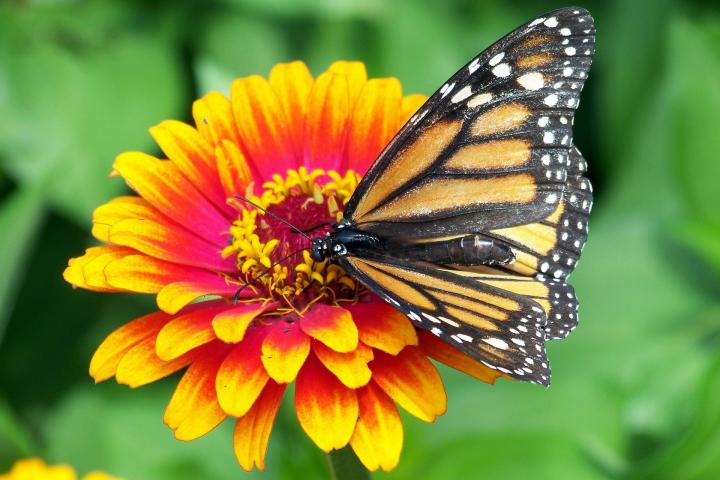
- Butterflies flock to zinnias, making them one of the easiest ways to add pollinator life to a sunny bed.
- Zinnias are said to symbolize thoughts of absent friends and lasting affection — fitting for a flower that keeps blooming all summer long. Learn about more flower meanings here.
- Zinnias were the first flowers to successfully bloom in space (aboard the International Space Station)! Despite battling mold from high humidity, astronauts carefully adjusted their care—and the plants pulled through.

More Like This
Comments

It is natural for leaves on a heat stressed plant to wilt a bit during the hottest part of the day but the whole plant should not be collapsing. It definitely needs more water. It is not unusual to have to water container plants several times a day in extreme heat. Your plant sounds like it would benefit from being moved into a larger pot with more soil mass. Next year pay attention to the spacing requirements on the seed package. If the varieties you are growing need to be planted 4 or 6 or 8 inches apart, plan for a large enough container to accomodate them.
Your seedlings may have succumbed to a fungus called pythium that caused them to keel over after germinating. The condition is called "damping off." The best remedy is to start the seeds in a sterile potting mix.
Hi, Dell: The stronger the plant, the stronger (more viable) the seeds are likely to be. Seeds from a diseased zinnia are not so much likely to transmit/continue disease as they are just to produce weaker plants. So go ahead and save them and see. The greater danger, which many people overlook, comes from disease that remains in the soil and then rejuvenates when replanted upon. So it is important to make sure that you clean the bed first. Thanks for asking!
- « Previous
- 1
- 2
- …
- 10
- Next »

Your comment that your zinnias are "very tall" may mean that they are reaching for sunlight? competing with nearby plants? And if they are competing, are there too many in a space allowed?
It may also be "dampening off"—too much moisture, too cool temps. The plants collapse, then, sometimes, recover as you have described. This is soil-borne condition caused by—you guessed it—dampness and high temps, in which conditions plants may grow too rapidly at first, collapse, then recover as yours do (not all plants recover from dampening off). Your tools and pots could be infected; wash thoroughly. Only use good potting soil, and do not plant seeds too deeply.