
Caption
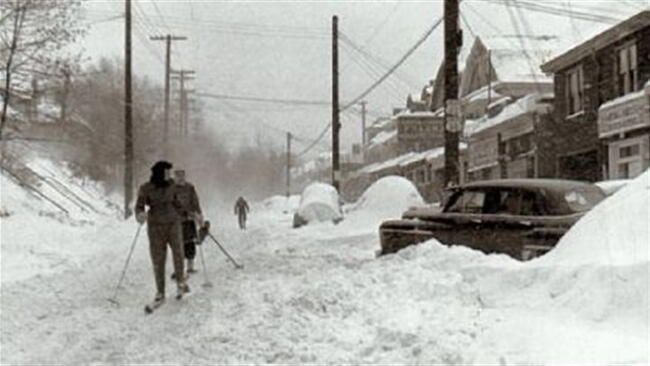
THE BLIZZARD OF ’78 PILED UP CARS ON ROUTE 128 IN NEEDHAM, MASSACHUSETTS, OUTSIDE BOSTON.
Do you have memories of bad blizzards? Let’s take a look back at some of the most memorable February storms of the past 50 years.
Memorable February Blizzards Over the Last 50 Years
Blizzard of 1972: Ithaca’s Record Snowfall
Does anyone remember the blizzard of February of 1972? I was near Ithaca, New York, where it snowed heavily from around 9:00 a.m. until about 1:00 p.m., leaving an accumulation of 29 inches during the 5 hours or so that it snowed. Helping to push cars that were stuck in the snow that afternoon, I felt cold for perhaps the first time in my life, as my metabolism began its downward slope to where I have to carefully watch my weight today.
Blizzard of 1978: The Megalopolitan Storm
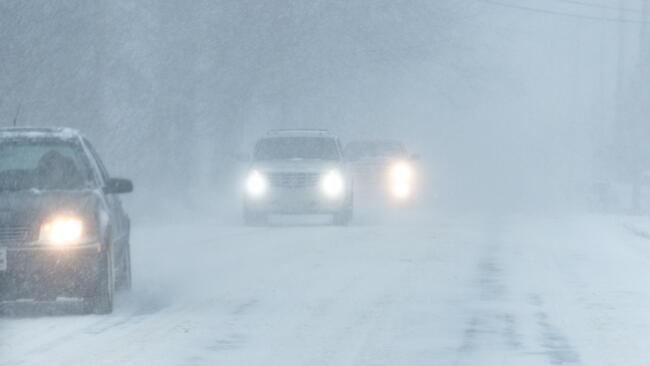
Another memorable storm is the Blizzard of ’78, on February 6 to 7, 1978. At the height of the storm, I drove to my workplace on the shore of the Hudson River in Ossining, New York. The snow was falling so heavily that my windshield wipers could not keep up with it, and I had to periodically pull over to clean my windshield. When I got to work, I found that it was closed due to the storm. I immediately started my return trip home, under even worse conditions. That 1978 storm is considered one of the worst blizzards in U.S. history, as it brought then-record snowfall to places from Atlantic City to Boston and caused nearly $2 billion in damage (in current dollars).
Blizzard of 1983 and Thundersnow Events
Another of the worst blizzards—sometimes called the “Megalopolitan Blizzard”—occurred on February 10 to 12, 1983, burying an area from Virginia to southern New England in 20 or more inches of snow and bringing thundersnow to areas from Washington, D.C., and Baltimore to Philadelphia.

Photo Credit: Eddie Danna/danna@siadvance.com
Snowpocalypse 2011: Chicago and Beyond
A more recent memorable blizzard was the February 1 to 2, 2011, “Snowpocalypse.” This storm brought heavy, blowing snow from northern Texas to New England and eastern Canada. Hardest hit was Chicago, whose 21.2 inches of snow, whipped by winds as high as 60 miles per hour, fell just short of its all-time record of 23 inches. Blizzard conditions affected many other large cities along the storm’s path, including El Paso, Tulsa, Oklahoma City, Kansas City, St. Louis, Des Moines, Milwaukee, Detroit, Indianapolis, Dayton, Cleveland, New York City, and Boston.

Photo Credit: Victor Grigas/Wikimedia.
Why February Is Prone to Severe Blizzards
Although it is the month of some of the greatest blizzards, February is the driest overall in terms of monthly total precipitation, which consists of rain plus melted snow and ice.
There are two reasons for this.
- First, the air is colder in winter, and since cold air can not hold as much water vapor as warm air, there is less moisture available and less potential for precipitation in winter.
- Second, February is the shortest month, which means that it has fewer days in which precipitation can occur.
Despite its overall dryness, February is a time when some of the largest snowfalls and worst blizzards have occurred. (See the definition of a blizzard and other winter weather terms.)
The reasons for this are again twofold:
- First, by early February, the ground has typically hit its coldest temperature, making adjacent air colder and thus snow more likely in the presence of moisture.
- Second, as the days have grown longer since the winter solstice around December 21, a greater potential has developed for warmer air to the south to lift moisture into the atmosphere, bringing heavier snow amounts than in December and January.
Do you recall any major blizzards from your past? Share below!
Also, see our long-range weather forecasts for February and beyond!

More Like This


Comments