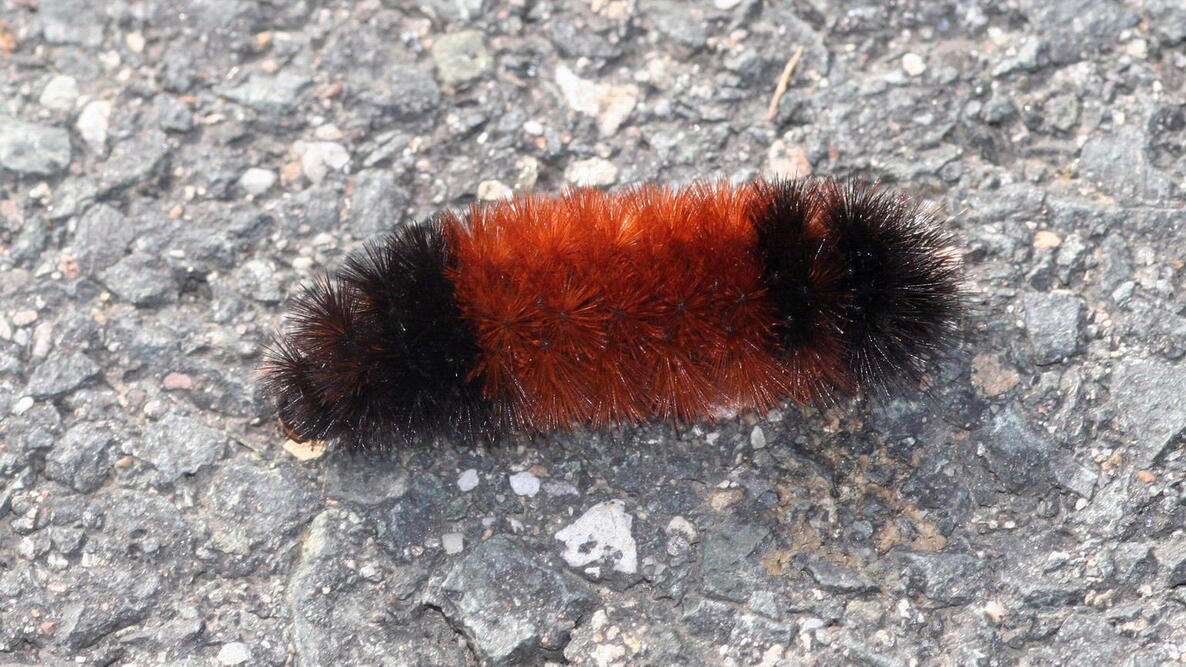
Caption
Based on the measurements of the distinctive woolly bear caterpillar, you can figure out your weather forecast!
Woolly bear caterpillars—also called woolly worms—have long been said to predict winter weather. According to folklore, the wider the rusty brown band on the woolly bear’s body, the milder the winter. More black? A harsher season may be ahead.
Before making your own winter forecast, take a closer look! Not every fuzzy caterpillar is a woolly bear, and even woolly bears can vary in color. Here’s how to identify one and read its bands.
How to Identify a Woolly Bear Caterpillar
If you see a black and brown fuzzy caterpillar, there’s a good chance it’s a woolly bear! The banded woolly bear is usually black on both ends and rusty brown in the middle, though some are mostly—or even entirely—black or rusty brown.
White or yellow fuzzy caterpillars are often different species, some also called “woolly bears,” rather than the familiar banded woolly bear of winter folklore.
The woolly bear caterpillar is the larva of the Isabella tiger moth (Pyrrharctia isabella), which has yellow-orange and cream wings spotted with black. Alas, the moths are not known for their weather-predicting abilities.
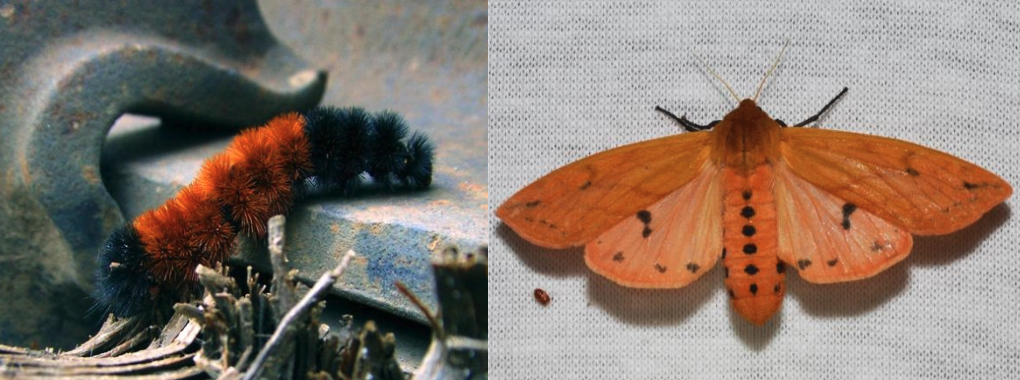
Credit: SillyPuttyEnemies / Andy Reago & Chrissy McClarren
What Do Woolly Bear Colors Mean for Winter?
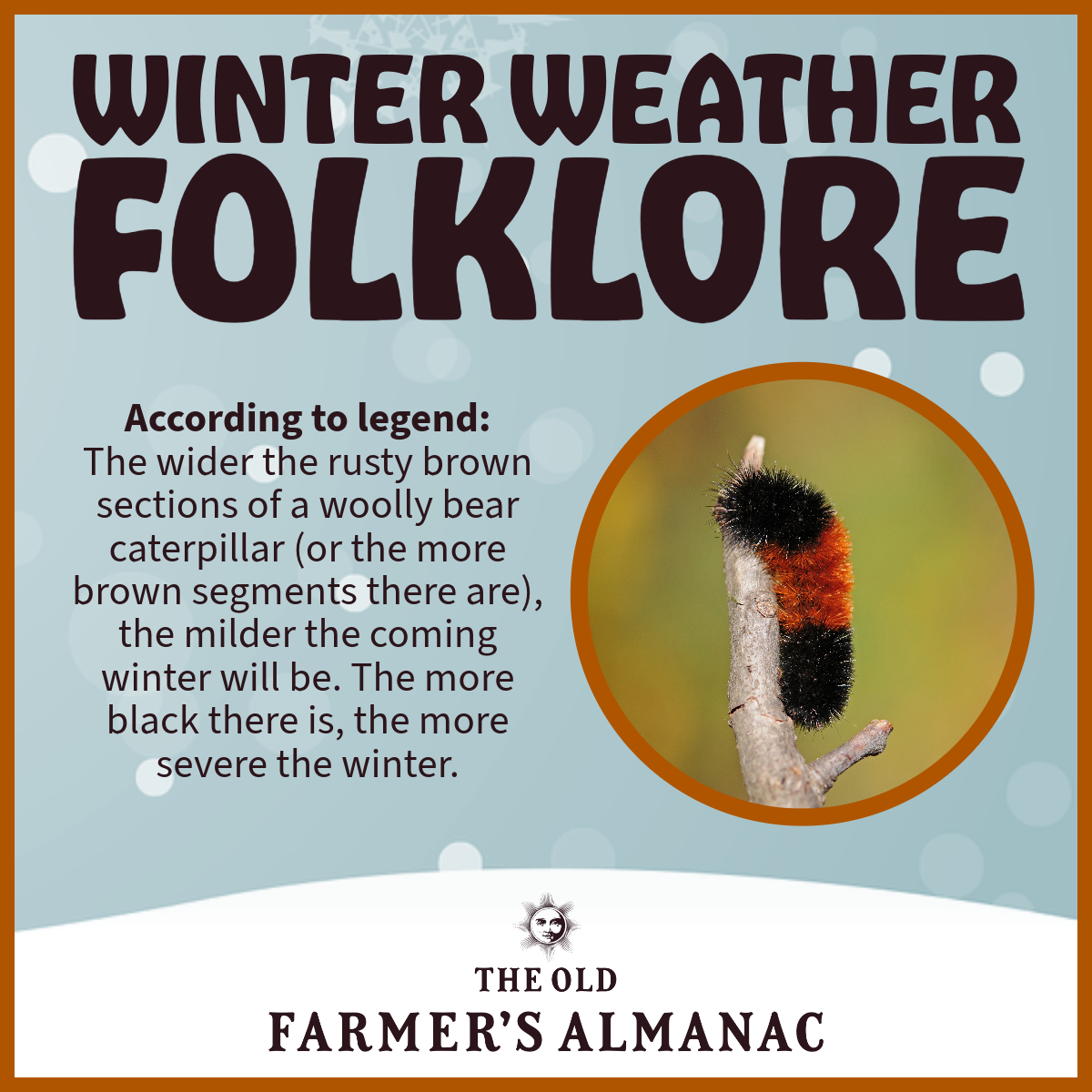
The woolly bear caterpillar has long been associated with winter weather. According to folklore, the woolly bear’s 13 body segments represent the 13 weeks of winter. Here’s how to read its colors:
The wider the rusty brown sections (or the more brown segments there are), the milder the coming winter will be. The more black there is, the more severe the winter.
Love weather lore? Read about more signs of a hard winter.
Can Woolly Bears Really Predict Winter Weather?
That’s part of the fun of woolly bear folklore! Their colors aren’t a proven way to forecast winter, but one entomologist decided to put the legend to the test.
Between 1948 and 1956, Dr. C. H. Curran counted the rusty-brown segments on woolly bears. His counts suggested milder winters—and lo and behold, the winters that followed were milder than average! Still, Curran knew his samples were small. He was having fun with an old tradition, not claiming a scientific breakthrough.
Try Your Own Woolly Bear Winter Forecast!
Spotted a woolly bear? Take a look at its black and rusty-brown bands and make your own winter prediction! Do your fuzzy forecaster’s predictions match the Almanac’s winter outlook?
Watch a woolly bear in action in this short video!
Whether it’s fact or folklore, we always enjoy the fun! Share what your local woolly bears are predicting in the comments below.
Frequently Asked Questions
-
Is a woolly bear the same as a woolly worm?
Yes! “Woolly bear” and “woolly worm” are both common names for the black and brown banded fuzzy caterpillar that becomes the Isabella tiger moth. You may also see them written as “wooly bear” or “wooly worm,” with one “l.” Despite the nickname, it’s a caterpillar, not a worm.
-
What do woolly bear caterpillars eat?
Woolly bear caterpillars eat the leaves of low-growing plants—think dandelions, plantain, dock, asters, goldenrod, and even some grasses. -
Are woolly bear caterpillars poisonous or safe to touch?
No, woolly bear caterpillars aren’t poisonous or venomous. They don’t sting, but their bristly hairs can irritate sensitive skin. The safest bet is to enjoy watching them without picking them up. -
Where do woolly bear caterpillars live?
Woolly bear caterpillars live all over North America—from the United States and Canada down to Mexico. Look for them around grasses and weeds. When fall rolls around, you might spot them seeking shelter under bark, rocks, logs, or a cozy pile of leaves to ride out the winter. -
What do woolly bear caterpillars turn into?
Woolly bear caterpillars become Isabella tiger moths (Pyrrharctia isabella), with cream and yellow-orange wings spotted with black. After spending winter as caterpillars, they spin cocoons in spring and emerge as moths.
Sources
- National Weather Service — Woolly Bear Caterpillar - Winter Predictor Or Not?
- Iowa Department of Natural Resources — Winter Is Coming: Can the Woolly Bear Predict It?

More Like This


- « Previous
- 1
- 2
- …
- 10
- Next »

Comments