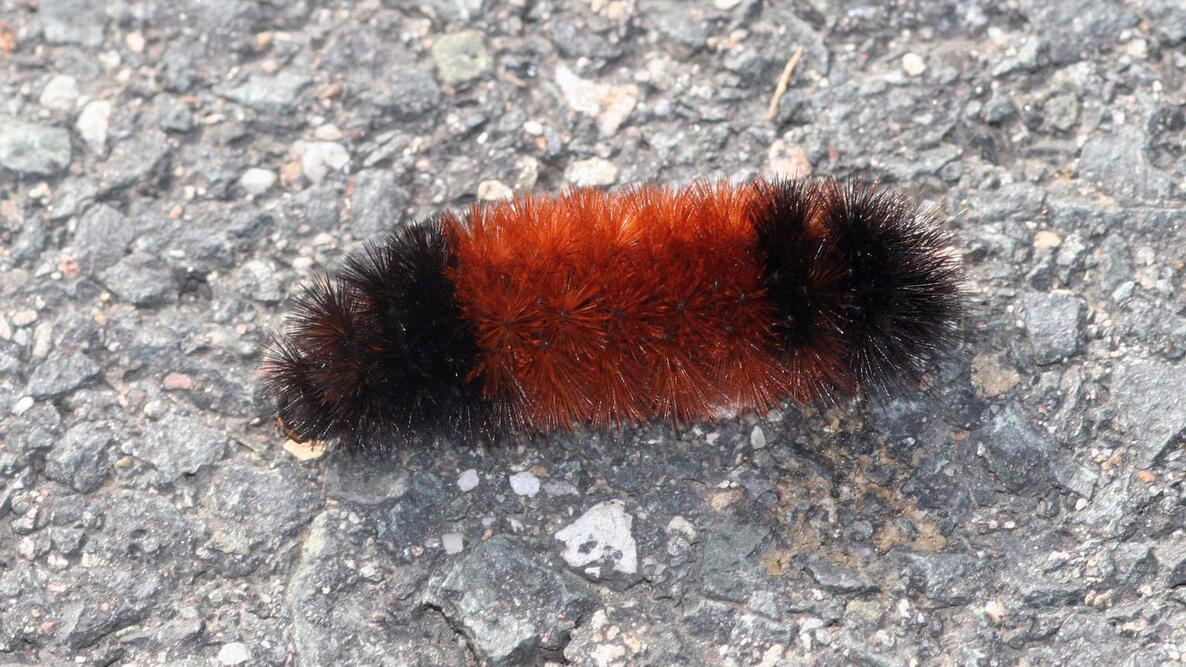
Caption
Based on the measurements of the distinctive woolly bear caterpillar, you can figure out your weather forecast!
Woolly bear caterpillars—also called woolly worms—have long been said to predict winter weather. The wider the rusty brown band on their body, the milder the winter. More black? A harsher season may be ahead.
But how much truth is there behind this folklore? Learn more about this legendary caterpillar and how to “read” the worm!
The Legend of the Woolly Worm
The woolly worm has long been associated with winter weather. According to legend:
The wider the rusty brown sections (or the more brown segments there are), the milder the coming winter will be. The more black there is, the more severe the winter.
Love weather lore? Read about more signs of a hard winter.
What do you think they’re predicting for the winter? Do their fuzzy forecasts match the Almanac’s winter outlook? We’ll leave the weather-prognosticating “skills” to your observation!
What is a Woolly Worm?
First of all, the “woolly worm” is not a worm at all! It’s a caterpillar, specifically, the larva of the Isabella tiger moth (Pyrrharctia isabella). Nonetheless, the name “worm” has stuck in some parts of the United States. In others, such as New England and the Midwest, people call them “woolly bears.” (Worm or not, at least we can all agree that they’re not bears!)
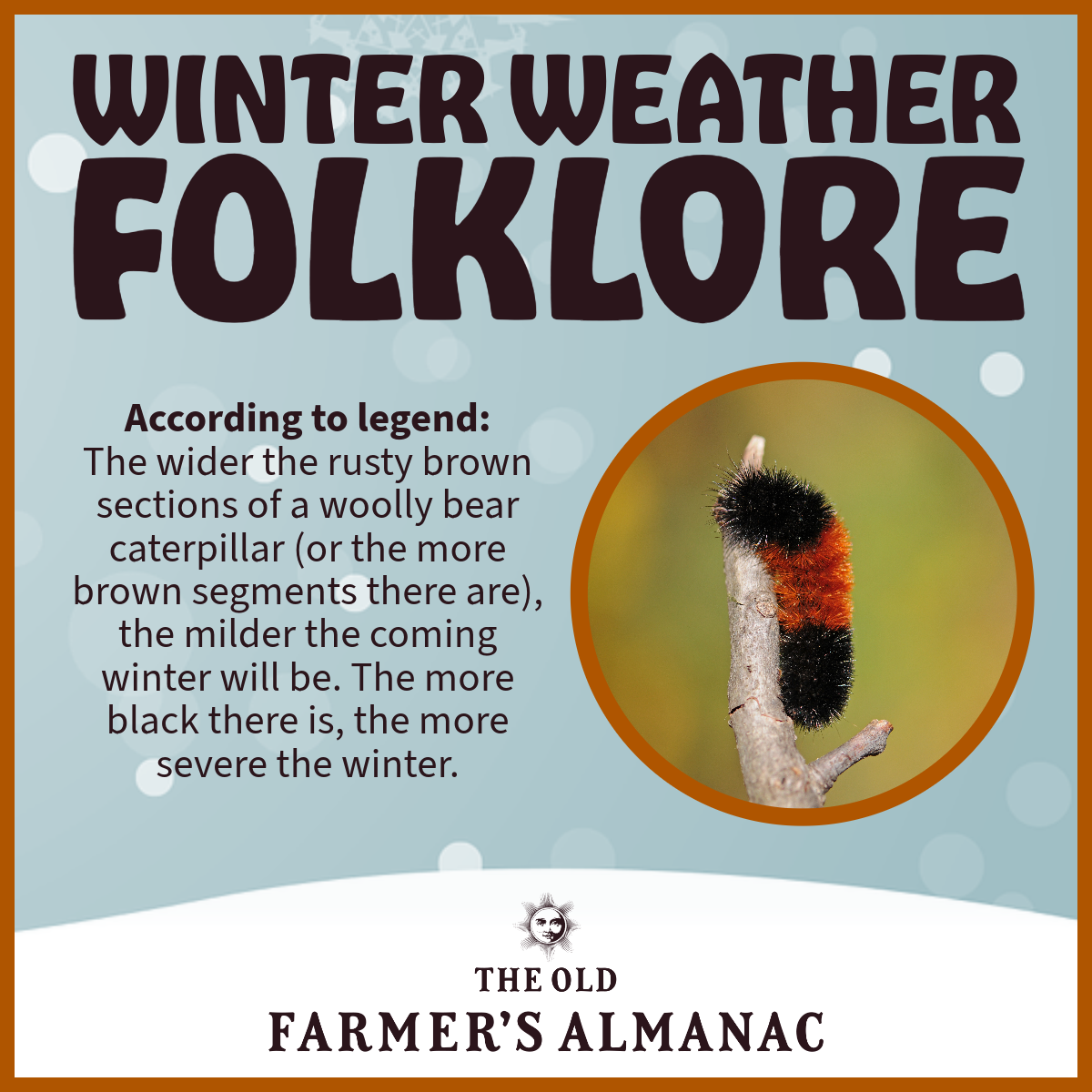
In terms of appearance, the caterpillar has 13 distinct segments, either rusty brown or black. It is often black on both ends with rust-colored segments in the middle, although it may sometimes be mostly black or rusty. (Note: All-black, all-white, or yellow woolly caterpillars are not woolly bears! They are different species and not part of the woolly worm lore. So, if you spot an entirely black caterpillar, it isn’t forecasting an apocalyptic winter!)
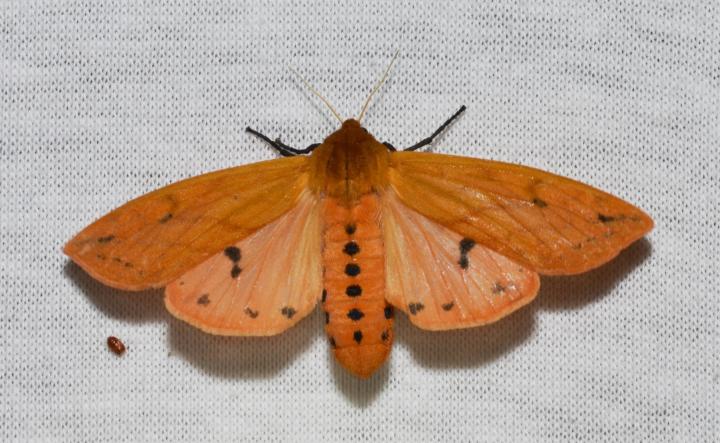
Mature woolly bears search for overwintering sites under bark or logs, often crossing roads in the fall. In spring, they spin cocoons and emerge as beautiful Isabella moths with yellow-orange and cream wings spotted with black.
How the Woolly Bear Caterpillar Became “Famous”
In the fall of 1948, Dr. C. H. Curran, curator of insects at the American Museum of Natural History in New York City, took his wife 40 miles north of the city to Bear Mountain State Park to look at woolly bear caterpillars.
Curran collected as many caterpillars as he could in a day, determined the average number of reddish-brown segments, and forecasted the coming winter weather through a reporter friend at The New York Herald Tribune.
Curran’s experiment, which he continued over the next 8 years, attempted to prove scientifically a weather rule of thumb that was as old as the hills around Bear Mountain. The resulting publicity made the woolly worm one of the most recognizable caterpillars in North America (alongside the monarch caterpillar and tomato hornworm).
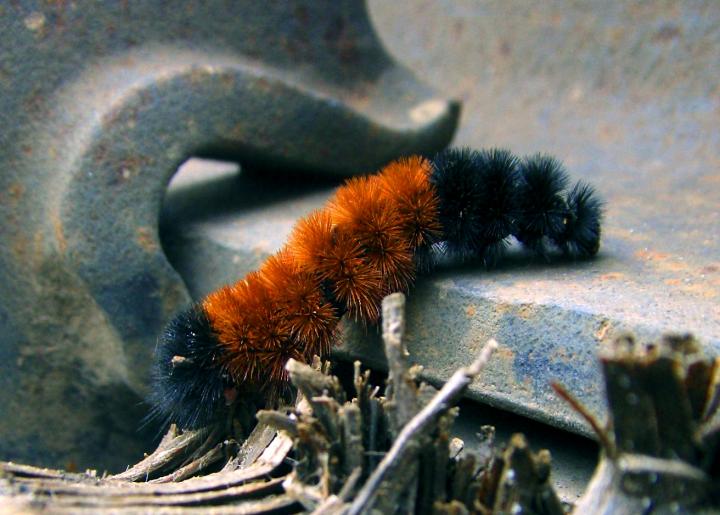
Between 1948 and 1956, Curran’s average brown-segment counts ranged from 5.3 to 5.6 out of the 13-segment total, meaning that the brown band took up more than a third of the woolly bear’s body.
The corresponding winters were milder than average, and Curran concluded that the folklore has some merit and might be true.
But Curran was under no scientific illusion: He knew his data samples were small. Although the experiments legitimized folklore to some, they were simply an excuse for having fun. Curran, his wife, and their group of friends escaped the city to see the foliage each fall, calling themselves The Original Society of the Friends of the Woolly Bear.
Most scientists discount the folklore of woolly bear predictions as just that—folklore. Doug Ferguson, who served as an entomologist at the National Museum of Natural History, once said, “I’ve never taken the notion very seriously. You’d have to look at an awful lot of caterpillars in one place over a great many years in order to say there’s something to it.”
Mike Peters, who spent more than 30 years teaching entomology at the University of Massachusetts, didn’t disagree, but he once said there could, in fact, be a link between winter severity and the brown band of a woolly bear caterpillar. “There’s evidence,” Peters said during his UMass tenure, “that the number of brown hairs has to do with the age of the caterpillar—in other words, how late it got going in the spring. The [band] does say something about a heavy winter or an early spring. The only thing is … it’s telling you about the previous year.”
Woolly Worm Festivals
Thirty years after the last meeting of Curran’s society, the woolly bear brown-segment counts and winter forecasts were resurrected by the nature museum at Bear Mountain State Park. Since then, the annual counts have continued, more or less tongue-in-cheek.
For over 40 years, Banner Elk, North Carolina, has held an annual Woolly Worm Festival in October, highlighted by a caterpillar race. Retired mayor Charles Von Canon inspects the champion woolly bear and announces his winter forecast. Similarly, there is a Woollybear Festival that takes place in Vermilion, Ohio, each October.
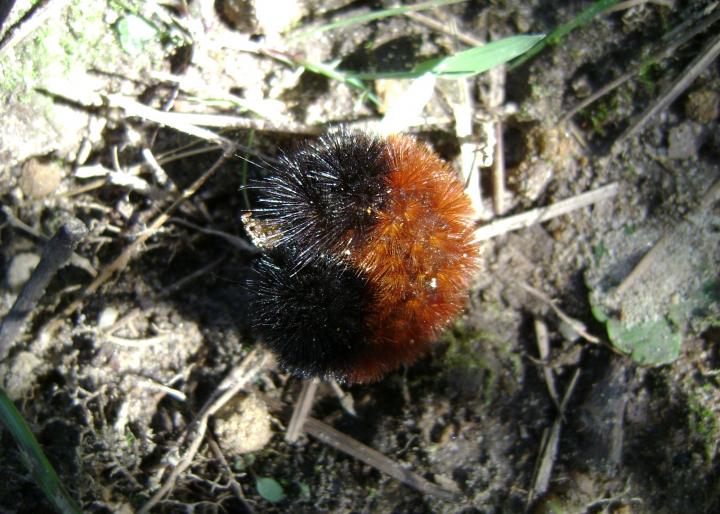
Every year, the woolly worms look different—and it depends on their region. So, if you come across a local woolly worm, observe the colors of the bands and what they foretell about your winter weather. Remember:
If the rusty band is wide, it will be a mild winter. The more black there is, the more severe the winter.
Speaking of Weather Predictions …
Did You Know: The 2027 is Old Farmer’s Almanac is now available! The brand-new issue includes our famous 2027 Winter Weather Forecast.
Get your copy of the 2027 Almanac, where books and magazines are sold, or you can now order straight from Amazon to your home.
Woolly Worm Video
In tribute to our fellow prognosticator, we made a woolly worm video …
Whether the predictive powers of the woolly worm are fact or folklore, we always enjoy the fun! Feel free to share your experience with the woolly worm in the comments below.
Sources
- National Weather Service — Woolly Bear Caterpillar - Winter Predictor Or Not?

More Like This

- « Previous
- 1
- 2
- …
- 10
- Next »

Comments