
The Harvest Moon relates to the timing of the autumnal equinox, so it changes each year. In 2026, look for the brilliant Harvest Moon on and around September 26. Why does this phenomenon happen? Learn more—and shine on Harvest Moon!
When Is the Harvest Moon 2026?
In 2026, the brilliant Full Harvest Moon is on Saturday, the 26th of September, reaching full illumination at 12:49 P.M. It will appear full for 3 days so start looking early if the weather is clear!
Note that the Harvest Moon is not always in the same month. It’s the Full Moon that occurs nearest to the autumnal equinox. Usually, as with 2026, it’s the September Full Moon, but occasionally it’s in October, depending on how the lunar cycle aligns with the Gregorian calendar.
In addition, the Harvest Moon is an astronomical event that astronomers have long recognized, and it’s not associated with traditional folklore and Native American Moon names that are used to track the lunar months.
The Harvest Moon typically occurs in September, replacing the Full Corn Moon. However, it occasionally lands in October, replacing the Full Hunter’s Moon.
What Is the Harvest Moon?
For several evenings, the Moon rises very soon after the Sun sets, resulting in an abundance of bright moonlight early in the evening. Traditionally, this extra light aided farmers and crews in harvesting their summer-grown crops. Hence, it’s called the “Harvest” Moon!
On average, there are just a little over 12 complete Moon cycles every year (about 29.53 days in a synodic month). The Harvest Moon isn’t like the other Moons.
- Usually, throughout the year, the Moon rises an average of about 50 minutes later each day.
- However, for the few nights around the Harvest Moon, the Moon seems to rise at nearly the same time: just 25 to 30 minutes later across the northern U.S. and only 10 to 20 minutes later farther north in Canada and Europe.
Additionally, the Harvest Moon rises at sunset and will rise about 30 minutes later for several nights. It may almost seem like there are Full Moons multiple nights in a row!

More About the Harvest Moon
If interested, here is more detailed information about the Harvest Moon. (Warning: Scientific explanation below!)
The Moon’s orbital motion (combined with the larger orbit of the Earth around the Sun) carries it farther eastward among the zodiac constellations from night to night. At any one moonrise, the Moon occupies a particular place on the celestial sphere (the great dome of the heavens). Still, when the Earth turns toward that point 24 hours later, the Moon has moved off to the east about 12 degrees, and it takes an average of 50 minutes longer for the Earth to rotate toward the Moon and for the Moon thus to “rise.” Think of it as a giant Slinky in which each loop, representing one lunar orbit of the Earth, advances the orbit a bit farther along the spiral path. The result of all this is that the Moon doesn’t rise at the same time every day.
However, around the date of the Harvest Moon, the Moon rises at about the same time for several days in a row. Why? Remember that the zodiac is the band of constellations through which the Moon travels from night to night. The section of the zodiac band in which the Full Moon travels around the start of autumn is the section that forms the most shallow angle with the eastern horizon. Because the Moon’s orbit on successive nights is more nearly parallel to the horizon at that time, its relationship to the eastern horizon does not change appreciably, and the Earth does not have to turn as far to bring up the Moon.
The Moon may rise as little as 23 minutes later on several nights before and after the Full Harvest Moon (at about 42 degrees north latitude), which means extra light at peak harvest time near autumn. By the time the Moon has reached the last quarter, however, the typical 50-minute delay has returned.
At the start of spring, the opposite applies. The Full Moon is in the section of the zodiac that has the steepest angle with respect to the eastern horizon. For several days bracketing the Full Moon nearest the vernal equinox, the delay in moonrise is as much as 75 minutes (at 42 degrees north latitude).
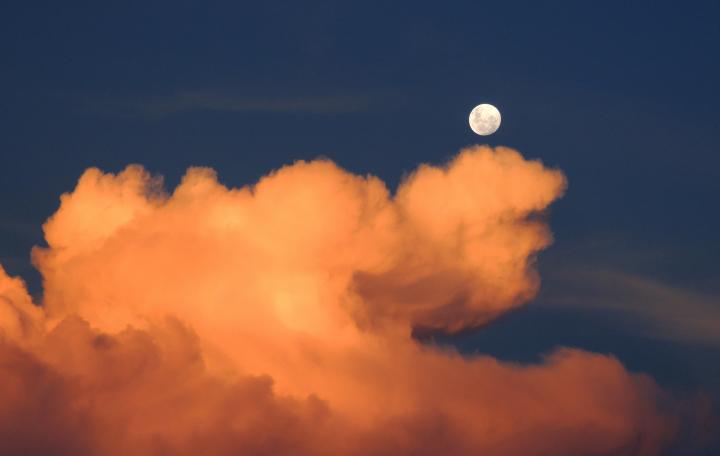
Here is another way of expressing what happens with the Harvest Moon: It is in this part of the zodiac that the Moon’s eastward (orbital) motion has its largest northward component. For observers in Earth’s Northern Hemisphere, the farther north an object is in the heavens, the longer an arc it makes across the sky, and the longer a time it is visible above the horizon. Thus, to say that the Moon is getting rapidly farther north each night around the time of the Harvest Moon is to say that, for northern latitudes on Earth, it will keep rising distinctly earlier than would otherwise be expected—nearly the same time as the night before.
How nearly the same is “almost the same time” each night? This varies with latitude; the farther north you are, the shallower the angle of the zodiac is with respect to your horizon. In most of the United States and southern Canada, the Harvest Moon rises 25 to 30 minutes later each night. The effect is less noticeable the farther south you go. But going north makes the Harvest Moon more extreme.
According to astronomy author Guy Ottewell, the idea of the Harvest Moon originated in Europe (average latitude of about 50 degrees north), where the Harvest Moon rises only 10 to 20 minutes later each night. It must have seemed a boon that just when days were getting rapidly shorter, and the Sun seemed to go down all too soon, the Harvest Moon arrived to extend the hours that harvesting could be done.

Chinese Harvest Moon Traditions
As a final note, I should add that it is not just Western civilization that has given special importance to the Harvest Moon. For Chinese people, this Full Moon is the occasion for the Festival of the August Moon (the “August” is through a calendar discrepancy) or Mid-Autumn Festival (in some cultures, the equinoxes and solstices have been considered the middle of the seasons). This festival is celebrated with joyful games and the eating of “Mooncakes.” Read more about how other countries celebrate the Harvest Moon.
I vividly remember being invited to one such celebration, where I sang songs and played my guitar to a circle of friendly faces by the light of the rising Harvest Moon!
Find out the dates of the next Full Moon.

More Like This


Ed,
Thank you for reading our almanac! We're happy to hear that you've enjoyed its contents. That warning was our tongue-in-cheek attempt at humor!
- « Previous
- 1
- 2
- …
- 10
- Next »

Comments