This year offers some of the easiest and most beautiful skywatching moments in recent memory. Dark skies for the two biggest meteor showers, plus Moon meet‑ups, lunar eclipses, and a Christmas Supermoon, make 2026 a year anyone can enjoy. No telescope, no experience — just step outside and look up. Here are the most noteworthy sky events to watch for in 2026.
1. Moon Near Regulus: February 2, 2026
During the evening hours
Ready to spot a bright winter star? After sunset, look low in the eastern sky for the Moon. Nearby, you’ll see Regulus, a bright, slightly bluish star.
As the evening goes on, the Moon and Regulus will rise higher together, staying close all night. The Moon’s glow may make Regulus look a little fainter, but the pairing is still easy to see with the naked eye.
For experienced observers: In many parts of North America, the Moon will briefly pass in front of Regulus in an event called an occultation. This is subtle and best seen with binoculars or a small telescope.

Credit: Joe Rao using Starry Night Pro 8.0 (Simulation Curriculum).
2. Moon Meets Mercury: February 18–20, 2026
Shortly after sunset
Wednesday, February 18
Ready for a rare chance to spot Mercury—the tiny planet closest to the Sun? Tonight, the Moon sits unusually close to Mercury, making the planet easier to find than usual.
About 45 minutes after sunset, look low in the western sky for a thin crescent Moon. Just above the Moon, Mercury shines like a bright star. Mercury is usually hard to see because it stays close to the Sun’s glare, but tonight the Moon acts as a helpful guide.

Credit: Joe Rao using Starry Night Pro 8.0 (Simulation Curriculum).
Thursday, February 19
Look again after sunset for the crescent Moon in the west. Tonight, the Moon sits next to Saturn, about two finger-widths apart at arm’s length. Just above them, you’ll find Mercury.
This is a great night to look because Mercury is at its greatest eastern elongation—the point when it appears farthest from the Sun in the evening sky, making it higher and easier to see than usual.

Friday, February 20
Tonight is Mercury’s best evening appearance of this stretch. About 45 minutes after sunset, look low in the western sky. Mercury will be higher than it’s been all week, shining above Saturn and the thin crescent Moon.
If you found Mercury on Wednesday or Thursday, tonight it will be even easier to spot.
For more experienced observers: In parts of the southern United States, the Moon will pass extremely close to Mercury around 7:37 P.M. EST / 6:37 P.M. CST, a subtle event best viewed with binoculars against the twilight sky.
3. A Total Eclipse of the Moon: March 3, 2026
Early morning, before sunrise
Ready to watch the Full Moon slowly darken and turn red? Set an alarm and look west in the early morning hours. As the Moon moves into Earth’s shadow, it will fade from bright white to a deep, coppery glow.
The fully eclipsed phase, called totality, lasts nearly an hour. Totality begins at 6:03 A.M. EST (3:03 A.M. PST), when the Moon is completely inside Earth’s central shadow.
Skywatchers across the western half of the U.S. can see the entire eclipse from start to finish. Along the East Coast, the Moon will set while the eclipse is still underway, creating a dramatic view of an eclipsed Moon sinking toward the horizon.
This is the last total lunar eclipse visible from the contiguous U.S. and most of southern Canada until June 2029.
Curious why the eclipsed Moon turns red? Learn more about what a “Blood Moon” is—and isn’t: What Is a Blood Moon?
Want to learn more? Read our complete guide to seeing a total lunar eclipse.

4. A Brilliant “Double Planet”: June 9, 2026
Shortly after sunset
Venus and Jupiter come together tonight in a striking close pairing—appearing as a brilliant “double planet.” Shortly after sunset, look low in the west-northwest as the sky begins to darken.
Start by finding Venus, the brightest object in the evening sky. Just below it, you’ll see Jupiter shining almost as brightly. The Moon isn’t out this evening—it rises after midnight—so the planets really stand out.
To the right of Venus and Jupiter, you’ll spot Pollux and Castor, the brightest stars of Gemini. Very low on the horizon, Mercury may also be visible in the fading twilight for observers with a clear view.
Curious how bright these objects are compared to one another? Try our Bright Star Calculator.

5. The Perseid Meteor Shower Peaks: August 12–13, 2026
Late night into early morning
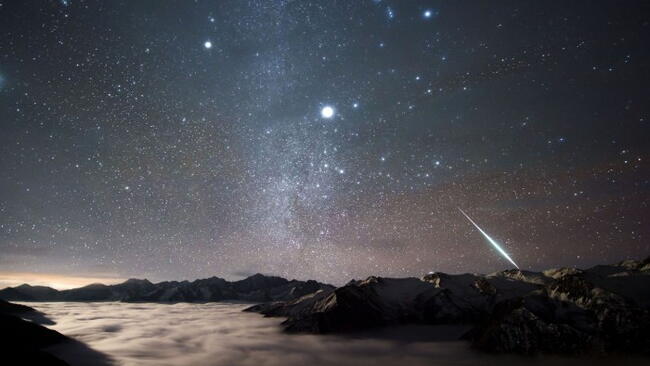
It’s a great year to watch the famous Perseids. A thin crescent Moon sets early on August 12, leaving the sky darker for the best viewing after midnight and into the early morning of August 13. Under these conditions, you could see 60 to 100 meteors per hour in a truly dark sky.
For the best views, get away from bright lights. Look high overhead, and also toward the northeast (where the shower’s “radiant” is located). The meteors can appear anywhere in the sky, so the wider your view, the better.
These “shooting stars” are tiny bits of debris left behind by Comet Swift-Tuttle. Every August, Earth passes through the comet’s dust trail, and the particles burn up in our atmosphere as quick streaks of light.
For more tips and timing details, see our full guide: Perseid Meteor Shower 2026: When and How to Watch.

Also on August 12
A partial solar eclipse will be visible from parts of the northern United States and Canada. This is a very subtle event—you won’t notice a change in daylight as you would during a total solar eclipse. (Learn more about the difference between partial and total solar eclipses.)
Use proper eye protection at all times. With approved eclipse glasses or a solar filter, you may see the Moon take a noticeable “bite” out of the Sun around 1:45 P.M. EDT, depending on your location.
6. An “Almost” Total Lunar Eclipse: August 27–28, 2026
Around midnight
This is a deep partial lunar eclipse—so deep it will look almost like a total one. At the peak of the eclipse, about 93% of the Full Moon will slip into Earth’s shadow at 12:12 A.M. EDT on August 28. Most of the Moon will glow a coppery red, while a thin upper edge remains bright.
Look around midnight to see the eclipse at its deepest. Much of North America will have a good view. In the Pacific Northwest, Alaska, and Hawaii, the eclipse will already be underway as the Moon rises on the evening of August 27.

7. Moon Near Jupiter: October 6, 2026
Before sunrise
The Moon and Jupiter rise unusually close together, creating one of the year’s easiest sky sights. The Moon sits right beside Jupiter, which is extremely bright in early October 2026—brighter than any planet or star in the pre‑dawn sky. It’s a simple, beautiful pairing for beginners.
Look to the east before dawn to catch the pair in the morning sky. No telescope is needed to enjoy the view. Check your local sunrise and twilight times with our Sunrise Calculator.
For experienced observers: In central and eastern North America, the Moon will pass in front of Jupiter in a rare dark-sky occultation, best seen with binoculars. Much of the region gets a true ringside seat. In the West, the occultation occurs before moonrise.

Credit: Joe Rao using Starry Night Pro 8.0 (Simulation Curriculum).
8. A Gathering of the Moon, Venus, and Spica: November 7, 2026
Before dawn
The Moon and Venus gather with a bright bluish star in a tight grouping this morning. That star is Spica, the brightest star in the constellation Virgo. All three sit low in the east-southeast before dawn, fitting into a small patch of sky—just a couple of fingertips wide at arm’s length.
The light from Spica has taken about 250 years to reach us, meaning you’re seeing it as it appeared around the time the Declaration of Independence was signed. For 2026, it’s fitting to think of Spica as “America’s star.”

Credit: Joe Rao using Starry Night Pro 8.0 (Simulation Curriculum).
9. A ‘Gem’ of a Meteor Shower: December 13-14, 2026
Early morning
In 2026, conditions for the famous Geminid meteor shower are outstanding. A thin crescent Moon sets shortly after sunset, leaving skies dark for the rest of the night—ideal for this reliable December display.
Under truly dark skies, observers could see up to 120 slow, graceful shooting stars per hour, ranging from faint streaks to bright meteors and occasional fireballs. While the official peak occurs around 2 a.m., the Geminids are an evening-friendly shower. You can catch plenty of activity before midnight, and in 2026, the sky will already be beautifully dark early on.
Astrophotographer Dr. Eliot Herman captured the brilliant Geminid fireball shown below. Reflecting on the night, he said, “The 2017 Geminids were the meteor shower of my lifetime. Everything lined up just right, and I saw five fireballs in a single hour. This one was the best of them all. It was epic.”

10. A Pre-Christmas Supermoon: December 23, 2026
At moonrise
This is the year the Christmas-card sky comes true. The Moon turns full at 8:28 P.M. EST (5:28 A.M. PST) on December 23—the night before Christmas Eve—and it will rise looking big, bright, and beautifully round.
Because this Full Moon closely coincides with perigee, its closest approach to Earth, it will be the largest Full Moon of the year, coming within 221,612 miles of Earth. That added closeness makes the Moon appear noticeably larger in the sky—an effect often nicknamed a “Supermoon.”

And just like in holiday illustrations, the Moon will look full for a couple of nights both before and after December 23. It’s easy to imagine Santa and his sleigh crossing a bright December Moon—a beautiful way to end the year beneath the night sky.



Comments