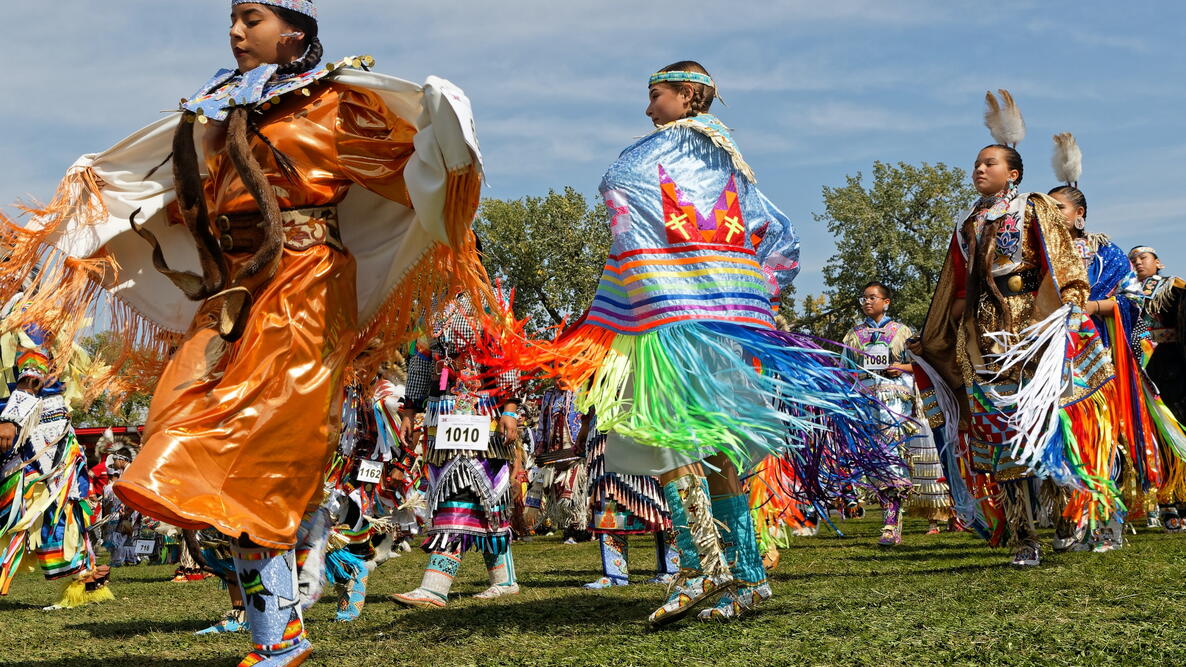
Caption
Dancers celebrate at the 49th annual United Tribes Pow Wow in Bismark, ND, in 2018.
Indigenous Peoples’ Day occurs on the second Monday in October in many parts of the United States. In 2026, it is observed on Monday, October 12. What is Indigenous Peoples’ Day? Why is it celebrated on the same day as Columbus Day? Here is a bit more information about the holiday and its history.
What Is Indigenous Peoples’ Day?
Indigenous Peoples’ Day honors the histories, cultures, and ongoing contributions of Indigenous peoples. It recognizes Native peoples as the original inhabitants of the Americas and celebrates the diverse Tribal Nations and communities that continue to shape life today. This day promotes awareness of Indigenous peoples’ struggles, resilience, and unique traditions, fostering understanding and unity among diverse cultures.
When Is Indigenous Peoples’ Day?
Indigenous Peoples’ Day is celebrated annually on the second Monday in October. In 2026, it will be observed on Monday, October 12.
| Year | Date |
|---|---|
| 2026 | Monday, October 12 |
| 2027 | Monday, October 11 |
| 2028 | Monday, October 9 |
| 2029 | Monday, October 8 |
Canadians observe a similar holiday, National Indigenous Peoples Day, on June 21 each year.
A Brief History of Indigenous Peoples’ Day
Dr. Arthur Caswell Parker, a member of the Seneca Nation, was the director of the Rochester Museum of Arts and Science (now the Rochester Museum & Science Center) from 1924 to 1945 and an early proponent of establishing a day to honor Indigenous peoples. He convinced the Boy Scouts of America to observe a day for “First Americans” from 1912 to 1915.
In 1914, Rev. Red Fox James, now presumed to be a member of the Blackfeet Nation, campaigned for a national holiday to honor Indigenous peoples, traveling more than 4,000 miles on horseback to seek support from state governors. On December 14, 1915, he presented endorsements from 24 governors to President Woodrow Wilson at the White House.
Also, in 1915, the president of the American Indian Association declared “American Indian Day” on the second Saturday of May each year. New York was one of the first states to officially proclaim this observance on May 13, 1916. Other states celebrate on the fourth Friday in September.
In 1977, during the United Nations International NGO Conference on Discrimination Against Indigenous Populations in the Americas, an “International Day of Solidarity with the Indigenous Peoples of the Americas,” to be observed on October 12, was proposed.
In 1990, South Dakota became the first state to replace Columbus Day (the second Monday in October) with Native Americans’ Day as an official state holiday.
In 1992, Berkeley, California, became the first city to officially observe Indigenous Peoples’ Day. This coincided with the 500th anniversary of Christopher Columbus’s arrival in the Americas in 1492.
Is Indigenous Peoples’ Day a Federal Holiday?
Indigenous Peoples’ Day is not a U.S. federal holiday. It has been recognized through presidential proclamations and is observed by various state and local governments. Columbus Day remains the federal holiday on the second Monday in October.
A growing list of state and local governments have acknowledged it in some form as well, including those of Alabama (American Indian Heritage Day), Alaska, California, Hawaii (Discoverers’ Day, to honor Polynesian discoverers of the Hawaiian Islands), Idaho, Iowa, Maine, Michigan, Minnesota, New Mexico, Oregon, South Dakota (Native Americans’ Day), Texas (Indigenous Peoples’ Week), Vermont, Virginia, and Wisconsin, among others.
Where Indigenous Peoples’ Day is officially acknowledged, it is often celebrated in place of or alongside Columbus Day. This is in recognition of the disease, genocide, and slavery brought to the Americas through the interactions of Columbus and other European explorers with Indigenous peoples. In addition, the arrival of European explorers and settlers also meant that Indigenous peoples increasingly lost access to their ancestral lands and natural resources, which significantly impacted their ability to practice aspects of their cultures and traditions.
How to Celebrate Indigenous Peoples’ Day
- Learn more about the land you live in and its Indigenous peoples’ history.
If you’re unfamiliar with the Indigenous peoples who live or have lived in your area, there are plenty of online tools available to help you easily learn more. A good place to start is this site’s map that outlines an approximation of the Indigenous territories in North America. - Attend an Indigenous Peoples’ Day celebration.
Check locally to see if there are any celebrations that you can attend in person. There are also numerous opportunities to experience the cultures and perspectives of Indigenous peoples online, including virtual powwows, workshops, and podcasts. - Learn about native plants and their traditional uses.
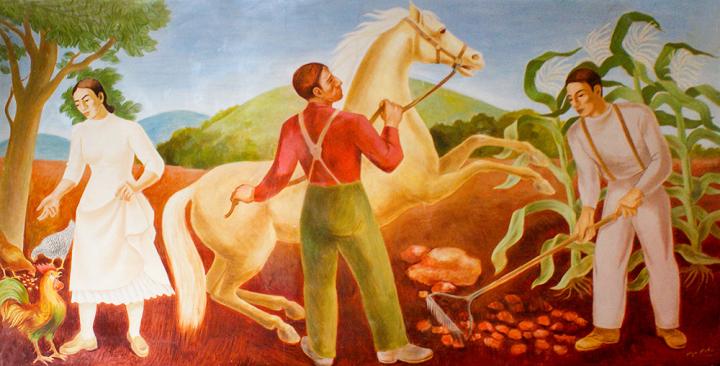
Plants that are native to a particular area or region support healthy ecosystems and habitats for insects, birds, and other wildlife. Indigenous peoples’ traditional gardening techniques—such as the well-known Three Sisters method—were used to cultivate native plants for medicine and food. - Visit a museum that recognizes Indigenous history.
There are a number of museums across North America that include or focus on the perspectives, history, and/or art of Indigenous peoples. Some of these include the National Museum of the American Indian (Washington, DC; New York City, NY), Burke Museum (Seattle, WA), Sen. John Heinz History Center (Pittsburgh, PA), The Journey Museum and Learning Center (Rapid City, SD), Heard Museum (Phoenix, AZ) and the Museum of Native American History (Bentonville, AR), among others.
Frequently Asked Questions
-
When is Indigenous Peoples’ Day in 2026?
Indigenous Peoples’ Day falls on Monday, October 12, 2026. In many parts of the United States, it is observed on the second Monday in October, on the same date as Columbus Day.
-
Is Indigenous Peoples’ Day a federal holiday?
Indigenous Peoples’ Day is not a U.S. federal holiday, although it has been recognized through presidential proclamations. Columbus Day remains the holiday listed on the federal calendar for the second Monday in October.
-
Does Indigenous Peoples’ Day replace Columbus Day everywhere?
No. Some state and local governments observe Indigenous Peoples’ Day in place of Columbus Day, while others recognize both or use another name. Observance varies by location.
-
Are schools and businesses closed on Indigenous Peoples’ Day?
Closures vary by school district, employer, and location. Recognition of Indigenous Peoples’ Day does not automatically mean a day off. Check your school calendar or the organization’s posted holiday hours.
-
Is Indigenous Peoples’ Day the same as Native American Heritage Month?
No. Indigenous Peoples’ Day is an October observance, while National Native American Heritage Month takes place throughout November. Both offer opportunities to learn about Indigenous histories, cultures, and ongoing contributions.
-
Does Canada celebrate Indigenous Peoples’ Day?
Canada observes National Indigenous Peoples Day on June 21 each year. It celebrates the histories, cultures, and contributions of First Nations, Inuit, and Métis peoples and is a separate observance from the U.S. October holiday.

More Like This

Comments