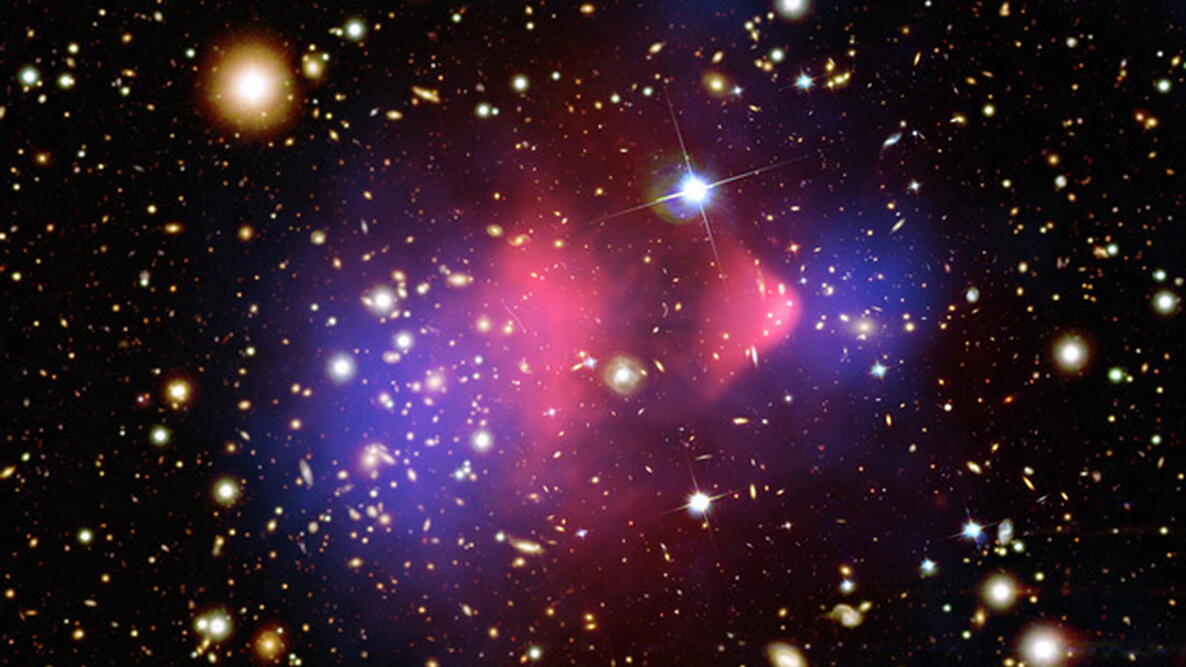
In 1933, astronomers discovered something shocking—most of the universe was missing. Not missing as in lost, but invisible. Today, scientists believe that about 85% of the universe is made of dark matter, a mysterious substance that cannot be seen but holds galaxies together. So what exactly is dark matter, and how do we know it exists?
The Discovery of Dark Matter
Dark matter was coined by the famous Swiss physicist Fritz Zwicky. He worked most of his life at the California Institute of Technology in the U.S. It was he who first used the term “supernova.” He was such a heavy hitter that everyone paid attention when his gigantic brain went boing.
It did exactly that in 1933 when he studied speeds in a group or cluster of galaxies. What he perceived was astonishing. Each galaxy member moved so quickly; it should have no problem escaping the gravitational glue of the entire cluster. Why were they clumped together? Zwicky figured out they’re held together by gravity due to what he called Dunkle Materie—translated as “dark matter”—between the galaxies.
What is Dark Matter?
First, understand that the term “dark” simply means it’s not visible like the planets, stars, comets, asteroids, gas clouds, and other objects that we see. Only 5% of the universe is made of visible matter.
Dark matter is not visible to us because it emits no radiation by which to observe it. It does not absorb or emit light. But clearly, not all matter has visible light or “luminosity.”
Dark Matter Quick Facts
- Makes up about 85% of the universe’s matter
- Cannot be seen or detected directly
- Discovered by Fritz Zwicky in 1933
- Detected through gravitational effects
- May be made of WIMPs (Weakly Interacting Massive Particles) or unknown particles
How Do We Know Dark Matter Exists?
So, how do we know that it exists? We “see” this matter by how it exerts gravitational forces on other astronomical objects and influences their motion. We know that more mass exists than what we can see for a universe our size and stability. Dark matter is believed to be part of the missing mass of our universe. This is why dark matter was initially called “missing matter.”
Why is this important? Understanding dark matter helps us better understand the formation of galaxies and what holds our galaxy together and doesn’t tear us apart. It also helps us understand the origin of the universe, how the universe expands, and other mysteries.
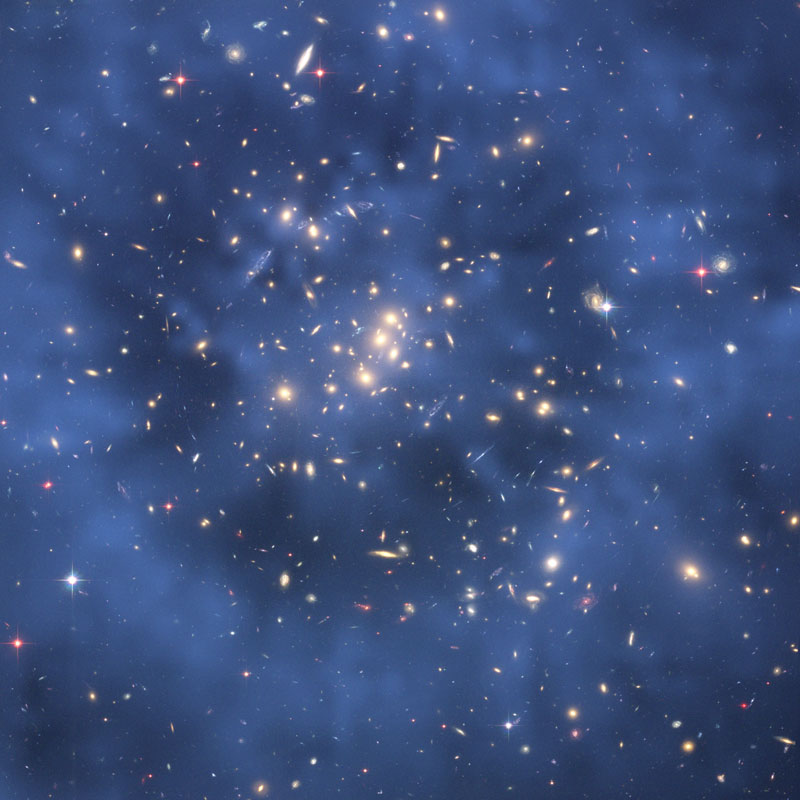
What Is Dark Matter Made Of?
Keep in mind that dark matter is a theory. As telescopes got bigger and we observed more of the universe, we realized that there’s far more gravity in the universe than can be accounted for. What’s creating it? What is this strange, unseen, powerful stuff?
| Theory | Explanation | Status |
|---|---|---|
| Dark Matter | Invisible particles create extra gravity | Most accepted |
| WIMPs | Hypothetical particles | Not yet detected |
| Modified Gravity | Gravity behaves differently at weak levels | Alternative theory |
WIMPs and Other Theories
Most astronomers assume dark matter consists of undiscovered particles created in the very early universe that weakly interact with planets, stars, our bodies, and ourselves. They call this WIMPS, for Weakly Interacting Massive Particles.

It’s not farfetched. The universe’s most common particle is the neutrino. Like WIMPs (which are a hypothesized class of particles to explain dark matter), neutrinos, too, are invisible. And neutrinos, too, are numerous, and barely influence normal matter. A trillion neutrinos pass through each of your fingernails every second. So, it’s not much of a stretch to imagine a kind of souped-up neutrino mostly dwelling in haloes around each galaxy. Meaning, galaxies are like ships in bottles, enclosed by dark, massive, unseen spheres.
Every few years, researchers think they’ve spied traces of WIMPS, but it’s never panned out.

Could Gravity Be Different Instead?
Then, almost 40 years ago, an Israeli physicist proposed an entirely different theory to the crazy galaxy motion problem. Instead of seeking missing mass that tugs at everything, he showed that we’d see the same thing if gravity itself behaves differently at weak levels. If there’s a lower limit on how wimpy gravity can become, then the motion of the universe makes sense without there needing to be any dark matter at all.
Frequently Asked Questions
What is dark matter in simple terms?
Dark matter is invisible matter that we cannot see but know exists because of its gravitational effects on galaxies and stars.
Who discovered dark matter?
Swiss physicist Fritz Zwicky first proposed dark matter in 1933 while studying galaxy clusters.
Is dark matter proven?
Dark matter is strongly supported by evidence, but scientists have not directly detected it yet.
What percentage of the universe is dark matter?
About 85% of the universe’s matter is believed to be dark matter.
Could dark matter be wrong?
Some scientists think gravity behaves differently instead of dark matter existing, but this remains debated.
So which is it? Weird gravity, or some unseen substance? Feel free to weigh in on the food fight between the two sides, which is likely to rage for years. Until then, we can only gaze into the night sky and wonder whether most of the cosmos is missing.








Cassiopeia is the small but distinct W in the sky!

Hi -- you mean 1933, right? Sorry I didn't make the chronology clear. I'll do it now. In the 1920s, we first discovered the speeds of external galaxies. In 1933, Zwicky showed that something about them didn't make sense. Since then, we've made periodic confirmations of this "dark matter."
Yes, you're right. As bad as "dark matter" is, which is an unseen pulling (gravity-like) force, there's also "dark energy", a mysterious unseen repelling force, which appears to constitute most of the cosmic inventory. Kind of humbling, to be ignorant of most of the universe.

Comments