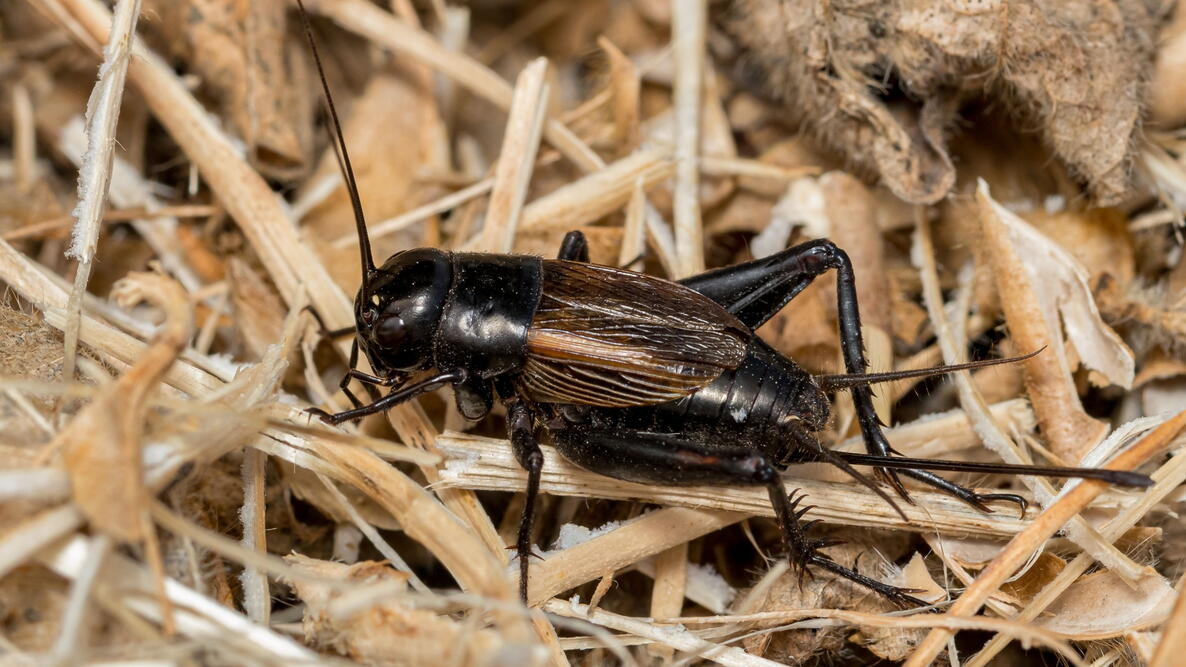
Do you know a cricket from a grasshopper—or how crickets sing? Crickets are fascinating insects, and they’re also a great (non-biting) insect for children to observe, especially in the classroom. Learn how crickets make their famous chirping sound, how to tell males from females, what they eat, how temperature affects their song, and more.
Studies show that our pets help improve our mood and lower blood pressure. And, strangely, this is even true of crickets! In many Asian countries, crickets are indeed a popular insect pet, and studies have shown crickets help the well-being of the elderly.
Fun Facts About Crickets
- Crickets, unlike grasshoppers, are short and stubby and tend not to jump.
- A fully grown male is less than an inch long, while the female cricket is about 50 percent longer.
- Insects have a head, thorax, and abdomen and six legs.
- Crickets shed their exoskeleton when they need to grow.
- Crickets can sing and eat at the same time. (Can you?)
- Females have an ovipositor (the long stick-like body part at the end of her abdomen); males have two wings and no ovipositor.
- The males chirp to find a mate.
- Female crickets lay their eggs in the fall. When they hatch in May or early June, there are thousands of tiny black crickets, but by July they are bigger and large enough to start singing.
- The females lay their eggs in damp dirt by pushing their ovipositor into the dirt. They can lay up to approximately 10 eggs a day.
- Like all insects, crickets are cold-blooded. They sing faster or slower depending on the temperature.

How Do Crickets Chirp?
Only male crickets can sing. They don’t use their mouth or legs to make the noise but their wings. To sing, male crickets lift their wing casings at a 45-degree angle and rub them together.
Can Cricket Chirps Predict the Temperature?
Did you know? To convert cricket chirps to degrees Fahrenheit, count the number of chirps in 14 seconds and then add 40 to get the temperature.
Example: 30 chirps + 40 = 70°F
Find out more about using cricket chirps to predict temperature.
Cricket vs. Grasshopper: What’s the Difference?
| Cricket | Grasshopper |
|---|---|
| Usually has a shorter, stockier body | Usually has a longer, more slender body |
| Has long antennae | Has shorter antennae |
| Usually stays close to the ground | Often found among grasses and plants |
| Known for its chirping song | Usually makes sounds by rubbing its wings or legs |
| Male crickets chirp to attract mates | Both males and females can make sounds, depending on the species |
| Generally nocturnal | Generally active during the day |
| Often hides in grass, under rocks, or around buildings | Often found in fields, meadows, and gardens |
| Has large hind legs, but doesn’t typically leap as far as a grasshopper | Has powerful hind legs built for long jumps |
| Eats plants, insects, and other organic matter, depending on species | Primarily eats plants and grasses |
| Some species are commonly kept as feeder insects or pets | Less commonly kept as pets |
Quick way to remember:
- Crickets = long antennae + nighttime chirps
- Grasshoppers = short antennae + powerful jumping legs
Can You Keep a Cricket as a Pet?
A cricket is a great insect for children to observe, especially in the classroom.
- A fishbowl or terrarium covered with wire mesh is ideal. Or any glass or plastic enclosure is fine as long as there is proper ventilation (so the insects can breathe) with good airflow.
- Add moist dirt or sand and leaves to the bottom of the jar. A piece of bark can also create a comfortable atmosphere for your cricket. Toilet rolls also allow them to hide.
- Because they’ll need a constant source of water, provide a water tray that’s shallow enough that they can’t drown. You could use the lid of a plastic medicine jar. It can be put in with tweezers or a bacon turner. You can fill the water dish by drawing water through a straw.
- Add a food container; a bottle cap is fine. Crickets need clean food every day. They like most everything, especially raw vegetables such as cucumber as well as grains including granola and oats. They will also need a little protein (tofu, chicken, or even a dog biscuit) or they will start eating each other. You can also buy specifically made cricket food from pet shops. They also like fish food.
- Avoid all pesticides that will kill your cricket. Using insecticides around the home can kill your crickets, too. Put them outside if you’re spraying chemicals.
- The best place to catch a cricket is inside your house. In the fall, crickets come inside, attracted by the warmth. You can also buy crickets at a pet shop (they are food for lizards and frogs).
- Once you catch your cricket, wrap him loosely in a handkerchief and transfer him into a jar. We might do this in a glass enclosed shower stall.
- Crickets don’t like extreme cold or heat. They prefer a regular temperature of about 86°F.
- Clean their home every few days. Always remove any dead crickets. Make sure the food doesn’t have any mold on it.
The sad part is, a cricket’s life is very short, whether they are outside or protected inside. Typically, if you catch one in good condition in August or September, he should last till about Thanksgiving. When the time comes, bring the jar outside and say your goodbyes.
Are Crickets Edible?
In many countries, crickets are eaten! They are farmed and consumed as a high-protein, low-fat snack, boiled and sautéed with some salt and olive oil. Recently, cricket “flour” has been gaining in popularity, too; it’s an expensive, gluten-free, high-protein alternative to wheat flour.

Photo: TeeBangkok
Yep, those backyard critters have 16 to 21 grams of protein per 100 grams of cricket. An entomologist with the Audubon Nature Institute says, “Crickets provide more than enough protein to fuel the rest of your day. And they contain a good, but not excessive, amount of fat and carbohydrate.” They’re an eco-friendly super food that has more protein density per bite than beef and is chock-full of vitamins and minerals!
Note: Crickets are are farmed are not bought from pet shops; store-bought crickets are not meant for human consumption based on their artificial feed.
Do you know any cricket facts? Or have you ever kept a cricket as a pet? Let us know in the comments!

More Like This



If you have a lawn, let the grass grow longer. Crickets need the shelter from predators, and will feed on the grass and other plants.
That's a great point (about the mold). We'll add it above.
- « Previous
- 1
- 2
- …
- 10
- Next »

Comments