Are your garden beds and lawn starting to look like a miniature subway system? You may have voles to thank. These sneaky little rodents tunnel just under the surface, feasting on your plants and grass roots as they go. Unlike their mole cousins, voles are plant-munching machines that leave behind winding, snakelike trails in your turf. But don’t worry, we’ve got everything you need to identify voles vs. moles, prevent further damage, and kick these furry squatters to the curb. Here’s how to get rid of voles and reclaim your yard!
What’s the Difference Between Voles and Moles?
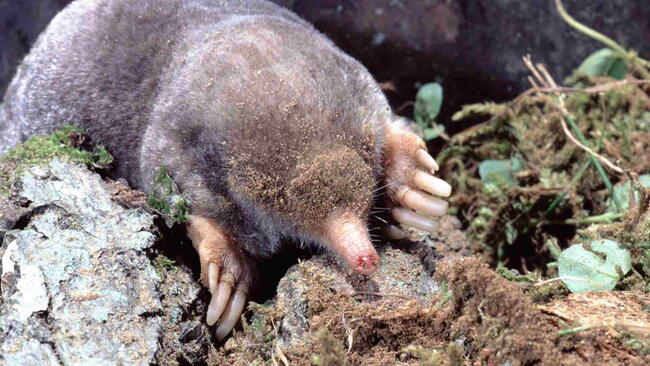
First off, voles are not moles! People confuse the two animals because they both tunnel through your yard and are small, dark-colored mammals. You might not have seen either critter since they’re usually underground, but they look very different up close. Voles are small, stocky rodents similar to field mice. In fact, a vole might look like a mouse at first glance. In contrast, moles are NOT rodents. Moles are all nose and mouth. And they have big feet used for digging! See our article on dealing with moles here.
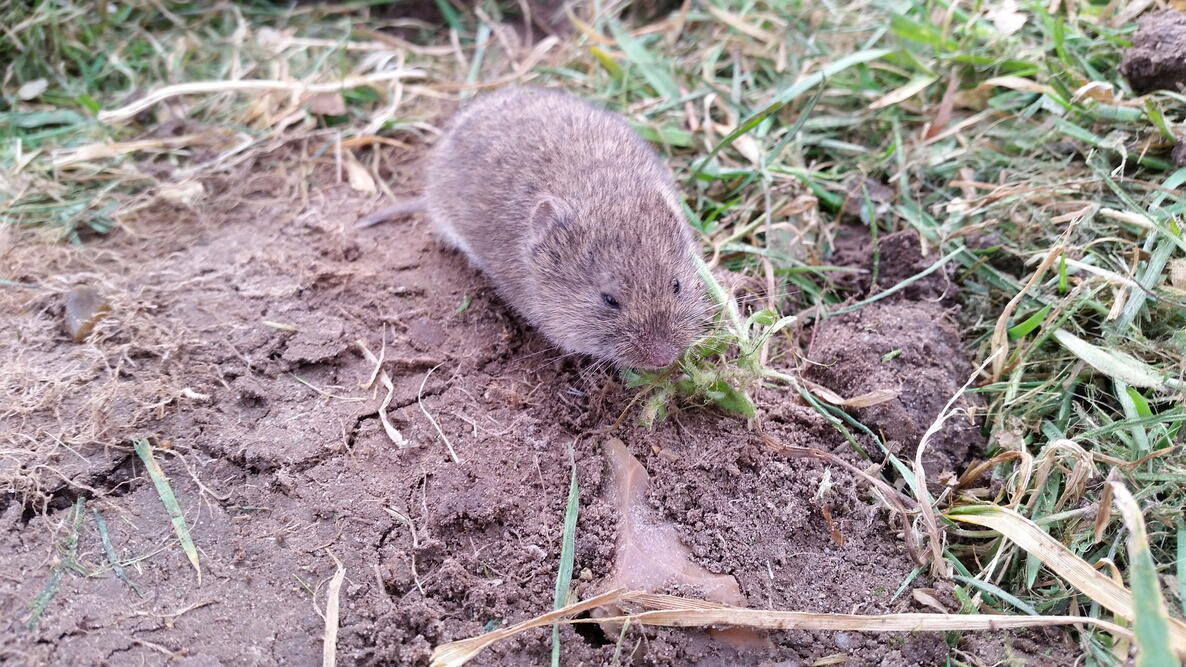
Voles have small, rounded ears that are often hidden by their fur, small eyes, and short tails. Their fur is generally thick and light brown to gray. Two common species of voles in North America are the prairie vole (Microtus ochrogaster) and the meadow vole (Microtus pennsylvanicus). Meadow voles are more widely distributed, but prairie voles are more common in grassland and prairie areas. They are very similar, and the methods for controlling them are mostly the same.
What Do Voles Eat?
Like many other rodents, voles are omnivores, meaning they’ll eat almost anything. However, voles have a primarily vegetarian diet; they mainly eat stems and blades of lawn grass, so it’s usually vole tunnels that you’ll see near the yard’s surface. Moles, on the other hand, have a mainly carnivorous diet consisting of invertebrates. (Moles are actually beneficial in many ways. They help plow the soil and eat pest larvae and insects!)
It’s helpful to know this difference not only because it will help you identify the damage (see below) but also because a vole bait might use peanut butter, whereas moles would be more interested in an insect or earthworm.
If it helps, remember that their frenzied activity does subside. Vole populations cycle, and about every 2 to 5 years, there will be a population boom. Mild winters with good snowfall can help to increase vole populations, as the voles can travel beneath the snow cover, safe from predators.
Many of the same methods that you use to get rid of mice can be used to get rid of voles; after all, voles are commonly referred to as “meadow mice.” Photo Credit: Washington State University.

Identification
How to Identify Vole Damage
You’ll know voles by the shallow, snakelike tunnels that you’ll see all over your lawn. The tunnels are about 2 inches wide and very near the surface so they can eat their favorite foods: grass stems and blades. Voles are especially manic in the early springtime.
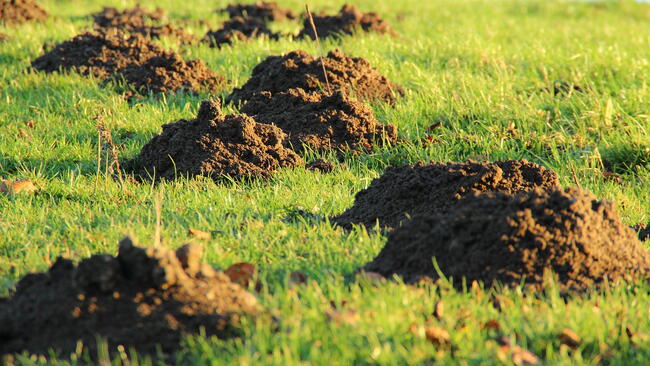
Moles, on the other hand, have deeper feeding tunnels that they use as a network. They do have secondary runways that appear on your lawn’s surface; however, they look more like raised ridges and have little volcano-shaped mounds. Voles leave no mounds behind.
You’ll also be able to identify voles by the type of damage. Remember: It’s the voles who are plant eaters.
If you have partially eaten carrots, potatoes, or other root vegetables in your garden, you probably have a vole problem. According to one reader, “They dig under my carrots, pulling them down, and eating them. There’s just a row of holes where the carrots were. It’s kind of amusing, like a Bugs Bunny cartoon. They’re a real pest this year.”
Voles also eat flower bulbs from below the ground, as they’re near the surface.
If you see chewed-up bark near the base of trees and shrubs, look closely. A vole’s front teeth will leave ¼-inch side-by-side grooves in the wood as it gnaws away on the bark. (They’re rodents, after all!)
Voles also tunnel through any root system, causing damage to trees and shrubs. If you see young trees or shrubs leaning over, it may be due to vole activity.
Control and Prevention
How to Get Rid of Voles
If you’ve come to this page, we assume you’re looking for immediate ways to deal with these crazy voles! If it’s too late for preventative measures, consider these control measures:
In small areas, trapping may be an effective way of reducing vole populations. Try Havahart live vole traps situated perpendicular to the widest vole runways or near the nesting sites at the base of trees and shrubs. Bait traps with peanut butter. Set baits midday to early evening when voles get more active. Reset the traps as often as necessary until you eliminate the population. Relocate voles if it’s legal where you live. (Note that it may not be!) The key to trapping is persistence. You may want to cover the traps so that pets and children do not accidentally find them.
Repellents have mixed results and need to be reapplied after it rains. Garden stores sell fox or coyote (vole predator) urine, which usually turns off voles.
Bulb control? You can discourage voles from nibbling on bulbs by adding gravel to the planting hole (surrounding the bulbs). When you plant bulbs, drench or powder them with a fungicide to keep voles at bay.
Vole damage to tree bark is best prevented by encircling the tree with a light-colored tree guard (mesh or hardware cloth). The guard should be tall enough to reach above the snow line in the winter, and the base should be buried in the soil or have a soil ridge around it. Make sure the guard is loose enough so that it does not constrict the tree.
Voles in the veggie garden? These little critters aren’t very good climbers. Protect plants by fencing the area with a half-inch of mesh (hardware cloth), at least 12 inches above the ground, and burying them 6 to 10 inches deep.
Some readers have suggested a variety of irritants sprinkled into vole tunnels (from natural to chemical): cayenne powder, garlic, onion, castor oil, a little nitrogen fertilizer, and ammonia. In many cases, these ingredients can be mixed with water or soapy water and put in a spray bottle. However, you will need to reapply after it rains.
One of the best control methods is an outdoor cat or a dog that is a specialized ratter!
If you are desperate and about to sell your home, large vole populations have been effectively reduced with baits. However, most pesticides recommended for voles are restricted and can only be used by Certified Pesticide Applicators. Contact your local Extension educators for more information.
While the damage may look visible in early spring, it is rarely permanent. Vole activity is heaviest in the springtime in most regions and does subside! Simply rake up the dead grass and reseed the area. As the surrounding grass grows, it will cover up the trails.
How to Prevent Vole Damage
Make your yard inhospitable to voles! Prevention is very important to keep vole numbers down.
Voles like dense, heavy vegetative cover, weeds, and meadows because they provide them with protection from predators and provide nesting material. Cut back brush, mow, weed, and create a clean space.
Remove woodpiles and hiding places for voles from near your garden, shrubs, and trees.
Keep your lawn mowed and bushes trimmed up from the ground.
Avoid putting dense mulch too close to trees and shrubs.
Keep snow cleared from the base of trees and shrubs. Protect young trees by wrapping the lower trunk with a chew-proof material (such as small-grade hardware cloth).
Bird feeders are another attraction for voles and should either be removed, or the ground kept very clean to keep vole numbers down.
Fortunately, voles are a prime food source for many predators, such as snakes, hawks, owls, foxes, and badgers!
Learn more about common garden pests like mice and groundhogs.
Catherine Boeckmann loves nature, stargazing, and gardening so it’s not surprising that she and The Old Farmer’s Almanac found each other. She leads digital content for the Almanac website, and is also a certified master gardener in the state of Indiana.
I got rid of the voles, moles and mice tunneling through my lawn by spraying the lawn in the late fall with castor oil. Have had zero damage from any critter in the last 3 years. If you do this, make sure you buy a natural castor oil that has not been deodorized. The unscented one you find in most drug stores will not work. Plenty of the natural one can be found with Google.
Reply to comment
<span>Amy Steele</span>Mon, 03/20/2023 - 21:24
Do you have to do the spray in late Fall or could I do spring
Reply to comment
<span>Kim Watson</span>Mon, 10/04/2021 - 20:49
I'm not sure what critter we have in our yard. In Colorado we had voles, which tunneled close to the surface and ate the roots of the grass, leaving paths of dead grass, and there were holes where we could put in rat poison. Now in Texas, we have the paths of dead grass, but we do not see holes. I've read that moles eat worms, and voles eat grass roots, but would moles eat rat poison? We purchased the noisy (almost sounds like a sheep) units, and that did not bother the critters at all. What a waste of money. Any comments will be appreciated.
Reply to comment
<a title="View user profile." href="/author/editors">The Editors</a>Thu, 10/07/2021 - 11:24
In Texas, tunnels in the lawn can be caused by a few animals, and of course control will vary depending on which is doing the damage. If you think you might have moles, you may be interested in the control guidelines mentioned on our Mole page: https://www.almanac.com/pest/moles. Moles form volcano-shaped mounds and their tunnels usually have raised ridges, whereas vole tunnels do not have a ridge. In Texas, gophers also tunnel in the ground, creating fan-shaped mounds; usually their tunnels are wider and not as visible at the surface compared to those of moles. Ground squirrels (various species, such as the thirteen-lined ground squirrel) can make tunnels in the ground without leaving mounds of dirt by the entrance holes. Much smaller (in width) tunnels can be caused by mole crickets or other insects. For further help, you might try contacting your county's Cooperative Extension service. Contact information can be found here: https://www.almanac.com/cooperative-extension-services
Reply to comment
<span>Todd</span>Thu, 06/08/2023 - 10:18
I see you mentioned squirrel's. I have something eating the roots of my tomatoes last year and this year so far my bell peppers. I go out and the plant is wilted. Then I check it out and the roots are gone and theirs a hole underground by where the roots were. We do have a problem with ground squirrels but I've never seen a vole run ing around. Whatever they are they tunnel to the plant then retreat the same way. It was only two last falls planting. Then one so far after the plants were in the ground about two weeks( got a late start this year). I live in the mountains of lower central California(93240)zone 8b. Are their even voles here? It's desert about 25 miles away, So our soil is sandy. I flooded the hole then put coffee grounds in it and sealed it up. I know the person who owned the house before us said they had a problem with something eating the roots of their plants. Any ideas of what is doing this? Then any ideas? These squirrels are becoming a hazard. Burrowing everywhere. So I need to get rid of them and whoever is killing my garden plants. I don't have a huge garden so 1 plant is a 20% loss. I replanted but I've lost a seedling that was 2 months old. I guess I could grow spares in case this happens. Then I won't lose as much time. But I'd rather get rid of them. Right now I need a fast method, lethal is ok also. Especially for the squirrels. If those sonic spikes work. I don't mind driving them out. But I do have animals and it is in my vegetable garden. So most poisonous options may be out. Unless it's just the squirrels. As I was at my wits end and was ready to poison them. My dog brought one to the porch. They had never eaten one before this one. So I didn't put out the poison. In another house I used tomcat mice bait cubes. Threw a couple in a hole and never saw them again. But that is out now.
Reply to comment
<span>Greg</span>Wed, 08/04/2021 - 15:10
Apparently, some folks who think these things aren't a nuisance haven't twisted an ankle sinking into one of their tunnels or had a river form from a hard rain because of the same. I look forward to wiping out every last one of these from my yard and having it look as nice, neat and smooth as my neighbors. Thank you, Darryl Crum, for that great advice. I'm getting bug-b-gone asap. Might give mouse traps with peanut butter bait a go, too. There's probably a thousand of these pests making the yard look like a nightmare.
Reply to comment
<span>Anne</span>Sun, 06/11/2023 - 10:07
Foster or adopt and outdoor Barn Cat; the Cat will get every one over time; (put the outdoor Cats litter box outside using Feline Pine);
Reply to comment
<span>Steve</span>Thu, 04/29/2021 - 10:48
I accidentally found out that voles love to eat Ortho Bug B Gon granules (the dry insecticide). They eat it because it smells like grain, but the poison in it it kills them. I use it to control bugs around landscaping, but started noticing dead voles the morning after I spread it. I even had one come in the garage and gnaw a hole through the bag to eat it and die shortly afterward. Now I just put some granules down around their trails or near their holes and the problem is solved.
Reply to comment
<span>Darryl Crum</span>Wed, 04/21/2021 - 11:58
Ray Lewis - I want to thank you. I don't know how long it will take me to rid my yard of voles, but I tried the technique you suggested and in six days I've caught (killed) nine voles. I have 7 traps and three buckets. On the first and second nights, I only had four traps and two buckets. I caught two both nights, but on the second night, a vole broke one of my traps. So, I bought another pack of mouse traps and added a bucket. The third night, using the three buckets, I caught three voles. The next night I did a bad job of setting my traps and got no voles. Because I was busy, I removed the one thrown empty trap and put the buckets back over the unbaited traps thinking I would fix this when I had some time; however, this morning, I had caught two more voles which brings me to a total of nine.
Ray, I really want to thank you. I will keep this up until I catch nothing and they do not eat the bait (sunflower seed).
Reply to comment
<span>Don</span>Thu, 02/17/2022 - 20:53
How are the buckets used or set??--With the traps do you use peanut butter and seed? thank you.
Comments