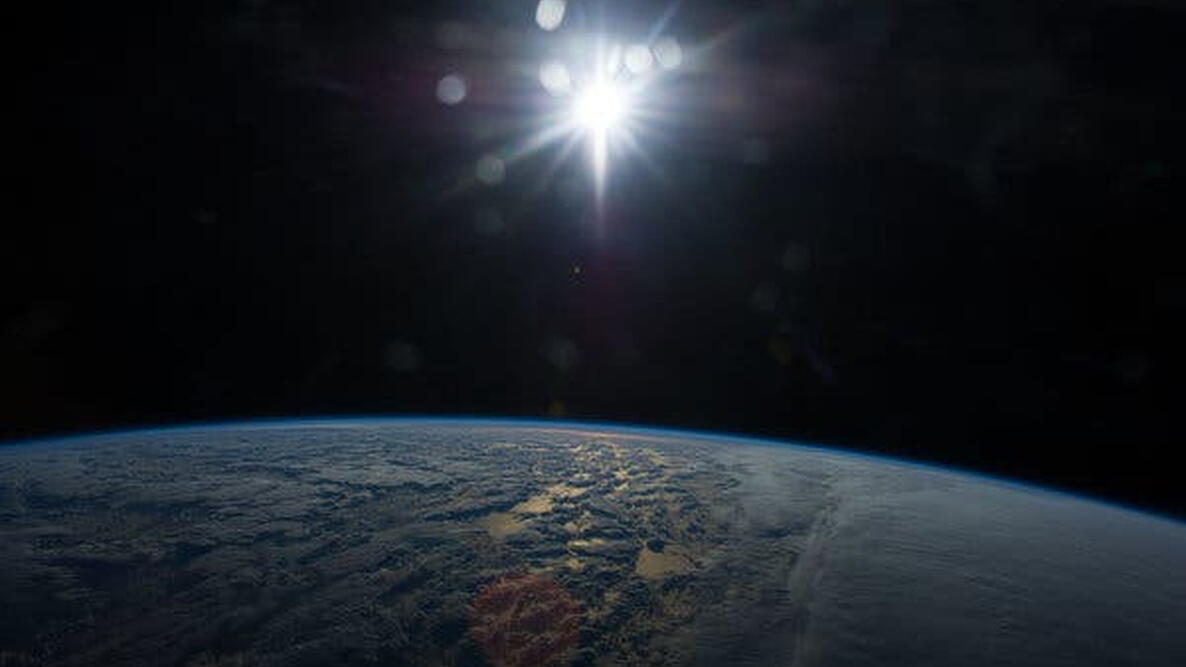
Caption
Sunset over Earth oceans as seen from the International Space Station.
Earth reaches perihelion, its closest point to the Sun, on January 2, 2027, at 9:33 p.m. EST. It reaches aphelion, its farthest point, on July 5 at 1:06 a.m. EDT. What do these terms mean, and how do they relate to the seasons?
What Are Aphelion and Perihelion?
The terms perihelion and aphelion describe different points in our planet’s orbit around the Sun. This can also apply to other planets, comets, or bodies.
- Aphelion is the point of the Earth’s orbit that is farthest away from the Sun. It always happens in early July, about 2 weeks after the June solstice,
- Perihelion is the point of the Earth’s orbit that is nearest to the Sun. This always happens in early January, about 2 weeks after the December Solstice.
The words come from ancient Greek, in which helios means “Sun,” apo means “far,” and peri means “close.”
(Did You Know: The point in the Moon’s orbit that is closest to the Earth is called the perigee, and the point farthest from the Earth is known as the apogee. Learn about perigee and apogee.)
Aphelion and Perihelion Dates for 2027 and 2028
| Year | Event | Date and time (Eastern Time) |
|---|---|---|
| 2027 | Perihelion | January 2, 9:33 p.m. EST |
| 2027 | Aphelion | July 5, 1:06 a.m. EDT |
| 2028 | Perihelion | January 5, 7:28 a.m. EST |
| 2028 | Aphelion | July 3, 6:18 p.m. EDT |

Do Aphelion and Perihelion Cause the Seasons?
It’s not the distance from the Sun that causes our seasons. Seasons happen because the Earth’s axis is tilted at an angle. It’s because Earth orbits the Sun on a tilt that our planet gets more or less of the Sun’s direct rays at different times of the year. Read more about the reason for the seasons!
Aphelion and Perihelion on Mars
Mars has four seasons, too. Because a Martian year lasts about 687 Earth days, its seasons last longer than Earth’s—and they’re not all the same length. Mars’s more elliptical orbit also affects how long and how warm its seasons are.
Mars is closest to the Sun near the end of southern spring. As a result, southern spring and summer are shorter than their northern counterparts, and southern summer is warmer. Mars is farthest from the Sun during southern winter, which lasts longer.

Did you learn something new today? Or perhaps, do you understand aphelion and perihelion a bit better?
Frequently Asked Questions
-
Do perihelion and aphelion happen on the same dates every year?
No. The dates and times shift slightly from year to year because the calendar year and Earth’s orbit don’t line up exactly.
-
Does Earth’s changing distance from the Sun affect the seasons?
It has a small influence on seasonal intensity, but it doesn’t cause the seasons. Earth’s axial tilt is the main reason for seasonal changes.





Comments

Good question! However, as it happens, aphelion and perihelion are not related to the summer and winter solstices. The times of aphelion/perihelion are slowly shifting. In 1246 a.d., for example, perihelion and the December solstice were on the same day. Now, they are a few weeks apart. In 6430 a.d., perihelion is expected to align with the March equinox.

Yes, it's all about the tilt! During the Northern Hemisphere's winter, the Northern Hemisphere is tilted away from the Sun, but during summer, it's tilted towards the Sun.