
The Big Dipper is an old friend to most of us. Poetically, it is spring itself, the season of renewal. On spring evenings, look high in the northeastern sky for its seven bright stars, forming that familiar dipper shape.
Looming large in the night sky, the Big Dipper’s shape is slowly changing and will look different in thousands of years. But it hasn’t changed a bit since we were kids.
What is the Big Dipper?
Curiously, the Big Dipper isn’t actually a constellation. It’s an asterism, a recognizable pattern of stars. It’s part of the constellation Ursa Major, also called the Great Bear or Big Bear. And “Big” is the right word: Ursa Major is the third-largest constellation in the sky.
Five of the Big Dipper’s seven stars are members of the Ursa Major Moving Group, one of the nearest stellar groups to Earth, about 80 light-years away.
Unlike the stars in most constellations, which only appear close together from our viewpoint, these five stars share a common origin and travel through space together. They’re members of the same stellar family.
The Dipper floats forlornly in a dark, desolate region of the sky, far from the Milky Way’s bright band. Hence, the Dipper guides our eyes away from the flat plane of our own galaxy and toward the rest of the universe.
The Dipper’s direction in space offers a crystal-clear window to distant galaxies, largely unblocked by the dust and gas of our own galaxy.
In 1995, the Hubble Space Telescope spent more than 100 hours observing a tiny patch of sky near the Dipper’s handle, revealing thousands of distant galaxies.
The light from those galaxies had traveled billions of years to reach us. It was the latest news from an era that no longer exists.
Where Is the Big Dipper in the Spring Sky?
The Big Dipper’s journey around Polaris, the North Star, has long helped people recognize the changing seasons. For generations, skywatchers observed the stars to mark the passage of time, from planting and harvests to the turning of the seasons.
On spring evenings, the Big Dipper rides high in the northern sky, its bowl tipped upside down. In summer, the handle points upward. By fall, the Dipper sits much lower, near the horizon, and in winter, it begins to climb again.
If you live in the northern United States or Canada, the Big Dipper may stay above the horizon all year. Astronomers call this circumpolar. Farther south, it dips below the horizon during part of the year.
Unlike stars that rise and set, Polaris appears nearly fixed in the northern sky, while the Big Dipper seems to circle around it.
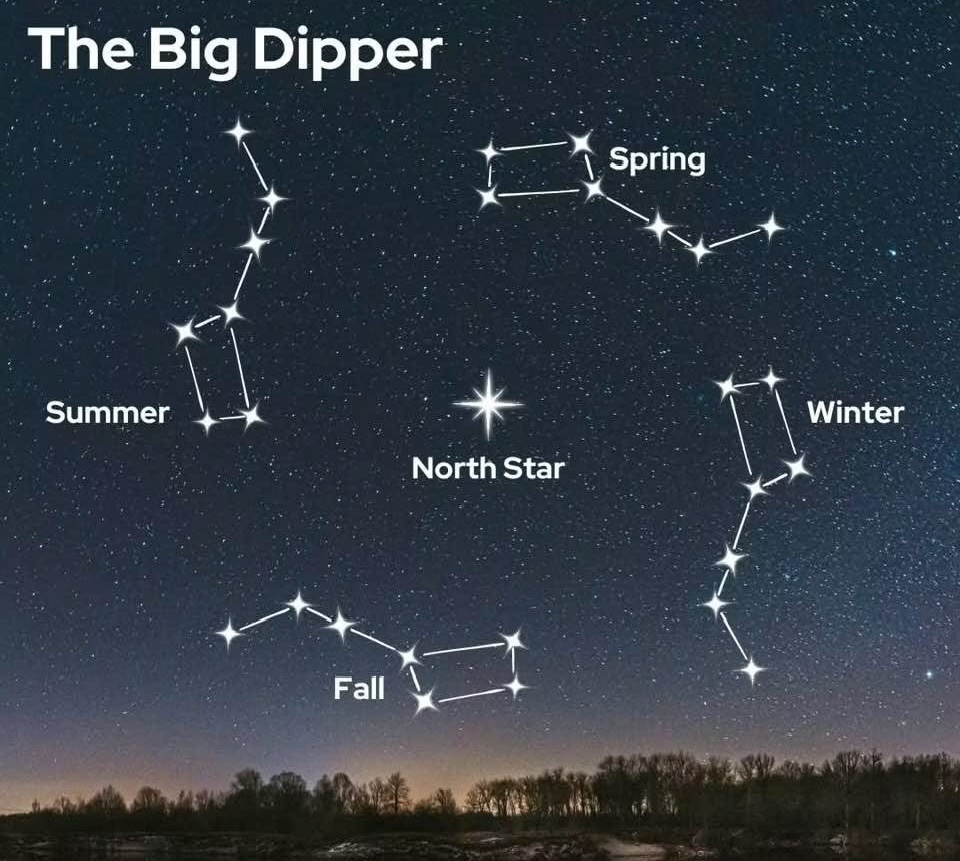
Look toward the northeast in early spring evenings to find the Big Dipper climbing high in the sky. Its seven bright stars form the familiar dipper shape.
As part of Ursa Major (the Big Bear), some people say the Dipper makes up the Bear’s tail and hindquarters.
How Do I Find the North Star?
But its greatest claim to fame remains its ability to guide the beginner to the North Star, Polaris.
- Locate the two outermost stars at the end of the Big Dipper’s bowl. We call them the “pointers” because they point straight to Polaris.
- Draw an imaginary line from Merak through Dubhe, then extend it about five times the distance between the two stars. You’ll reach Polaris, the North Star.
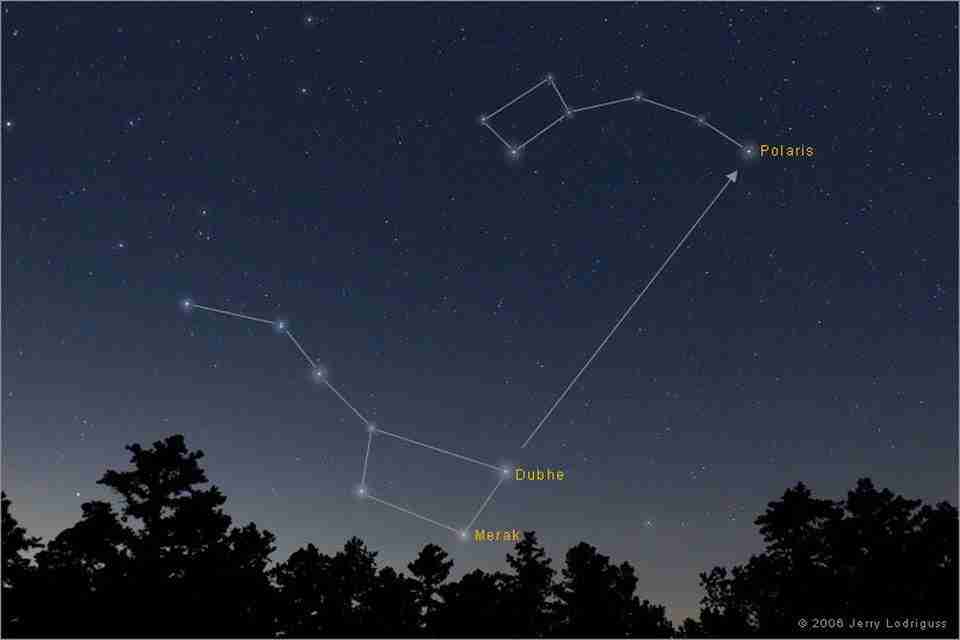
Using the Big Dipper to find Polaris is a simple way to locate true north—no compass needed! Face Polaris, and you’re facing north. Turn around, and you’re facing south. It’s that simple.
Mizar and Alcor: The Big Dipper’s Famous Double Star
The second star of the Dipper’s handle is the sky’s most famous double star: Mizar and Alcor. The ability to discern this “horse and rider” was an old Arabic test of keen eyesight. Either Alcor has brightened over the centuries, or else the Arabs had vision problems, because away from city lights the pair is easy to see.

Credit: VegaStarCarpentier/NASA
With all that, it’s a pleasure merely to gaze at the Dipper the way you did that night long ago, before you knew such facts. Such a dependable and lasting friend is worthy of a springtime salute.

More Like This





Comments