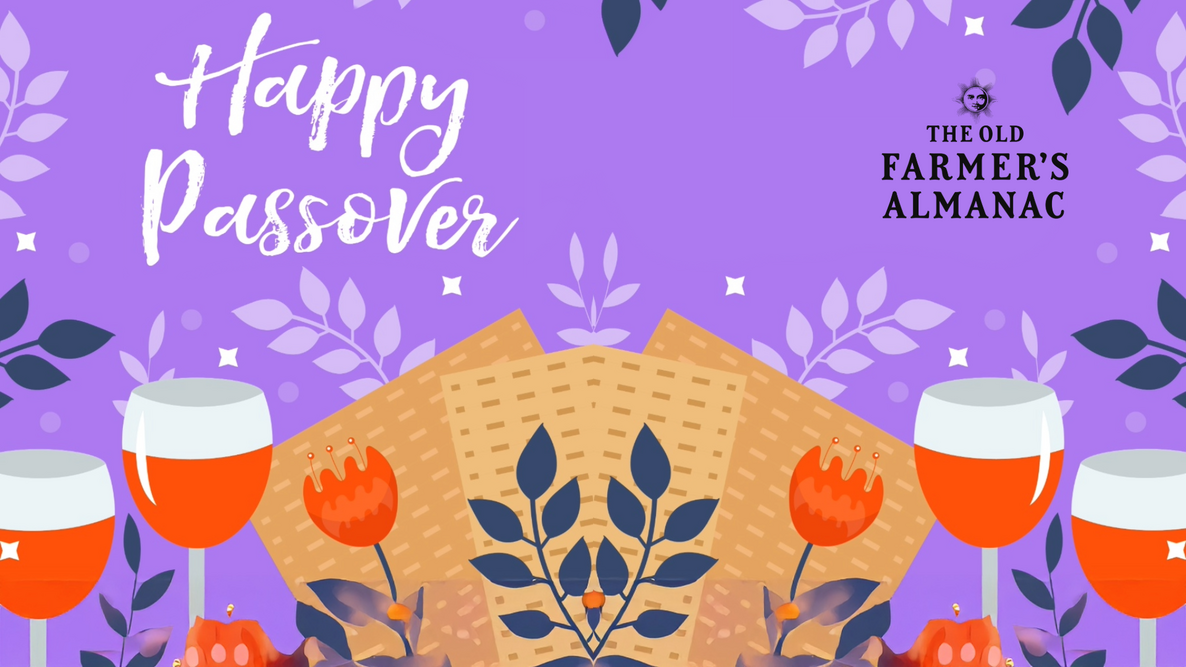
Passover (Pesach) is one of the most important Jewish holidays, celebrating the liberation of the Israelites from slavery in ancient Egypt. The weeklong festival is observed with special traditions, including the seder meal, symbolic foods, and the retelling of the Exodus story. In 2026, Passover begins at sundown on April 1 and ends on April 9.
What Is Passover?
The holiday of Pesach, or Passover, is an annual weeklong festival commemorating the emancipation of Jewish peoples from slavery (in ancient Egypt). The Hebrew name for the holiday, Pesach, means to pass over and is a reference to the plague—sent to kill all firstborn children of Egypt—having passed over the Israelites’ homes, sparing the lives of their firstborns.
When Is Passover 2026?
The dates are based on the Hebrew calendar, from the 15th day of the Hebrew month of Nissan (or Nisan) through the 22nd day.
Passover 2026 will be celebrated from April 1 to April 9. The first seder will be on April 1 after nightfall, and the second seder will be on April 2 after nightfall.
| Year | Passover Begins (at sundown) | Passover Ends (at nightfall, when 3 medium stars become visible) |
|---|---|---|
| 2026 | Wednesday, April 1 | Thursday, April 9 |
| 2027 | Wednesday, April 21 | Thursday, April 29 |
| 2028 | Monday, April 10 | Tuesday, April 18 |
| 2029 | Friday, March 30 | Saturday, April 7 |
Note: What is often called Passover today has its origins in two ancient observances. Nissan 14 was the Passover as mentioned in the Torah; at this time, an offering was made to the Lord—the sacrifice of a lamb, which was slaughtered and prepared during the afternoon. Nissan 15 (the new day starting at sundown) was the beginning of the seven-day Festival of Unleavened Bread. At the start of Nissan 15, the Passover lamb was eaten, along with unleavened bread. Over time, the Festival of Unleavened Bread became more commonly known as Passover and is now usually considered to begin at sundown between Nissan 14 and Nissan 15.
Celebrating Passover
In many Reform Jewish communities, Passover is celebrated for seven days, not eight. In more traditional Jewish communities—including both Orthodox and Conservative communities—Passover is celebrated for eight days.
Family and friends gather together after nightfall on the first and second nights of the holiday for the high point of the festival observance, the seder. During the seder, which means order in Hebrew, the experience of the Exodus is told in story, song, prayer, and the tasting of symbolic foods. The seder meals include four cups of wine, eating matzah and bitter herbs, and retelling the story of the Exodus.
The Meaning of Passover
(Note: To some followers of Judaism, it is considered disrespectful to write out the name of the Lord in full. Because Passover is primarily a Jewish holiday, we have elected to follow this custom on this page by using “G-d” to refer to Him. Thank you for your understanding.)
In Hebrew, this festival is known as Pesach (which means to pass over), because G-d passed over the Jewish homes to spare them from death that first Passover eve.
The Israelites had been enslaved by Egyptian pharaohs for many decades. Moses tried to appeal to the Egyptians with a message from G-d, but this was ignored. Devastating plagues destroyed crops and livestock.
On the 15th day of the Hebrew month of Nissan in the year 2448 from creation (1313 BCE), the last of the 10 plagues afflicted the Egyptians, killing all their firstborn children. However, G-d spared the children of Israel; the plague “passed over” their homes because G-d had instructed Moses to tell them to mark their doorposts with lamb’s blood. The pharaoh relented at last. Six hundred thousand adult males, plus many more women and children, left Egypt on that day and began the trek to Mount Sinai.
Passover Recipes
Popular Passover Foods
- Matzah (unleavened bread)
- Charoset
- Bitter herbs (maror)
- Gefilte fish
- Matzo ball soup
- Beef brisket
Perhaps the most well-known of Passover foods are maror (bitter herbs) and matzah (unleavened bread), a reminder of the haste with which the enslaved people left Egypt because they did not even have time for the bread to rise.
For the duration of Passover, no leavened or fermented food or drink is eaten, including cake, cookies, cereal, pasta, and most alcoholic beverages.
Passover Charoset (or Haroset)
Traditionally, the matzah is served with a sweet condiment called charoset, a mixture of apples, nuts, and wine. This symbolic dish represents the bricks used by the enslaved Jews to build the pharaoh’s cities. The basic recipe (though it varies) is:
- 1 cup walnuts
- 3 apples, unpeeled, cored and cut into about 8 pieces
- 1 teaspoon ground cinnamon or to taste
- 1 tablespoon sugar or to taste
- 2 to 3 tablespoons grape juice or sweet Passover wine
Put the walnuts in the chopping bowl, if doing it by hand, or a food processor fitted with a steel blade. Roughly chop into large dice or pulse just a few times in the processor, being careful not to overprocess. Add the apple pieces and chop or pulse to the desired consistency. Add the rest of the ingredients and stir well to blend. Makes about 2 cups.
The above recipe is the most basic version. Below is another charoset recipe, which uses honey, raisins, and dried apricots.

Credit: Chatelaine
A traditional Passover meal also includes gefilte fish and matzo ball soup for starters. A classic dinner dish is a beef brisket.

Note: For the duration of the 8 days (or, in Israel, 7 days) of Passover, chametz (leaven) is avoided.
If you observe Passover, we hope you have a safe and enjoyable celebration!

More Like This







France, Thank you for your helpful feedback. We have checked with chabad.org and other authoritative sources and have updated the article accordingly.
- « Previous
- 1
- 2
- …
- 10
- Next »

Comments