It’ll cast a spell on you. True to its name, agapanthus—known in ancient Greece as the love flower (agape means love; anthos, flower)—tends to leave observers besotted with its beauty. Its common names, African Blue Lily and Lily of the Nile, hint at its origin, but only one is accurate.
Agapanthus is native to South Africa, not the Nile basin; the origin of the river moniker is a mystery. Note, too, that this plant is not in the lily family, although it was indeed included years ago. Today, it is the only genus in Agapanthoideae, a subfamily of the Amaryllidaceae family, which itself also includes clivia.
What Does The African Blue Lily Look Like?

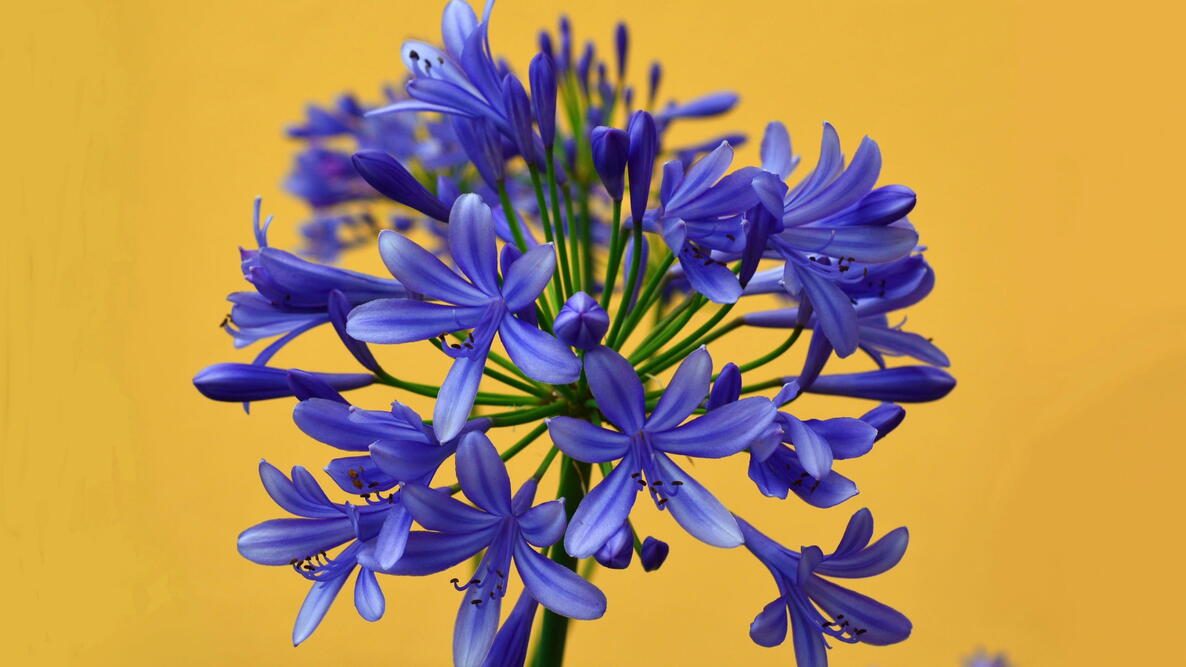
Sturdy stems rise above its foliage from a base of strap-like leaves to terminate in umbels (clusters) of up to 100 lily-like flowers in shades of blue, purple, or white.
Flowers: The plant produces large, spherical clusters of funnel-shaped flowers, usually in shades of blue, although white varieties also exist. The flowers bloom in dense clusters atop tall, slender stems that rise above the foliage, creating a dramatic effect.
Leaves: The leaves are long, narrow, and strap-like, with a glossy, deep green color. They grow in a clumping formation at the base of the plant, creating a lush, grass-like appearance.
Height: African Blue Lilies typically grow between 1 and 3 feet (30 to 90 cm) tall, with the flower stalks reaching above the foliage and sometimes towering even higher.
Overall Shape: It has a compact, bushy form, with the flowers standing out as the focal point. When in full bloom, the plant’s structure contrasts the vibrant flowers and the deep green foliage.
Whether you are an experienced or novice gardener, agapanthus offers a touch of exotic elegance and effortless charm. Get ready to discover exactly how to care for this captivating beauty!
Growing

After the first season, these plants are relatively low maintenance. Provide at least 6 hours of direct sun. Water regularly, especially in the first year after planting, so that they establish well. Avoid overwatering, though; they don’t like excess water.
After the first year, these plants don’t need much water. Watering in late summer if it’s been particularly dry will help them flower the following year. Fertilize lightly twice a year (spring and midsummer) with a high-potassium formula. Excess fertilization can result in lanky growth.
Cutting and Deadheading
In zones that do not freeze, cut the blue lily stems at the base when flowers pass, but leave the foliage. You can read more about cut flowers in the harvesting section. If uncut, flowers will develop and drop seeds.
Remove any dead foliage from deciduous types before bringing them indoors or into a cool greenhouse for the winter. Remove any tatty leaves during any time of the year.
Overwintering
Agapanthus is a tender perennial hardy in Zones 7/8 to 11; plants may be overwintered or treated as annuals elsewhere. Overwinter the most delicate types (mostly the evergreen varieties) in a cool greenhouse to protect your container plants.
The idea is to keep them away from frost and in a sheltered area. If you don’t have a greenhouse, wrap them in a few layers or horticultural fleece from November to April.
If your plants are in borders and you live in a particularly cold area, add a deep layer of mulch around the base of the plants in autumn and remove it in the spring.
Propagating
Divide root-bound potted plants every 4 to 5 years; divide evergreen varieties immediately after flowering and deciduous ones in spring before growth starts.
With a sharp knife, cut the rhizome clump into sections, making sure that each division has at least a couple of growing points and roots attached, and then pot them.
Allow a year or more for divisions to flower. Failure to divide a severely pot-bound plant can also hinder flowering.
Pests and Problems
While this is a low-maintenance plant once it is established, like all plants, it can be subject to pests and disease.
- Botrytis blight is a fungal disease that causes mold in plants. Pesticides can help to get rid of this disease and remove infected plants.
Pests that typically enjoy this plant are mealy bugs, slugs/snails, spider mites, and thrips.
Another common disappointing problem with growing agapanthus is when it doesn’t flower as well as you’d hoped. There is usually a good reason for this, though, and it can be fixed!
How To Get Agapanthus to Flower

Plants in an area that is too shady are bound not to flower much, so move all containers and plants into full-sun areas.
Lack of winter protection is another common reason for them not flowering in the summer. Make sure you follow our advice about overwintering above. On the other hand, if your plants are too warm over the winter, they’ll flower early, but the quality won’t be as good.
Blue lilies like to grow in containers and tend to flower better when pot-bound, but don’t neglect them. If they grow too big for their container, this will also affect the flowering, so always try to increase the container size by around 1 to 2 inches every year. When they’ve reached a large size, you can divide them and repot the divided pots to encourage more flowering.
Watering and feeding from spring to autumn will also encourage flowers to bloom.
With proper care, the African blue lily will reward you with vibrant and striking flowers, making it a beautiful yet low-maintenance addition to your garden.
Types

Hybridizing has resulted in more than 600 varieties with many differences beyond their apparent similarities. Depending on the variety and species, agapanthus can be evergreen or deciduous; have stems that rise from several inches to multiple feet tall; and bear funnel-, bell-, trumpet-, or tubular-form flowers that vary in their bloom periods.
Evergreen types retain their foliage and should be treated like houseplants in winter (provided with water and bright light in a 55° to 60°F environment); deciduous ones lose their strapping leaves in winter but can be stored in a cool (40° to 50°F), dark, frost-free space in their pot or wrapped in newspaper with their soil removed after they have been lifted.
If somewhat pot-bound, agapanthus tends to flower abundantly. Dwarf forms are especially suited to being grown in containers.
Evergreen species (Agapanthus africanus, A. praecox) include the following (consult your nursery for others):
- A. africanus ‘Albus’: white flowers; 2 to 4 feet tall; need partial sun/filtered light
- A. africanus ‘Peter Pan’: blue flowers; 1 to 2 feet tall; need partial sun/filtered light
- A. ‘Ever Sapphire’: deep blue flowers; 1 to 2 feet tall; need partial sun/filtered light
- A. praecox ‘Flore Pleno’: deep, lavender blue double flowers; 2 to 3 feet tall; need partial sun/ filtered light
- A. ‘Queen Anne’: blue flowers; 1 to 2 feet tall; need partial sun/filtered light
- A. ‘Snow Storm’: white flowers; 2 to 3 feet tall; need partial sun/filtered light
- A. ‘Snowball’: white flowers; 1 to 2 feet tall; need partial sun/filtered light
Note: Deciduous species are seldom available as ornamentals.

More Like This

Comments