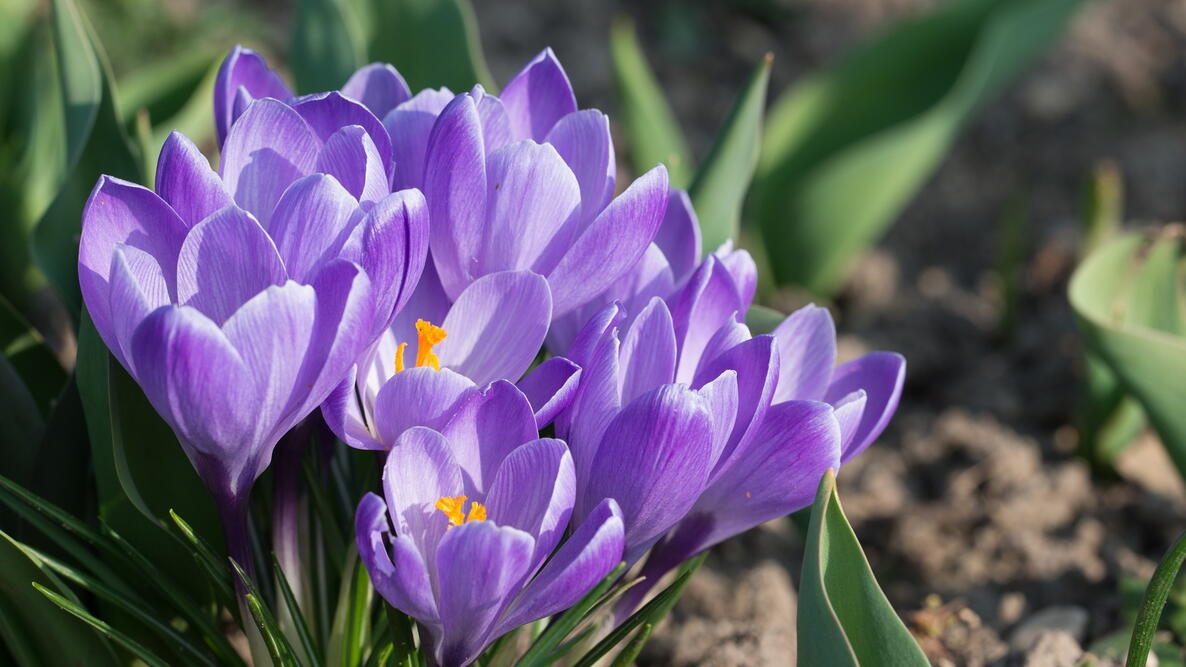
Planting
Where to Plant Crocuses
Crocuses do best in a spot that gets full sun (6+ hours of direct sunlight), but will grow in partial sun as well. Choose a planting site where there is well-draining soil; the corms will rot in soggy, compacted ground. Before planting, work in organic matter such as compost to a depth of at least 10 inches.
When to Plant Crocuses
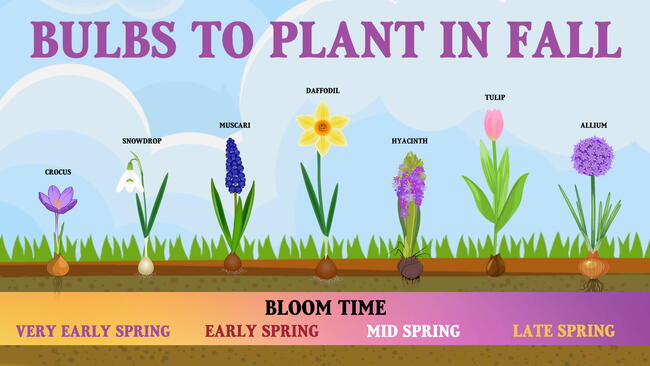
- Crocuses need to experience an extended period of cold weather in order to bloom, so plant them in the fall to get spring blooms.
- Before the ground freezes in the fall, crocus corms can be planted most anywhere, except in the dense shade on the north side of buildings or under thickets.
- Ideally, plant crocus corms 6 to 8 weeks before a hard frost is expected in the fall and when the soil temperature is below 60°F (16°C). This is usually during September or October in the northern U.S. and Canada, and October or November in the southern United States.
How to Plant Crocuses
- Plant crocus corms 3 to 4 inches deep (with the pointy end up). After planting, water well.
- Plant bulbs in groups or clusters rather than spacing them in a single line along a walkway or border. Single flowers get lost in the landscape. Plant a few inches apart, and plant in groups of 10 or more.
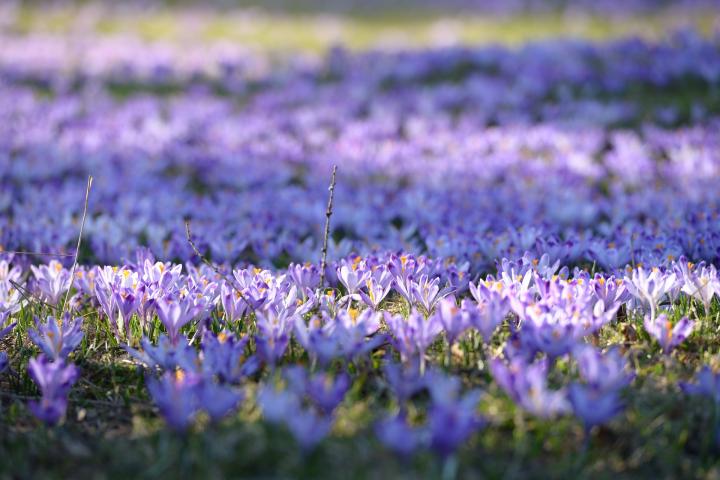
- Consider planting crocuses in lawns and meadows where they can form carpets, or mass them in the front of flower beds along the edge.
- Plant taller spring-flowering bulbs and shrubs behind the early bulbs for color contrast.
→ Learn more about planting fall bulbs.
Types
- ‘Bowles White’ produces white flowers with deep golden yellow throats in early spring. It grows 2 to 3 inches tall.
- ’Flower Record’ has single pale violet flowers in spring to early summer. It grows 4 to 5 inches tall.
- ’Pickwick’ is a striped crocus with alternating pale and dark lilac and dark purple bases. It’s 4 to 5 inches tall and blooms in spring to early summer.
- ’Tricolor Crocus’ is a beauty. Each narrow flower has three distinct bands of lilac, white, and golden yellow. It grows 3 inches tall and blooms in late winter and early spring.
- ’Purpureus Grandiflorus’ has an abundance violet flowers with purple bases. It grows 4 to 5 inches tall and blooms spring to early summer.


More Like This
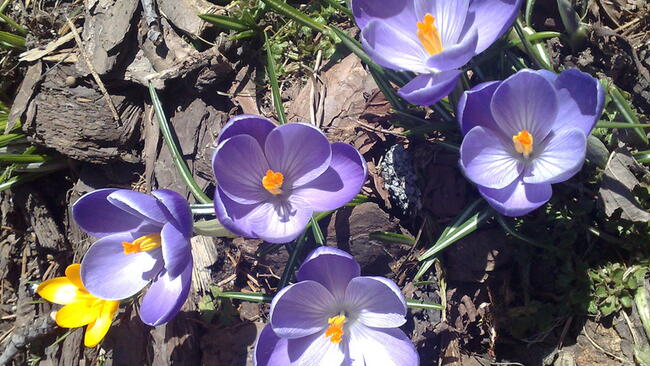

Apparently the yellow blooming crocuses tend to flower first—but only by a few days to a week. That's the suggestion of this study of bulbs for Kentucky gardeners: http://www.uky.edu/hort/sites/www.uky.edu.hort/files/documents/5204springbulbs.pdf see the chart on page 3, and not the March dates at the top. Presumably those dates would vary in other gardening zones.
We hope this help...
Sometimes plants just do not do well, Joy (sorry today...). You might consider some of the key differences between your property and that of your neighbors. Crocuses do not like too much water (was your compost/peat moss mix retaining it?). Crocus tommasinianus seems to be highly reliable—and squirrel resistant. (Did you consider that: could squirrels be your nemesis??) Some folks have best luck with little sunlight, water, or nutrients. Certainly if you plant them in a lawn or tidy your plant bed by mowing or cutting off the foliage, you are not helping the crocuses; they need the foliage to thrive.
As a last resort—or best next step—you might ask your neighbors what type they have and what their "secret" to success is. Maybe, just maybe, they'll dig up one or two corms and give you a couple to try in your conditions.
We hope this helps, even a little.
G'day, mate! Certainly you may have dropped a bulb. But in fact, some crocuses, especially Tommy crocus (Crocus tommasinianus 'Pictus'), naturalize and spread by seed. Whether you like that is up to you, but keep in mind, too, that "tommies" are the most squirrel-resistant crocuses. (If you've ever planted bulbs only to wake up the next day and see empty holes in the ground, you would appreciate this.) If they are growing well for you, enjoy them. Several folks on this page would like to have your "problem."
Cheers!
Hi Jane,
They do sound like autumn crocuses. I am not sure why you can't find them locally, but you will see them for sale online at places like White Flower Farm and American Meadows.
Squirrels will eat anything. Our worst experiences have included tulip bulbs and peaches on the tree. You can spend a lifetime trying to defeat or trick them. So plan accordingly.
Here are some of our—and Almanac reads'—best solutions for control: https://www.almanac.com/content/squirrels
- « Previous
- 1
- 2
- …
- 10
- Next »

Comments