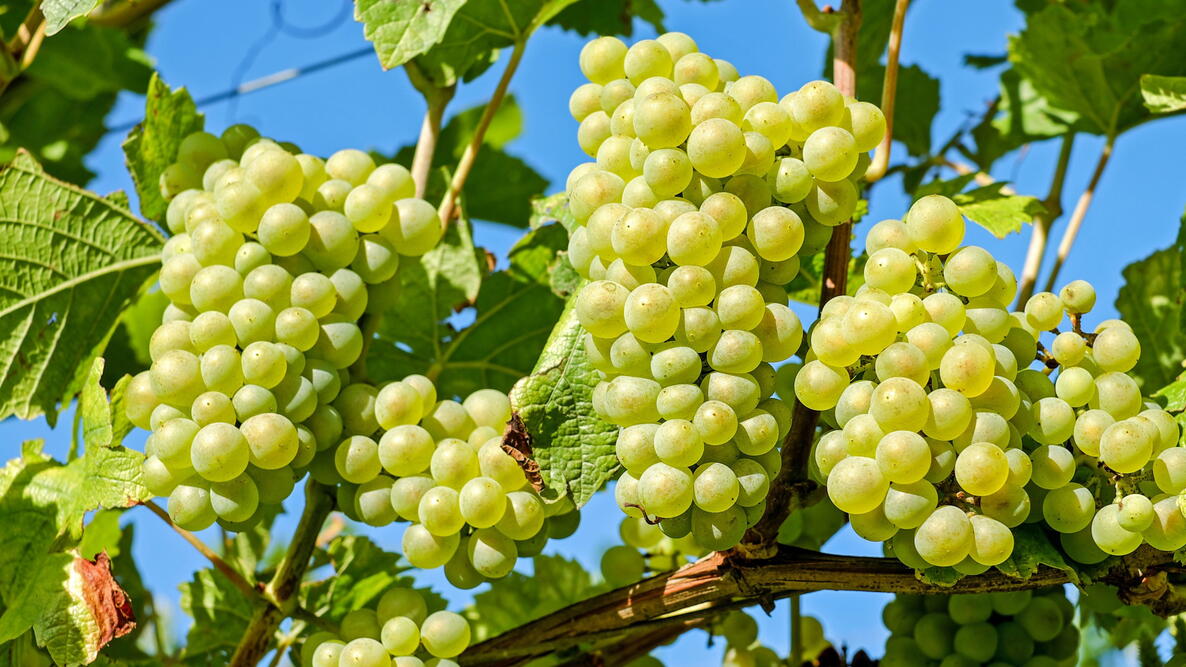
Pests and Problems
- Aphids
- Japanese Beetles
- Powdery Mildew
- Black Rot

Types
Note: Seedless varieties will produce smaller grapes.
- ‘Edelweiss’: Hardy in zones 4–7 (–20°F), early white variety. Table and wine.
- ‘Reliance’: Hardy in zones 4–8, seedless, pink table grape.
- ‘Seibel’: Hybrid, wine grape. Cold hardy.
- ‘Swenson Red’: Hardy in zones 4–8, red table grape.
- ‘Magnolia’: White Muscadine wine grape. Sweet. Best in zones 7–9.
- ‘Valiant’: Eating grape hardy to Zone 2.

More Like This


Comments

If your grape vine has rooted in the pot, then you can move to a loarger pot (a gallon container) or plant the vine in the ground in the fall when the leaves drop, and water in well.
"Golden Muscat," "'Himrod Seedless," and "'Seneca" are some American hybrid grape varieties that seem to grow well in Zone 7 and central New Mexico.
Fine sandy loams is exactly what you want for growing grapes. The soil should be of average fertilize and drain well. If fertility is low, you can mix in some organic matter (well-rotted manure, compost, peat moss or a green manure crop).
Prepare the vineyard site a year ahead of planting to allow for soil pH adjustment, fertility-building, and eradication of weeds.
See this page for more detail: http://aces.nmsu.edu/pubs/_h/h-309.html Contact your NM cooperative extension for local advice.
As long as you were pruning and fertilizing correctly, and that the plants were getting enough sunlight etc., and were healthy, it is a mystery why no flowers would form. Incorrect pruning, or too much fertilizer, can affect blooming. Amount of full sunlight per day is also important. If plants have had any setbacks, such as diseases or pests, that can also affect blooming. If there are not enough pollinators, then you might get small fruit that shrivels. In general, sometimes if plants are under stress, they will bloom (not sure if grapes do this). Make sure that your plants are appropriate for your climate--those that are not quite hardy in your area may take longer to establish, if they survive. (Although it probably wouldn't take 20 years!) Check the health of the plants, and other conditions that may have changed. If the plants look fine, congratulations on your first crop!
To see if your old grapevine is still alive, take a pocket-knife and carefully scrape back the top layer of the bark to the cambium: the thin layer beneath the bark. Do not cut any further. If the colour of the cambium is a nice green, it's alive. If it's brown, it's dead. If it's very pale green, it may be dying.
Grapevines are quite resilient. If you find it's alive, you can do some very heavy pruning. You can remove 90% of the plant and spark the vine into new growth. Grapevines are very forgiving so it is hard to mess up.
- « Previous
- 1
- 2
- …
- 10
- Next »

This is Vitis vinifera 'Fragola.' We are not familiar with this variety in North America and it seems hard to get a hold of. It seems as if the Concord grape is close, but not quite right. Perhaps someone in our community can help!