
More Like This


This is a tough question because it sounds like you haven't done anything differently that would cause your plant to have problems!
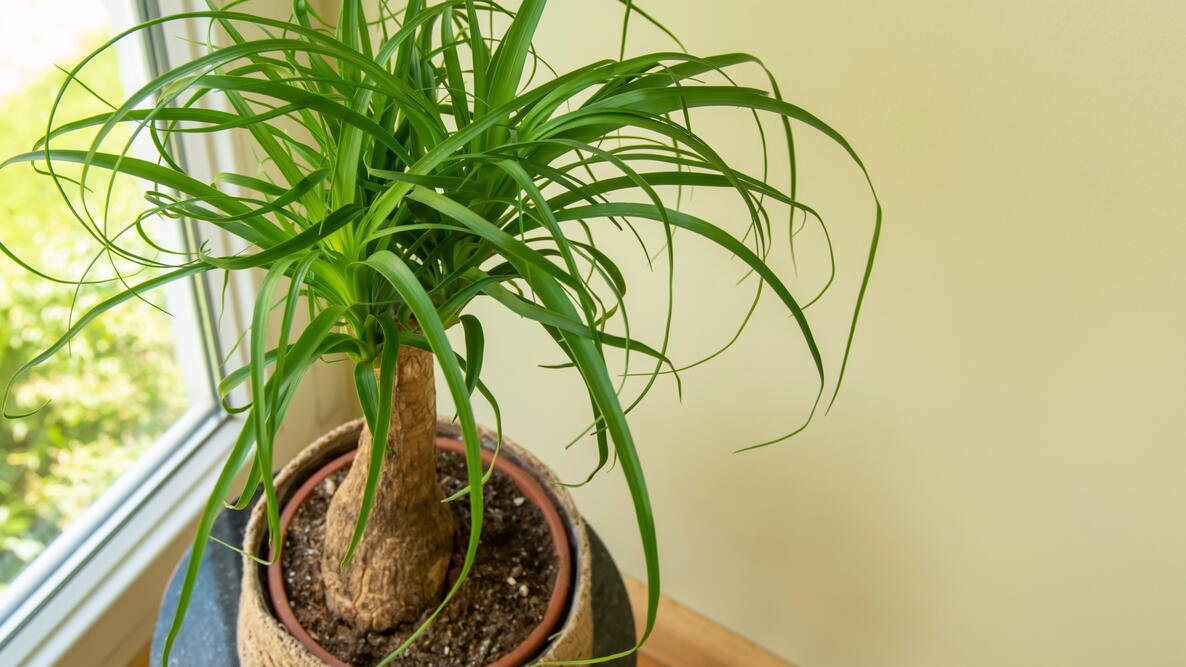
There are reports of 350-year-old ponytail palms in Mexico, so we doubt your plant's issues have anything to do with age. Perhaps the plant needs more light? They are a desert plant, so they grow best when given full sun all day long. Try moving it to a sunnier spot, if possible.
Check your fertilizer, too, to make sure that it is an all-purpose formula and that you are not fertilizing the plant too much or too little. Additionally, you may want to check the pH of the soil. If it is too acidic or basic, the plant will not grow well.
Finally, make sure that you are not over watering. Rotting leaves can mean that the plant is getting too much water. Let the top inch or two of soil dry out between waterings.
Hopefully, one of these changes will be successful for you and your ponytail palm. Good luck!
A ponytail palm grows very slowly, but will eventually fill the space it's given. They do well in pots because they can tolerate being root-bound—that's what keeps them small. If planted in the ground, they can get up to 30ft tall! How deep does the concrete go? If not too deep, the plant's roots will spread underneath, letting it get larger.
Ponytail palms like fairly dry, well-drained soil, and need full sun. If the spot where your husband would like to plant it is right up against the house, there could be rain run off from the roof or the plant could be shaded by your house, depending on which direction it faces.
Assuming that that spot doesn't get too wet and gets full sun exposure, you could plant the ponytail palm there, though you may have to remove it many years down the line if it gets too large. At that point, the roots may be too deep to remove, though!
It sounds like you could be battling mealybugs, which are tiny white pests that can quickly infest a plant. They tend to congregate on the undersides of leaves and look like little pieces of cotton or fungus.
Mealybugs can be tough to get rid of. Repeated application of an insecticide is usually what does the trick. The insecticide that you bought does list mealybugs on its label, so it should be appropriate. Follow the directions on the insecticide's label, and make sure that you search every nook and cranny of the plant, as well as in and around the pot and soil. Remove all the bugs that you can see by hand and know that you'll need to treat the plant several times to kill subsequent generations of the pest. The insecticide only kills the adult mealybugs, but not the eggs.
In the meantime, you may want to move the plant to a different area in case the insects are hanging around that area. Mealybugs spread easily, so keep the infected plant away from other plants.
It depends on what you're looking for in your plant! If you want it to grow as tall as possible with only one central stem, trim off the offshoots so that the plant focuses its growth upward. If you'd prefer that your plant be a little bushier, leave the offshoots alone. Offshoots can add interest, but a tall, single-stemmed ponytail palm is also quite a sight. The plant will do fine with or without the offshoots, so it's up you!
- « Previous
- 1
- 2
- …
- 10
- Next »

Comments