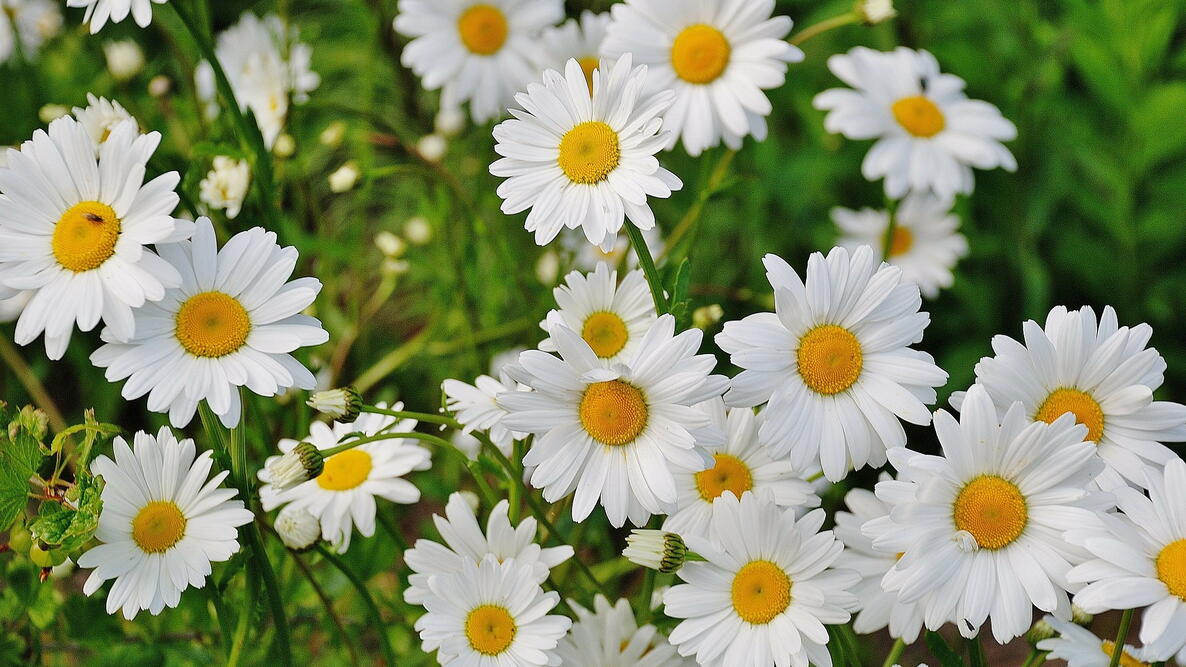
Caption
Learn how to plant and grow shasta daisies, a classic perennial.
Botanical Name
Leucanthemum x superbum
Grown as
Toxicity
Sun Exposure
Water Needs
Height
Spread
Soil pH
Flower Color
Resilience
Plant Type
Types
- ‘Becky’ is a classic variety with large flowers that grows to about 3 feet tall.
- ‘Cobham Gold’ is a popular variety with double flower heads and a yellow disc carried atop 2-foot stems.
- ‘Horace Reed’ is an elegant daisy with double white flower heads and incurved disk florets.
- ‘Snow Lady’ is a fast-growing, erect, bushy perennial that blooms the first year from seed and produces single white flower heads in the summer.

More Like This

Comments
Hi, When you deadhead a daisy do you just take the flower off or the stem it is growing from? I am new to gardening. Love it but a lot to learn.

Shasta daisies produce only one flower per stem, so once a flower is finished, you can cut its stem back to the ground. Other daisy varieties have branching flowers; in this case, cut back only to the next flower bud or set of leaves.
Planted my Shastas about 3 weeks ago. All looked good till I noticed that a a fair amount of heada have turned brown. I have a nist system that comes on every 12 hrs for 5 minutes. Is this condition normal? Should I dead head the flowers that are brown?
Had this question also. Thankyou!
Hello,
My wife and I have a beautiful raised beed that is part of a retaining wall to our pool area. It is filled with Shasta Daisies. They seem to love it there. Every year we cut them back and they grow again in the spring/summer months.
Id like to add some color to the bloom. We have 20+ potted Lillies that are in need of a permanent home. I feel like they would thrive in the same location of the daisies.
Has anyone attempted this?
Do both flowers thrive?
Do they need to be separated within the same bed?
What steps do you take to ensure each plant is healthy?
All advies is appreciated.
Thanks
just sowed seeds in our community green house . this will be a lovely addition to our gardens.
Last summer, after moving into my new abode - Southern Hemisphere time - I threw around some mixed seed - not knowing what might turn up. Amongst my more permanent plantings appeared what I now know is a clump of Shasta Daisies. Following last summer, we had a very wet winter when it rained on average, two or three days every week, if not more, long and heavy! I wondered why this new arrival, whose name I didn't at that time know, would wilt every time there was a bit of sun. Then, I researched on the internet and discovered that Shasta Daisies don't like to be watered too much and to my shame... until I knew what they were, I was supplementing them with even more water! However, when I cut back and the weather improved, my Shasta's have come into their own. They're magnificent!
Got my first Shasta this spring. Not knowing what they would do, I planted in a larger pot and kept on patio. I bring in lots of different plants and place them in southern window all winter and spring. Have had the same Boston ferns and Gerba's now for several years and they all get more beautiful as the years pass. What do I do with the Shasta, take it in or leave it outside in the pot? This spring I hope to put it in a sunny place outdoors and keep it there. Thanks. Cheryl in Central Illinois.
Shasta daisies need a dormancy period, so it would be best to leave the pot in a place where temperatures will get below 40°F. Place it in a spot that is sheltered from strong winds and melting snow—shasta daisies prefer not to sit in wet soil while dormant. It would also be wise to put a 2-inch layer of mulch on top of the pot for extra insulation. If you have a shed or unheated cellar, you could place the pot there, too.
- « Previous
- 1
- 2
- …
- 10
- Next »
📣The Gardening Club Just Got Better! 3 Deliveries, 10% Store Discount, and more!

Harden off (bring outdoors for a couple/few hours per day) and plant in a week or so. See other guidance above.