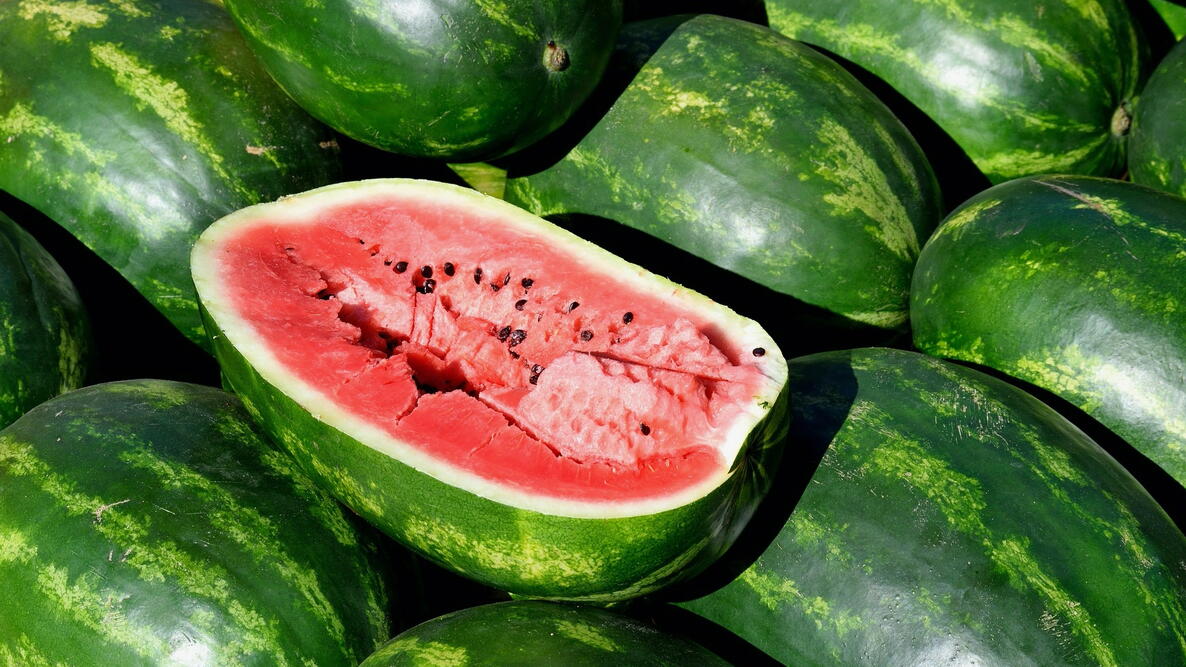
Image Credit:
Pixabay
Botanical Name
Citrullus lanatus
Grown as
Toxicity
Sun Exposure
Water Needs
Height
Spread
Soil pH
Bloom Time
Flower Color
Special Features
Resilience
Plant Type
Planting
When to Plant Watermelons
- In cool climates with short growing seasons, start seeds indoors 2 to 3 weeks before your last frost date. Plan to transplant seedlings into the garden about 2 weeks after that date or when the soil has warmed to at least 65°F (18°C).
- In warmer climates with long growing seasons, sow seeds directly outdoors 1 to 2 weeks after your last frost date, as long as the soil temperature has warmed to at least 65°F (18°C).
- Young watermelon plants can also be bought from nurseries. Plant these after there is no longer a chance of frost; they are very tender. Watch the local forecast and err on the side of caution! Consider laying black plastic over your planting area to warm the soil even more.
- Tip: Starting with young plants can result in an earlier harvest (usually up to 2 weeks earlier), so consider buying young plants, particularly if you live in a cooler climate.
Choosing and Preparing a Planting Site
- Amend soil with aged manure, seaweed, and/or compost before planting. Watermelons are heavy feeders, meaning they need soil that is fertile and has a high nutrient level. Learn more about soil amendments and preparing soil for planting.
- Watermelons do best in loamy, somewhat sandy, well-drained soil. They can struggle in soil that contains too much clay and doesn’t drain well.
- Watermelons prefer a soil pH between 6.0 and 7.5 (“slightly acidic to neutral”).
- Watermelons need A LOT of space—up to 20 square feet per plant. Their vines need room to sprawl, so plant them in a place where they won’t crowd out other crops.
- Growing the vines in raised rows, known as hills, ensures good drainage and will hold the sun’s heat longer.
- Plan to space the plants 2-3 feet apart in a 5-foot-wide hill.
- If you’re growing in traditional rows, space them at least 6 feet apart.
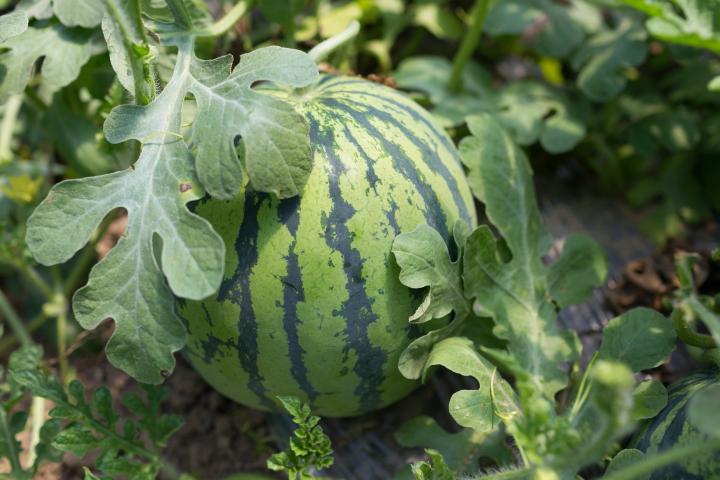
How to Plant Watermelons
- Sow seeds 1/2 to 1 inch deep outdoors or 1/4 to 1/2 inch deep in seed-starting pots indoors.
- Tip: To allow for more root growth, use larger starting pots than you would for most seeds. Also, consider using compostable pots that can be cut away or planted directly in the garden, as this will minimize the risk of damaging seedlings’ tender roots during transplanting.
- If direct seeding outdoors, sow 4 to 6 seeds per hill, eventually thinning to 2 to 3 seedlings.
Transplanting Seedlings
- Handle watermelon seedlings with extreme care when you transplant. Their roots are very fragile, so try not to disturb the soil when removing them from pots.
- After transplanting, cover the plants with row covers to keep pests at bay. Remember to remove the row covers when you see both male and female flowers on the vine, as pollinators will need to access the flowers.
- Find even more tips for planting melons in your home garden.
Growing
Watering Watermelons
- Watering is very important—from planting until fruit begins to form. While melon plants are growing, blooming, and setting fruit, they need 1 to 2 inches of water per week.
- Keep soil moist but not waterlogged. Water at the vine’s base in the morning, and try to avoid wetting the leaves and avoid overhead watering. Reduce watering once fruit is growing. Dry weather produces the sweetest melon.
Fertilizing
- If you choose to fertilize (and many do), make sure it delivers more nitrogen than phosphorus and potassium, as this will encourage leaf and vine growth. However, after flowering begins, use a fertilizer with less nitrogen to instead encourage flowers and fruit. We like to use a seaweed-based fertilizer.
Flowering and Fruiting
- Vines produce male and female flowers separately on the same plant. They often begin producing male flowers several weeks before the females appear. Do not be concerned if the male flowers fall off. The female flowers (which have a swollen bulb at the base) will stay on the vine and bear fruit.
- Blossoms require pollination to set fruit, so be kind to the bees!
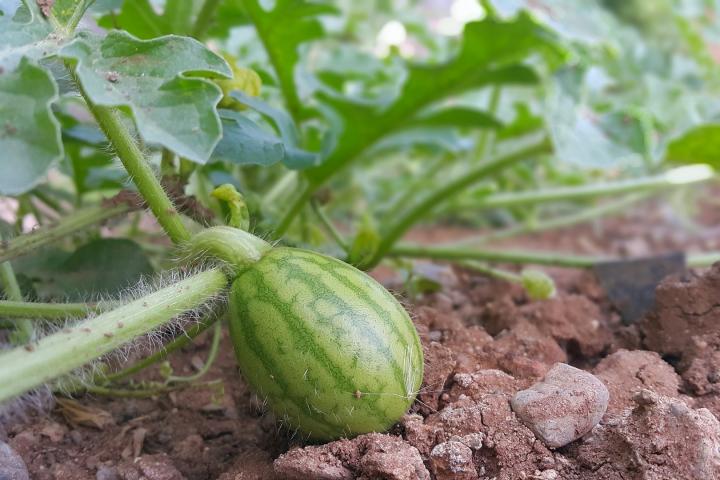
- As the fruit is ripening, prevent rotting by gently lifting it and putting cardboard or straw between the fruit and the soil.
General Watermelon Care Tips
- Mulching with black plastic or straw around the plants will serve multiple purposes: it will warm the soil, hinder weed growth, and keep developing fruits off the soil.
- Pruning generally isn’t necessary for watermelon plants, but vine productivity may be improved if you do not allow lateral (side) vines to grow and stick to the main vine. When the plant is young, just cut off the end buds as they form (before the side shoots become vines). You can also pinch off some blossoms to focus the energy on fewer melons (though it’s challenging to kill off a potential fruit).
Types
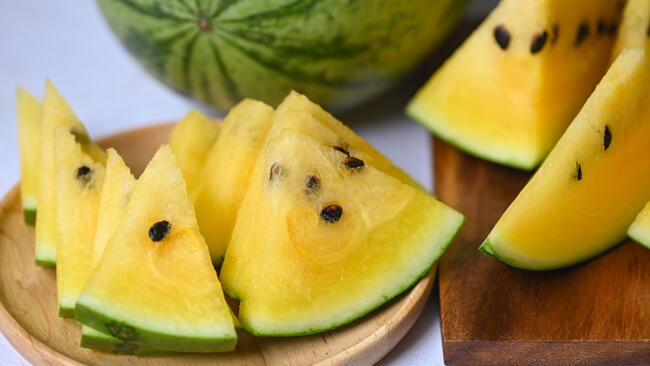
- ‘Golden Midget’: 70 days to maturity. Bears petite, yellow-skinned, 3-pound melons with pink flesh. Good for northern gardeners.
- ‘Sugar Baby’: 80 days to maturity. Produces 10-pound melons with bright red flesh. This variety of smaller fruit can be planted just 4 feet apart.
- ‘Sweet Beauty’: 80 days to maturity. A 2004 All-America Selection. Bears 6-pound, oblong melons with red flesh.

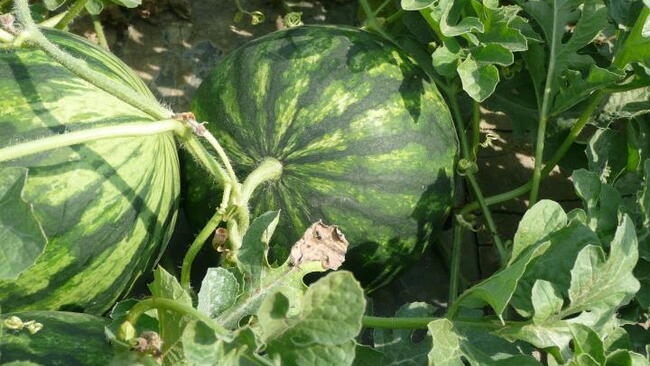


Several folks have had this problem this year (read some below). Your plant probably has a fungus. This can be brought on/introduced several ways; one common one is failure to rotate crops. Curcubits, such as watermelon, should be rotated properly with other crops and not return to the same place/soil in the garden for at least 3 years.
So,okay, you say, you’ve rotated or maybe this is your first year with watermelon. The fungus overwinters in the soil from a previous vine crop. It might be carried by a cucumber beetle. And frequent rains (or watering; you might be giving it too much) can help to spread the fungus. Some sources suggest spraying plants. Certainly some fertilizer—chemical or organic—can help a struggling plant; try it. Can’t hurt. (BTW, I recently heard a farmer observe: If we all drank just water, we’d grow some but we’d be thin and unhealthy.)
If possible, in future, grow cultivars that are resistant to fungus, and control weed growth.
We hope your daughter is not discouraged by this experience. Next year, try a few more kinds of plants. The chance of having greater success is more likely.
Then go to a farmer’s market and buy one, and ask the local grower what he would do or thinks was the problem, too. Sometimes, local conditions indicate more than we can know from here.
I am new to this but I have some water melon that are about the size of a football but some are shrivleing up at the end not where the stem is but the opposite side and another one has a black spot in the same place at the very end what is this from and what can I do to save my plants please help.....
it sounds like flower end rot to me. I had it really bad on my tomatoes last year. it's aparently common to tomatoes, peppers and some squash. my research told me it was due to a calcium deficiency, and that in most cases the soil has enough calcium, but the plant is unable to absorb it usually due to not enough watering, or irregular watering. I've watered my garden more consistantly this year and have not come across any black spot, or flower end rot so far.
I'm a first time grower and have been anxiously waiting for my watermelon plants to produce but every time I get a fruit it gets bite marks within a few days. The fruit then turns black and dies. I'm trying to figure out what the pest could be. I have eggplants and cucumbers that haven't had this problem. Also I have some watermelons that are off around level that are doing fine. Please help!
What type of bite marks? Small, insect holes or canine tooth marks? Animal pests might include racoons, deer, crows, and coyote. They like fruits and melons. Look for tracks near the garden.
If your fruit is turning black and dying, this is usually a different problem called blossom end rot. Usually, the reason is dry weather and lack of water. Watermelon needs adequate moisture, especially as it matures.
Go to your local dollar store or costco and buy crushed red pepper and put it on the outside of your planter box or about 6-12 inches from your plant.. It will keep and of the large animals away
I have a fence surrounding the garden so I'm assuming it's an insect. It does turn black and shrivels but only the fruit that has the bites. I live in the northeast so I don't think it's aphids which are normally south.
This site suggests cucumber beetles: http://urbanext.illinois.edu/tog/insect.cfm
This site suggests ticks: http://www.princeton.edu/~lawrapts/gardeningtips.html
This site suggests pickleworm: http://www.clemson.edu/extension/hgic/pests/plant_pests/veg_fruit/hgic2207.html
The best thing might be to camp out in the garden and keep an eye on it. And consult your local extension service. It might be something local and the experts there might be hearing about this from several people. Here's our handy list of Cooperative Extension links: http://www.almanac.com/content/cooperative-extension-services
This is our first time growing watermelon, hopefully we didn't start too late. We are just getting fruit. We recently had a lot of rain in the past week and my husband just noticed that our biggest watermelon (about the size of a ping pong ball) is black and mushy on the bottom. Does anyone know if this was maybe caused by the rain we got or a possible disease? Thanks!
Sounds like black rot (unless it is at the blossom end of the fruit, in that case it would be blossom end rot). It is a fungus that affects much of the cucurbit family. Immediately remove the infected melon. Ensure proper drainage so that when wet weather strikes, your melons are not sitting in water. Treat the remaining plants with fungicide. Good luck!
- « Previous
- 1
- 2
- …
- 10
- Next »
📣The Gardening Club Just Got Better! 3 Deliveries, 10% Store Discount, and more!

Comments