
Support those tomatoes to prevent branch breakage, avoid pest damage, and provide air circulation. Learn the best supports to use for two types of tomatoes—bush and vine—and how to make inexpensive tomato cages. Plus, we’ll share planting and pruning tips for tomatoes.
Planting Tomatoes
Before we get into supports though, let’s talk about how to prepare those plants. Tomatoes like the warm, so before putting tomato plants in the ground, make sure they acclimatize to the great outdoors for a week in a spot sheltered from wind. Perhaps bring plants in overnight for the first few nights, then leave them outside for increasingly longer as planting time approaches. A cold frame makes a superb halfway house and you can prop open the lid increasingly wide as the days roll on.
When planting, be sure to pick the sunniest spot in your garden – one that gets at least six hours of direct sunshine a day – and preferably more than that. Add plenty of well-rotted organic matter to your soil in the weeks or months before planting. When planting vining tomatoes, give them plenty of space for good sunlight and airflow (18 inches between plants, 2 feet between rows).
- Tomato Tip: Tomatoes are incredible plants because they can produce roots at any point along their stem. With this in mind, we dig planting holes quite a bit deeper than the depth of the rootball so you can bury some of the stems.
- Tomato Tip: Water in your plants (at soil level!) with a weak liquid seaweed solution just to give plants a bit of a lift and help settle them in. Once the plants start flowering, offer an occasional liquid tomato feed.
See the complete Growing Guide for Tomatoes for more information from planting through harvest.
Supporting Tomatoes
Tomatoes need support to avoid breakage, pests, and other problems. The type of support you use depends on the type of tomatoes you’re growing!
- Bush tomatoes (also known as determinate tomatoes) grow up to about three feet high and, therefore, require less support, sometimes little more than a sturdy stake or perhaps a tomato cage. Determinates, by the way, are called that because they have a pre-determined height they’ll reach – and they won’t grow any taller.
- Vining tomatoes (also known as indeterminate tomatoes) grow to head height and sometimes sky high, so they’ll need something more substantial.
(See how to make the supports described below in Ben’s video above.)
Vining/Indeterminate Tomatoes
Vining tomatoes can be grown against tall canes or garden stakes or in a greenhouse, twisted around string.
Firmly secure canes or garden stakes into the ground so they can support the considerable weight of fruit-laden plants and withstand sudden gusts of wind. Tie stems to their canes at regular intervals, leaving enough slack for the stem to continue growing in girth. Secure a tie just above a truss, as this will better support the weight of fruits than a tie secured below a truss.
String supports are easy to set up. Dangle strong string directly from the greenhouse’s framework or from a horizontal string secured and stretched taut between the gable ends. Remember that the greenhouse will be bearing the entire weight of the plants, so it must be strong enough for the job.
Loop the string around the tomato plant’s rootball at planting time to secure it in place. As the plants reach up, twist the string around the stem, completing a full loop around the stem every two leaves. When you reach a truss, tuck the string above or behind it, never below it.
Vining tomatoes can also be trained up in a wigwam structure, one plant for each cane.
Bush/Determinate Tomatoes
In theory, bush tomatoes do not need support, but heavy fruits can weigh plants down onto the ground, increasing the chances of diseases and slug damage.
The simplest way to support them is with garden stakes hammered into to the ground. Tie plants to the stakes. Lift up the branches and drape them over the canes as they grow.

How to Make Tomato Cages
Tomato cages are another option for supporting determinate tomatoes, particularly vigorous varieties that produce lots and lots of branches. Unlike vining types, determinate tomatoes don’t need any pruning and tend to crop over a much shorter period, which makes cages very suitable. But purpose-sold tomato cages don’t come cheap!
It’s easy to make your own from concrete-reinforcing mesh. The 6-inch squares will allow you to easily flex the mesh into a tube to make your cage. They’re inexpensive to make and can be reused for many years.
- Start by cutting mesh that is five to six feet long. When rolled into a tube, this will give a cage diameter of 18 to 22 inches—tight enough to support a plant, while giving it enough room to expand. Use sturdy wire- or bolt cutters to make the cuts, and wear gloves to protect your hands from snagging cuts.
- Once cut, roll the length of the mesh into a tube. Tie the ends together with heavy gauge wire or strong string, then cut off the bottom wire from the cage to leave just the vertical wires sticking out. These wires can be used to push the cage into the ground. For added stability, tie the cage to a vertical length of rebar or a similar sturdy upright. You can also pin the bottom wire to the ground with tent pegs.
- Lower your tomato cage over the top of a plant and pull through any stray branches. As the plant grows, encourage growth upwards through the center of the cage, leaving fruiting trusses to grow outside of the cage to make picking even easier. At the end of the season, store the mesh flat to save space.
See how it’s done. Here’s another video as Ben explores different options for supporting indeterminate/vining and determinate/bush tomatoes.
Companion Plants for Tomatoes
Once you’ve planted and added stakes for your tomatoes, consider giving them some companions to help deter pests.
- Marigolds not only add a splash of color but also deter whiteflies. Just add seeds at the foot of the plants and, in a few weeks’ time, when they come into flower.
- Another great companion to tomatoes is dill, which beneficial bugs like hoverflies love.
- And finally, a sowing of basil – because basil and tomatoes are the perfect pairing, after all.
See our Companion Planting Chart.
Pruning Tomato Plants
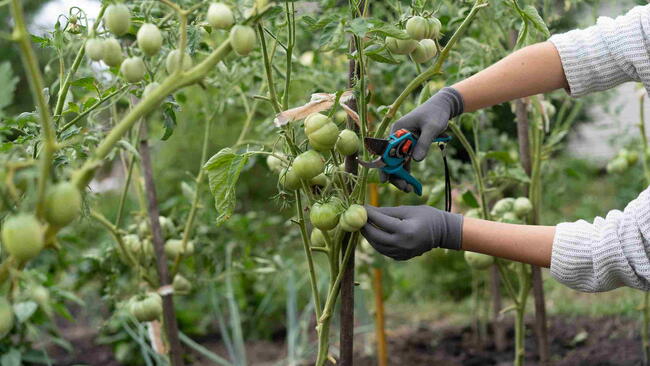
Tomatoes need regular pruning for the best results. This includes pruning trusses to remove excess fruits, removing unproductive lower leaves, and removing side-shoots (suckers). Pruning can even affect the flavor of your tomatoes, according to our page on Tomato Tips.
- Truss Pruning
- Thinning the fruits within the trusses of prolific fruiters such as cherry tomatoes will ensure those that remain grow larger. For varieties that bear particularly heavy fruits, such as the beefsteak tomatoes, thinning fruits to just three per truss will reduce the weight of the truss and make it less likely to snap away from the stem.
- Prune trusses by snipping off the fruits with sharp scissors while they are still small.
- Removing Leaves (Vining Tomatoes)
- Remove all leaves below the lowest ripening trusses of vining tomatoes. These older leaves divert the plant’s energy away from producing more flowers and fruits and reduce air circulation and light penetration. Remove the leaves by pulling them sharply up and then down so they come away from the main stem. Support the stem as you do this.
- Removing Sideshoots (Vining Tomatoes)
- Also known as suckers, side shoots on vining tomatoes distract the tomato from producing flowers and fruits, and must also be removed. Side shoots appear at the point where a leaf joins the main stem. Remove them by wiggling them from side to side, then using your thumb to snap them out. Remove side shoots while they are still young, working from the bottom of the plant up.
Completing these simple training and pruning tasks needn’t take long; they’re a once-a-week job. At the same time, you can inspect your plants and check on the progress of your ripening tomatoes. You can check our Ripeness Guide to determine when your healthy tomatoes are ready for harvest.

More Like This

Thank you for your kind words. It will be too late to sow tomatoes for this year, but to find out what you can sow and plant now why not take out a 30 day free trial to our Garden Planner, which can give personalized sowing, planting and harvesting times for plants in your location. Visit http://gardenplanner.almanac.com/ and click on Start Garden Planner to start your free trial. Click on the Custom Filter button to the left of the plant selection bar on your plan and choose your sowing or planting month to show only plants that can be sown or planted during that month.
Gardening is indeed part art, part science! If you live in the Northeast (as we're guessing you do), it can be elusive due to the fickle weather. During those years when you have the benefit of a warmer-than-normal spring, the soil will get warmer, faster. This will give the tomatoes the boost they need to get ripe that season. Perhaps try warming the soil with black plastic to give it a good jump start? Or, you could try growing in a greenhouse or hoop house. Good luck! --Catherine, Almanac editor
