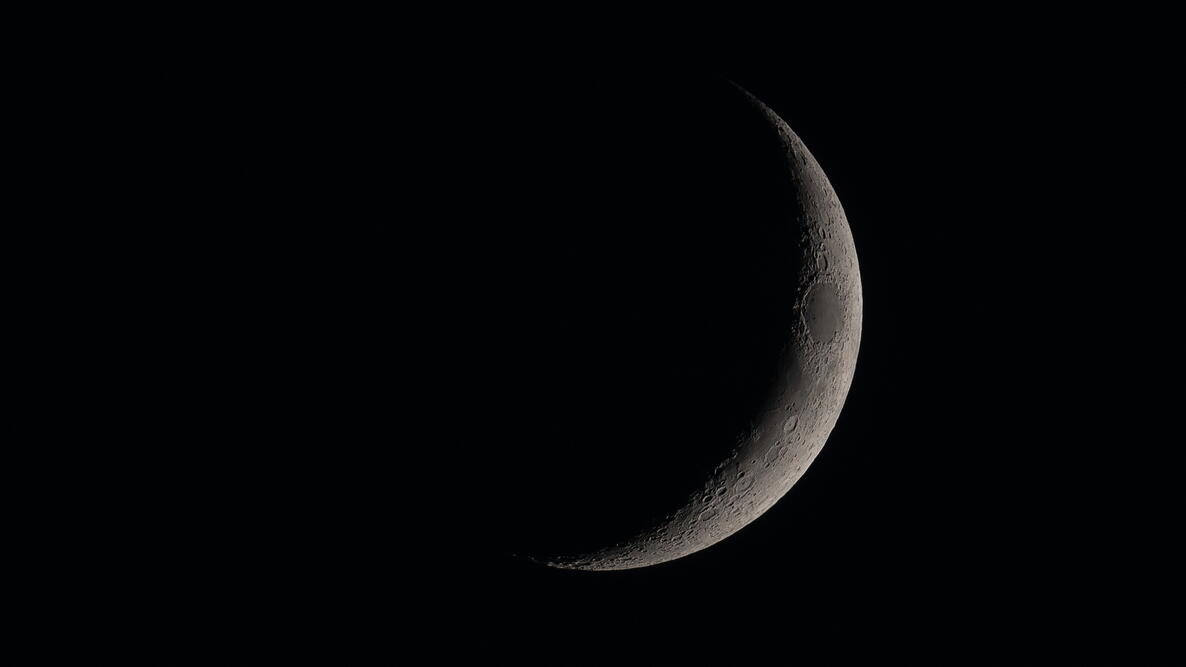
It’s a New Moon! For astronomers, a New Moon means no Moon to see. For many cultures, however, the New Moon carries special meaning. What does a New Moon look like, and what does it mean? Let’s explore, fellow Moon lovers …
What Is a New Moon?
A New Moon is essentially the opposite of a full Moon. During a full Moon, we see the side of the Moon that is illuminated by the Sun, giving the Moon its bright, glowing appearance. During a New Moon, however, we see the side of the Moon that is not being illuminated by the Sun, which makes the Moon blend in with the night sky.
When the Moon is “new,” it’s located between the Earth and the Sun. In other words, the Moon is in line with the Sun, and the Sun and Earth are on opposite sides of the Moon. (Note that when the Moon is perfectly aligned in front of the Sun, it blocks out the Sun, giving us a solar eclipse.)
The New Moon marks the beginning of a lunar cycle. It takes the Moon about 29.5 days to orbit Earth, so there’s a New Moon about once a month. In fact, the word moon shares its origins with the Latin word metri (to measure) and mensis (month). The Moon is called the Moon because it is used to measure the months.
When Is the Next New Moon?
Check out our Moon Phase Calendar or consult the table below to find out when the next New Moon will occur. Time refers to the moment when the Moon is illuminated by 0%.
Below are the exact dates and times of every New Moon in 2026 and 2027.
(Note: Dates and times are according to Eastern time.)
| Month | New Moon Date & Time |
|---|---|
| January | Sunday, January 18, at 2:52 P.M. |
| February | Tuesday, February 17, at 7:01 A.M. |
| March | Wednesday, March 18, at 9:23 P.M. |
| April | Friday, April 17, at 7:52 A.M. |
| May | Saturday, May 16, at 4:01 P.M. |
| June | Sunday, June 14, at 10:54 P.M. |
| July | Tuesday, July 14, at 5:43 A.M. |
| August | Wednesday, August 12, at 1:37 P.M. |
| September | Thursday, September 10, at 11:27 P.M. |
| October | Saturday, October 10, at 11:50 A.M. |
| November | Monday, November 9, at 2:02 A.M. |
| December | Tuesday, December 8, at 7:52 P.M. |
| New Moons in 2027 | Date and time (Eastern) |
|---|---|
| January | Thursday, January 7, at 3:24 P.M. |
| February | Saturday, February 6, at 10:56 A.M. |
| March | Monday, March 8, at 4:29 A.M. |
| April | Tuesday, April 6, at 7:51 P.M. |
| May | Thursday, May 6, at 6:58 A.M. |
| June | Friday, June 4, at 3:40 P.M. |
| July | Saturday, July 3, at 11:02 P.M. |
| August | Monday, August 2, at 6:05 A.M. |
| August | Tuesday, August 31, at 1:41 P.M. |
| September | Wednesday, September 29, at 10:36 P.M. |
| October | Friday, October 29, at 9:36 A.M. |
| November | Saturday, November 27, at 10:24 P.M. |
| December | Monday, December 27, at 3:12 P.M. |
When Does the New Moon Rise?
The New Moon always rises near sunrise! See our handy chart When Will the Moon Rise Tonight?
As the New Moon crosses the sky during the day, rising and setting around the same time as the Sun, it’s lost in the solar glare. See when the Moon will rise and set in your area!
The New Moon is also lit up from behind, showing us its dark side. It’s doubly invisible. New Moons generally can’t be seen with the naked eye.
A day or two after each month’s New Moon, a very slim crescent moon always becomes visible in the west after sunset. It may appear brighter than usual.
Seven days after the New Moon, the Waxing Moon reaches its First Quarter stage when it’s 50% illuminated. Learn why we call it the Quarter Moon rather than the Half Moon.
New Moon Folklore
Here at The Old Farmer’s Almanac, the New Moon is strongly associated with Gardening by the Moon. According to this age-old practice, one should plant vegetables that bear crops above ground during the light, or waxing, of the Moon—from the day the Moon is new to the day it is full.
We also look to the Moon’s phases to determine many holidays based on the lunar calendar. For example, the date of Easter is determined by the Moon’s phase, and the second New Moon after the December solstice marks the Lunar New Year.
Of course, many skywatchers look forward to the Moon’s return to the evening sky and the first sighting of the waxing crescent 1 or 2 days later. This very thin crescent is always low in the evening twilight.
After the Moon’s absence for a few days, it’s kind of a lunar rebirth. Thus, various ceremonies of many cultures revolve around the first appearance of the New Moon.
For Muslims, its sighting officially marks the beginning of each month.

Is There a Dark Side of the Moon?
We’re often asked about the “dark side” of the Moon. There is no side that is always dark: every part of the Moon experiences day and night. The far side is the hemisphere we don’t usually see from Earth.. See more about the dark or far side of the Moon.
What is a Black Moons
There are a few definitions of a Black Moon. One common definition is the second New Moon in a calendar month, similar to the way a Blue Moon can mean the second Full Moon in a month. Read more about Black Moons here.
Does the Moon Look Like a Smile?
Sometimes a waxing crescent looks like a smile; at other times, it resembles an archer’s bow. Its orientation depends on where you are and the time of year. In some northern locations, the crescent can look smile-like in late winter. Read more about Crescent Moons in my article The Captivating Crescent Moon.

More Like This

Comments

Lion-tide is very nice, I like it. The kind of thing that can really catch on. (I assume it goes with "March comes in like a lion....) since the other possible link, to the constellation Leo, wouldn't work, since the waxing crescent is nowhere near that pattern in Feb and March.