Ever wondered where we got the football helmet—or why basketball has a 24-second shot clock? Discover how six sports inventions changed the way we play and watch football, basketball, baseball, and golf.
The inventor’s genius is the ability to look at the everyday and see something new. Players, coaches, and fans with unorthodox views have changed the standard for many sports. Sometimes, all it took was a homemade flag, a pair of work gloves, or a little stretched rubber.
The Football Penalty Flag
Before the penalty flag, football referees blew a horn attached to their wrists to signify a penalty and blew a whistle to stop the play. On the sidelines in Youngstown, Ohio, coach Dwight “Dike” Beede couldn’t distinguish one from the other.
“I thought that perhaps if there were some visual signal given which wouldn’t be heard by the players, it would be helpful,” Beede said later.
On October 17, 1941, the Youngstown College Penguins were to play a night game against Oklahoma City. Dike asked his wife, Irma, to make four flags. She sewed triangles of red cloth from a Halloween costume to triangles of white cloth from a bed sheet. Into one corner of each flag, she sewed curtain weights.
“If you drop one of these whenever there’s a penalty, I think we’ll have a better game,” Dike suggested to the officials.
But the historical importance of this game passed unnoticed. The Penguins won, and three of the officials threw away their flags.
Only Jack McPhee, the head linesman, kept his flag, and he was to use it often. McPhee later tossed Irma Beede’s flag in a game between Ohio State and Iowa in Columbus, Ohio, helping introduce the idea to a wider audience.
What began as a homemade visual signal eventually became standard equipment. In 1948, the NFL approved the penalty flag.
Basketball’s 24-Second Shot Clock
Attendance was low in the National Basketball Association in the early 1950s. The problem was time: too much of it.
Danny Biasone, owner of the Syracuse Nationals—now the Philadelphia 76ers—recalled games in which no one scored during the last 8 minutes.
“The game had become a stalling game,” he said before his death in 1992. “A team would get ahead, even in the first half, and it would go into a stall. The other team would keep fouling, and it got to be a constant parade to the foul line. Boy, was it dull!”
“We needed a time element in our game,” he said.
Biasone and Nationals general manager Leo Ferris helped develop the solution: a limit on how long a team could hold the ball before attempting a shot.
The calculation was simple. If each team took 60 shots during a 48-minute game, that would mean 120 shots in 2,880 seconds—or one shot every 24 seconds.
The NBA introduced the 24-second shot clock for the 1954–55 season. Teams could no longer protect a lead simply by holding the ball. The clock helped turn a stalling game into a faster, livelier contest and is widely credited with helping save the NBA.
The Plastic Football Helmet
The football helmet wasn’t invented all at once. Early players wore leather headgear, and later designs introduced new materials and ways to improve the fit.
In 1939, the John T. Riddell Company of Chicago developed a plastic suspension helmet. Its molded shell and adjustable web suspension marked an important change from earlier leather designs.
An experimental use in the 1939 College All-Star Game in Chicago was a hit. But wartime shortages made plastic difficult to obtain.
The suspension design also found a military use, helping support the liners worn beneath soldiers’ steel helmets. When Army’s football team won the national collegiate championship wearing plastic helmets in 1944, other colleges took note.
The familiar football helmet would continue to change, but the move from leather to plastic was a major step in its development.
The Baseball Catcher’s Mitt
In the barehanded days of early baseball, the catcher required the nerves of a test pilot. Catching pitch after pitch without protection took a toll on the hands.
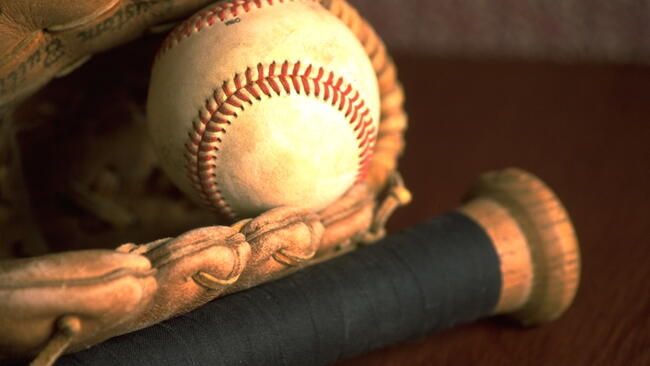
One early experiment came from William “Gunner” McGunnigle of Fall River, Massachusetts. Before a game against Harvard in 1875, he borrowed a pair of thick bricklayer’s gloves to protect his hands. The 1895 Reach’s Official Baseball Guide later credited him with an early use of the catcher’s mitt.
McGunnigle’s gloves were part of a broader change in baseball equipment. Gloves appeared in different forms during the 19th century, and increasingly padded designs helped lead to the rounded catcher’s mitt.
Heavily padded gloves made specifically for catchers were soon on the market. An 1890 advertisement for Spalding gloves listed four different models priced from $2 to $5.
“No player subject to sore hands should be without a pair,” the ad urged.
The Rubber-Wound Golf Ball
In 1898, Coburn Haskell of Cleveland, Ohio, and Bertram C. Work, a superintendent at the B. F. Goodrich Company, helped develop one of the most important innovations in golfing equipment: the rubber-wound golf ball.
Haskell’s obsession was golf. In the story told of their collaboration, Work challenged him to turn that enthusiasm into an invention.
“Why don’t you do something constructive,” Work chided.
“No thanks,” Haskell replied. “Golf is all I care about.”
“Then invent a better golf ball,” Work suggested.
Haskell accepted the challenge. Armed with a supply of elastic yarn, he worked at winding the stretched rubber into a tight ball. When the ball reached the size of a small marble, it shot from his fingers and bounced around the room.
Haskell and Work developed a ball with a tightly wound rubber interior and a gutta-percha (rubberlike material) covering. Their design was granted a patent on April 11, 1899.
When a local golf professional tested the prototype, he watched in amazement as it landed beyond a bunker that no one had reached in one drive. The new ball’s greater distance helped transform the game.
Prior to Haskell’s ball, golfers had played with leather balls filled with hair, leather balls filled with feathers, and solid gutta-percha balls. The rubber-wound design became an important step toward the golf balls used today.
The Reddy Tee: Popularizing the Wooden Golf Tee
In 1921, at the age of 60, Dr. William Lowell of South Orange, New Jersey, took up golf. He was appalled by the practice of teeing the ball on a pyramid of wet sand, leaving a player with gritty hands.
Instead, Lowell used his dental tools to whittle a golf tee.
He wasn’t the first to devise a wooden tee. Dr. George Grant had received a U.S. patent for a golf tee in 1899. But Lowell’s Reddy Tee helped make wooden tees common practice.
Although Lowell’s partners referred to his tees as “suppositories for wildcats,” his sons saw commercial potential. In 1924, Lowell received a patent for his design.
His Reddy Tee was packed in boxes of 18 that sold for a quarter. Lowell imagined golfers would leave them behind and use a box per round. He even planned a biodegradable version until he realized golfers were hanging on to the little wooden spikes.
The tee got a professional boost when Walter Hagen, the U.S. Open champion, pulled up to Lowell’s dental office and asked where he could get more.
Advertised as “The Tee of Champions,” the Reddy Tee became a commercial success. Competition eventually caught up with Lowell, and his company office closed in 1933. But the little wooden spike had earned its place in the game.
Do you know of any other sports inventions that changed the game? Share your favorites in the comments!






Comments