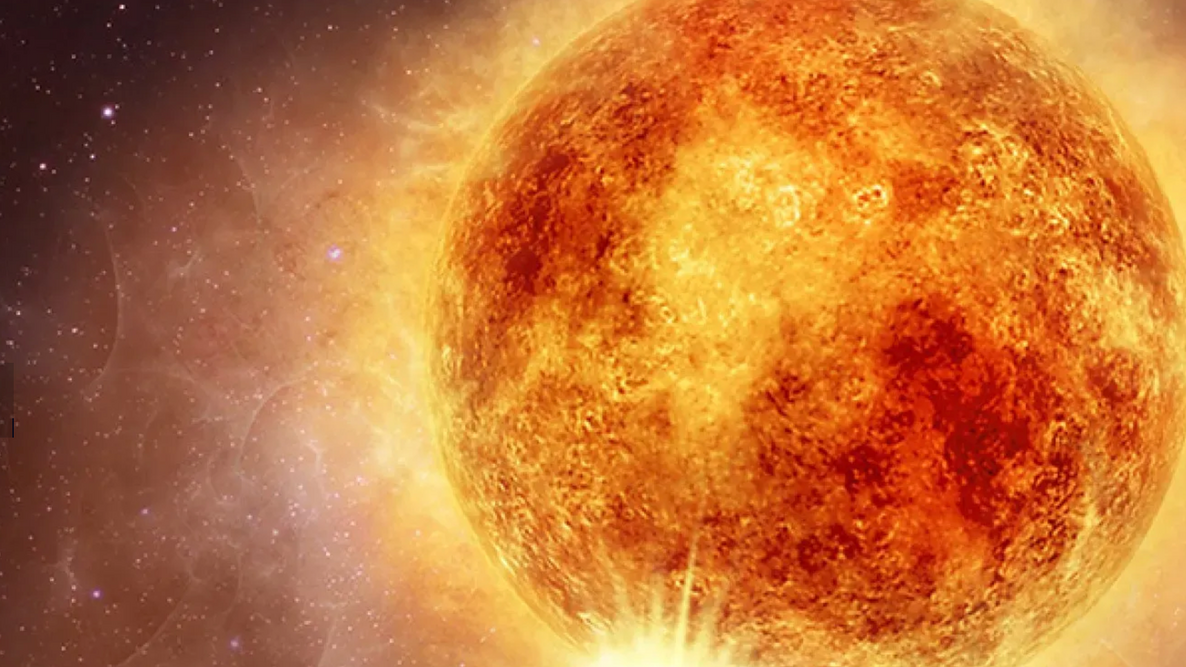
Caption
Betelgeuse, one of the most massive stars in the night sky
Betelgeuse, the brilliant red supergiant marking one of Orion’s shoulders, is returning to the night sky—just as many of us begin revisiting our favorite Beetlejuice movies! This famous star is enormous, unpredictable, and destined to explode someday. Discover how Betelgeuse got its unusual name, how big it really is, and when you can see it for yourself.
What Is Betelgeuse?
Betelgeuse is a red supergiant star in the constellation Orion. Its distinctive orange-red color is visible to the unaided eye, making it one of the easiest stars to recognize in the winter sky.
This celestial heavyweight is nearing the end of its life. After exhausting the hydrogen in its core, Betelgeuse expanded and cooled, becoming the swollen red star we see today. Eventually, it will explode as a supernova—but astronomers cannot say exactly when.
As seen from Earth, Betelgeuse marks the shoulder of Orion. We’ll get into viewing tips later. First, let’s tackle its unusual name, which may be almost as strange as the star itself.
What Does the Name Betelgeuse Mean?
The name Betelgeuse has confused scholars, astronomers, and dictionary writers for centuries. Older references offer translations ranging from “Shoulder of the Giant” to “Armpit of the Central One.”
Modern scholarship generally traces the name to the Arabic phrase yad al-Jawzā’, meaning “the hand of al-Jawzā’.” Al-Jawzā’ was a figure in early Arabian sky lore whose name later became associated with Orion.
So, how did yad become Betel? Most likely, a copying error changed the Arabic letter for “y” into one resembling a “b.” That small slip of the pen eventually may have given us the wonderfully odd name Betelgeuse.
The older “armpit” interpretation probably developed later, but it has proved difficult to shake—which seems appropriate for a star positioned near Orion’s shoulder.

How Do You Pronounce Betelgeuse?
There is more than one accepted English pronunciation. You may hear:
- BET-el-jooz
- BEET-el-joos
Astronomers often use the first, while the second explains why celestial beginners—and Hollywood—have long heard “Beetlejuice.”
In the original 1988 movie, actor Michael Keaton’s character was named Betelgeuse, matching the spelling of the star name, while the movie itself was titled Beetlejuice. The 2024 sequel doubled down with Beetlejuice Beetlejuice. Apparently, saying it three times remains inadvisable.
How Big Is Betelgeuse?
There’s nothing humorous about the actual star. Betelgeuse is one of the largest stars visible to the unaided eye, with a radius hundreds of times greater than the Sun’s.
If Betelgeuse replaced our Sun, its surface would extend beyond the orbit of Mars and possibly toward Jupiter, depending on which size estimate is used. Earth, Mercury, Venus, and Mars would all be swallowed inside it.
Just visualizing its enormity is fun all by itself. My favorite model, which I created during my college days, is this: If Betelgeuse were represented by an enormous orange ball standing as high as a 10-story building, Earth could be represented by the period at the end of this sentence.
Betelgeuse is also one of the few stars whose disk and surface features astronomers can resolve directly. It is so large—and close by stellar standards—that powerful telescopes can do more than record a pinpoint of light.
The red supergiant Antares, marking the heart of Scorpius, is a pretty good Betelgeuse look-alike. Both stars are immense, cool, reddish supergiants, although neither holds the title of largest known star.
How Far Is Betelgeuse From Earth?
Betelgeuse is probably about 500 to 600 light-years away, but measuring its distance has proved surprisingly difficult.
Ordinarily, astronomers determine the distance to nearby stars using parallax: measuring the tiny apparent shift in a star’s position as Earth travels around the Sun. But Betelgeuse’s enormous, changing surface makes it difficult to identify a stable center point, so distance estimates continue to vary.
A light-year is the distance light travels in 1 year. This means the Betelgeuse we see tonight is the star as it appeared roughly 500 to 600 years ago.
Does Betelgeuse Have a Companion Star?
For years, Betelgeuse appeared to be a bright, companionless orange star. That story has now changed.
Astronomers long suspected that a smaller star might be orbiting Betelgeuse and causing one of its mysterious cycles of brightening and dimming. In 2025, researchers reported a probable direct detection. Then, in 2026, astronomers using the European Southern Observatory’s Very Large Telescope captured the clearest image yet of Betelgeuse B, a much smaller companion circling the supergiant.
The pair appears to complete an orbit approximately every 6 years. Remarkably, the smaller star travels through or near Betelgeuse’s vast outer atmosphere—hardly a peaceful place for a companion.
This discovery makes Betelgeuse even stranger than we thought and may help explain its long cycle of changing brightness.
What Is a Supernova?
A supernova is the tremendous explosion that can occur when a massive star reaches the end of its life. During the event, the star suddenly becomes millions or even billions of times more luminous and may briefly outshine an entire galaxy.
Betelgeuse began life with far more mass than the Sun—current estimates put it at roughly 16 to 19 solar masses. Stars this massive live fast, burn through their nuclear fuel, and die young.
When Betelgeuse’s core can no longer support the star, it will collapse. The resulting explosion will blast much of the star’s material into space, while the remaining core will probably become a neutron star.
Will the Betelgeuse Supernova Be Dangerous?
Fortunately, Betelgeuse is much too far away for its eventual explosion to threaten Earth. NASA describes the anticipated supernova as a spectacular sight, but not a danger to us.
Visually, however, it would be unforgettable. Betelgeuse might become bright enough to see during the daytime and could cast shadows at night. It would then gradually fade over the following weeks and months.
Despite its brilliance, the supernova would not be unsafe to look at. It would simply give humanity a front-row seat to one of the universe’s most powerful events.

How to Find Betelgeuse in the Night Sky
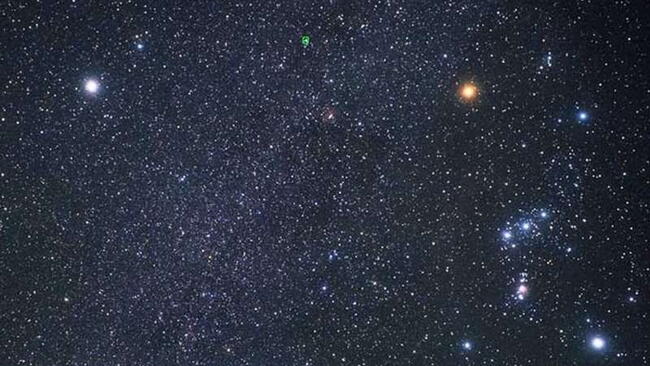
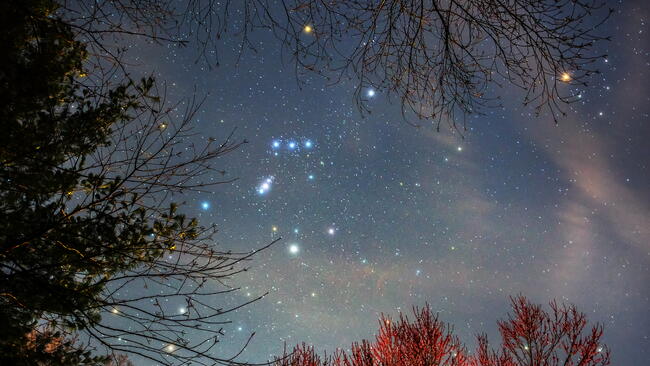
Betelgeuse is easiest to find by locating Orion’s Belt—the prominent row of three evenly spaced stars. When Orion is rising, the Belt may appear nearly vertical. Look to the left of the Belt for a bright orange-red star. That’s Betelgeuse.
From mid-northern latitudes, these approximate times can help:
- In late September, Betelgeuse rises after midnight and is best seen before dawn.
- By Halloween, it is low in the east around 11 P.M.
- By Thanksgiving, it rises around 9 P.M.
- By Christmas, Orion is visible during the evening and remains in the sky for much of the night.
- Betelgeuse continues to dominate the evening sky through winter and remains visible after sunset into April.
Exact rising times vary with your location, but Betelgeuse rises roughly 2 hours earlier each month.
Its color is the giveaway. Most bright stars look white or blue-white, while Betelgeuse displays an unmistakable orange-red glow.
Why Did Betelgeuse Suddenly Dim?
Observers have always known that Betelgeuse changes brightness. It is a semiregular variable star that expands, contracts, brightens, and fades through several overlapping cycles.
But in late 2019, something extraordinary happened. Betelgeuse began losing its familiar brilliance. By early 2020, it had faded to roughly 40 percent of its usual brightness. Suddenly, it no longer dominated Orion’s upper half; it barely outshone Bellatrix, the star marking Orion’s other shoulder.
Everyone had the same thought: Was Betelgeuse about to explode?

This NASA image shows how Betelgeuse became fainter in early 2020. In the first two panels, a hot blob of plasma is ejected from the surface. In the third panel, the gas rapidly expands outward, then cools into an enormous cloud. In the fourth panel, the huge dust cloud blocks the star’s light.
It wasn’t. By April 2020, Betelgeuse had largely recovered.
Observations from NASA’s Hubble Space Telescope and other observatories indicated that Betelgeuse had ejected an enormous amount of hot material from its surface. As that material traveled outward, it cooled and formed a dust cloud that temporarily blocked part of the star’s light.
Astronomers call this episode the Great Dimming. It was dramatic, but it was not the beginning of a supernova.
When Will Betelgeuse Explode?
No one knows.
Betelgeuse could go supernova tomorrow as seen from Earth, or it might remain intact for tens of thousands of years. Many estimates allow as much as 100,000 years until the explosion—and that is still “soon” in astronomical terms.
Because Betelgeuse is hundreds of light-years away, the explosion may even have occurred already, with its light still traveling toward us. But astronomers have detected no reliable sign that the event is imminent.
A backyard telescope won’t reveal the answer. Betelgeuse still looks like a bright orange point through ordinary equipment. Yet that point represents an enormous, restless star surrounded by expelled gas and dust, accompanied by a newly detected stellar neighbor, and creeping toward one of the most spectacular endings in nature.
It remains reassuring and perilous at the same time—a cosmic time bomb with a countdown clock no one can read.
So, we watch and wait.
Perhaps we could kill some time by seeing the movie.


Comments