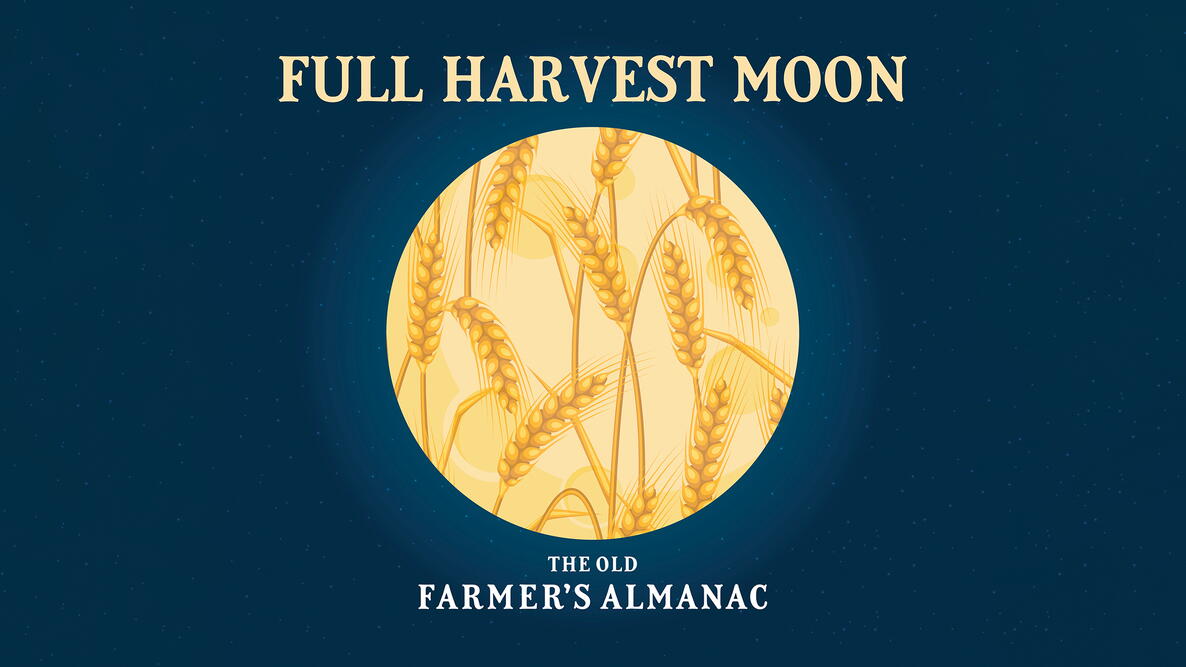
Mark your calendars! The September 2026 Full Harvest Moon peaks on Saturday, September 26, at 12:49 P.M. Eastern Time. Rising low on the horizon, it will appear bigger, brighter, and more golden than any other Moon this year, casting long light across autumn fields and evening skies.
When to See the Full Harvest Moon in September 2026
This year, September’s Full Harvest Moon will peak in illumination at 12:49 P.M. Eastern Time on Saturday, September 26. It will be below the horizon at this time, so be sure to watch for it after sunset… it will be hard to miss!
Why the Harvest Moon Is Different From Other Full Moons
The Harvest Moon is the Full Moon closest to the autumnal equinox (September 22 or 23). Unlike other Full Moons, it rises about the same time for several nights, providing extended evening light. Historically, this extra illumination helped farmers complete their harvests before fall frosts.
Read more about the Harvest Moon!
Best Times and Locations to View the Harvest Moon
- Horizon viewing: The Moon appears largest when rising or setting.
- Open landscapes: Fields, parks, or waterfronts add scale and drama.
- Local timing: Peak illumination is at 12:49 P.M. EDT, but it is visible for several evenings before and after.
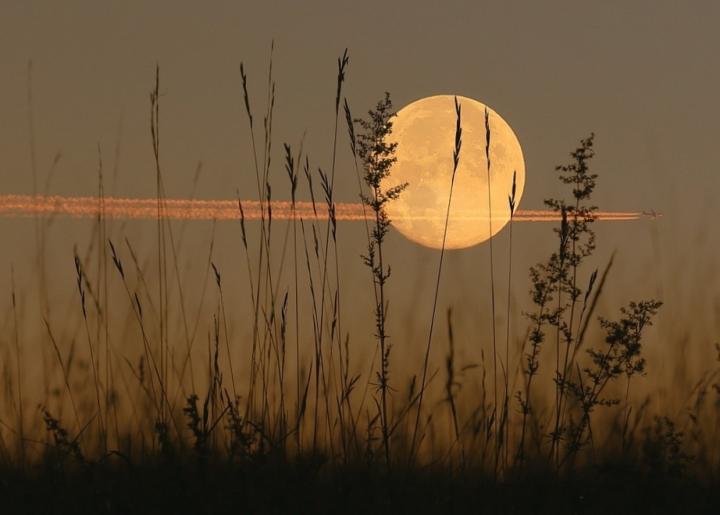
Is the September 2026 Full Moon a Harvest Moon or Corn Moon?
In 2026, the September Full Moon is a Harvest Moon.
Occasionally, the Full Moon closest to the equinox is actually the October Moon. When this happens, the October Moon is designated as the Harvest Moon, and the September Full Moon is named the Corn Moon.
This is because this time of year—late summer into early fall—corresponds with the time of harvesting corn in much of the northern United States. For this reason, a number of Native American peoples traditionally used some variation of the name “Corn Moon” to refer to the Moon of either August or September. Examples include Corn Maker Moon (Western Abenaki) and Corn Harvest Moon (Dakota).
Alternative September Moon Names
Other Moon names for this month highlight how September is the transitional period between summer and fall:
- Autumn Moon (Cree)
- Falling Leaves Moon (Ojibwe)
- Leaves Turning Moon (Anishinaabe)
- Moon of Brown Leaves (Lakota)
- Yellow Leaf Moon (Assiniboine)
The behavior of animals is also a common theme, with Child Moon (Tlingit) referring to the time when young animals are weaned, and Mating Moon and Rutting Moon (both Cree) describing the time of year when certain animals, like moose, elk, and deer, are looking to mate.
→ Read more about Full Moon names and their traditional meanings here.
Moon Phases for September 2026

Here are the Moon phase dates and times (EDT) for the month of September. Check our Moon Phase Calendar for dates and times in your city.
 | Last Quarter: September 4, 3:51 A.M. EDT |
 | New Moon: September 10, 11:27 P.M. EDT |
 | First Quarter: September 18, 4:44 P.M. EDT |
 | Full Moon: September 26, 12:49 P.M. EDT |
When is the next Full Moon? Consult our Full Moon Calendar to find out.
September Full Moon Video
Why does the Moon ride high or low in the sky? Find out the answer to this question—and learn more about September’s Full Moon—in this entertaining video.
Best Days in September 2026
Below are the best days for activities, based on the Moon’s sign and phase in September.
| Activity | Best Days |
| Harvesting aboveground crops | 14, 15 |
| Harvesting belowground crops | 5, 6 |
| Setting Eggs | 3, 4, 20-22, 30 |
| Fishing | 10-26 |
→ See Best Days for more activities.
Frequently Asked Questions
Why is it called the Harvest Moon?
The Harvest Moon is the Full Moon that occurs closest to the autumnal equinox. It rises shortly after sunset for several nights in a row, providing extra evening light that once helped farmers gather crops before the first frost.
Will the Harvest Moon look bigger than usual?
Yes. Because it rises low on the horizon, the Harvest Moon often appears larger and more golden due to the Moon illusion, especially just after moonrise.
Is the September 2026 Full Moon a supermoon?
No, the September 2026 Harvest Moon is not classified as a supermoon, but it can still appear impressively large and bright when viewed near the horizon.
Why does the Harvest Moon rise earlier than other Full Moons?
Around the autumnal equinox, the Moon’s path across the sky is at a shallow angle, causing it to rise only about 30 minutes later each night, instead of the usual 50 minutes.
Are you a Full Moon lover? Share your thoughts below!

More Like This
Comments

This is the time of the new Moon! You won't see it at night. It always rises at sunrise.
Read more: http://www.almanac.com/content/when-will-moon-rise-today
Interesting question! The times and time zone that you are describing suggest that the Moon was setting, which would explain its change in color and its later disappearance.
To give some details: No lunar eclipse has been forecast for this time. The new Moon was on September 24; first quarter on October 1. So, the Moon is now a waxing crescent. Although exact timing of moonrise/set will depend on your location, I've chosen Lebanon, Missouri, for an example for Central Daylight Time. So, according to the United States Naval Observatory data, for that location, on September 28, it rose at about 11:13 am CDT and set at about 9:47 pm CDT. On September 29, the Moon rose at about 12:12 pm CDT and set at about 10:36 pm CDT. So, I'm guessing from your time zone, you wouldn't see it at 10:45 (or at 10:00 September 28) because it would have then been below the horizon.
When the Moon is setting, one sees it through a thicker atmosphere. The thicker the atmosphere, the more likely the light has to travel through dust, pollution, etc., which can scatter more of the shorter wavelengths of light, leaving the longer wavelengths, such as red, to reach your eyes. This can make the Moon appear red. Smoke from fires or volcanic ash high in the atmosphere can also change the Moon's color to reddish.
Hope this helps!
Since a blue Moon occurs only every two or three years, a birth during this time is certainly something to celebrate! As to folklore, nothing shines through as a widespread belief, although you can find some sources online that say various things.
- « Previous
- 1
- 2
- …
- 10
- Next »

Hi Teri, we're sorry about that! It has been updated, so you can find the full Moon for August here.