Image Credit:
Wikimedia Commons
Identification
How to Identify Squash Vine Borers
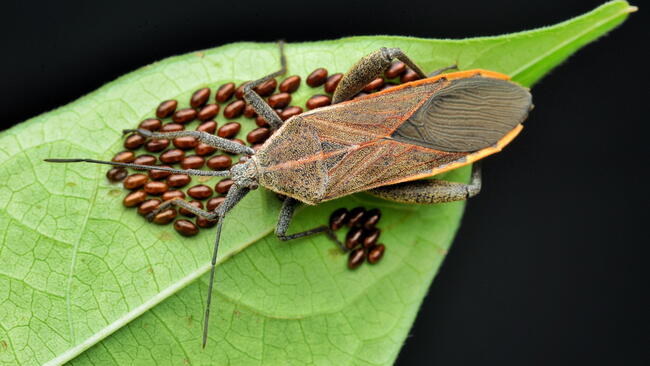
- Eggs: The eggs are tiny, flat, oval, and brown. The eggs are laid around the bases of squash plants.
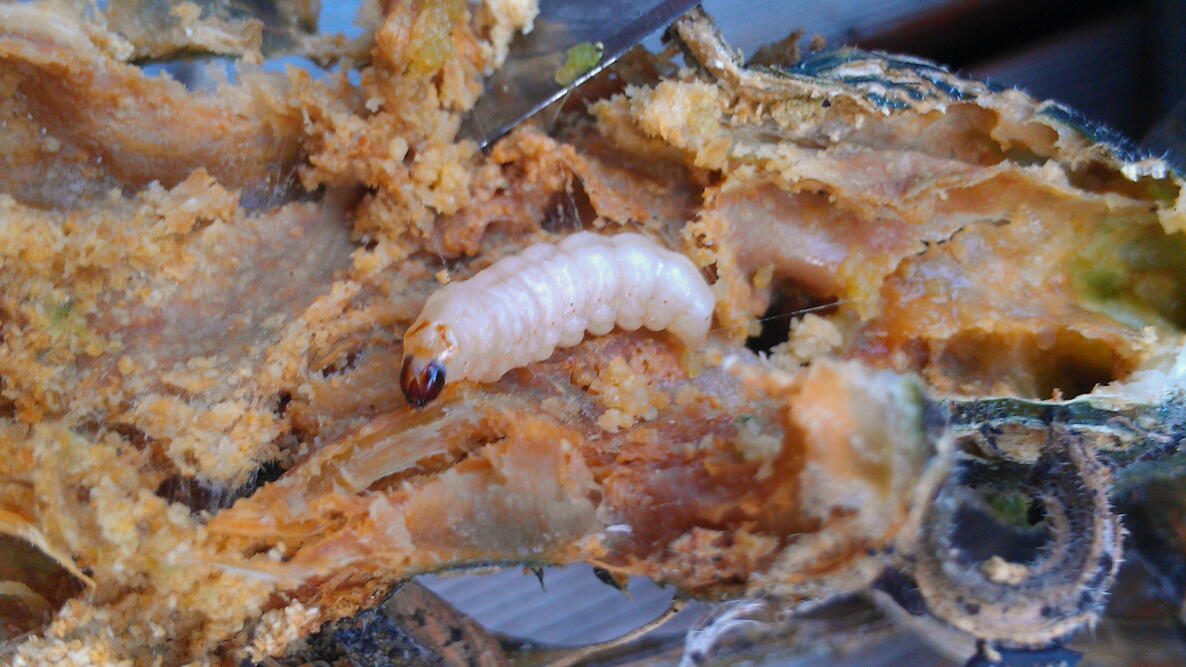
- Larvae: If you slit open a stem lengthwise with a fine, sharp knife, you will see the borer larva, which has a fat, white, wrinkled body and brown head; it can grow to about 1 inch long.
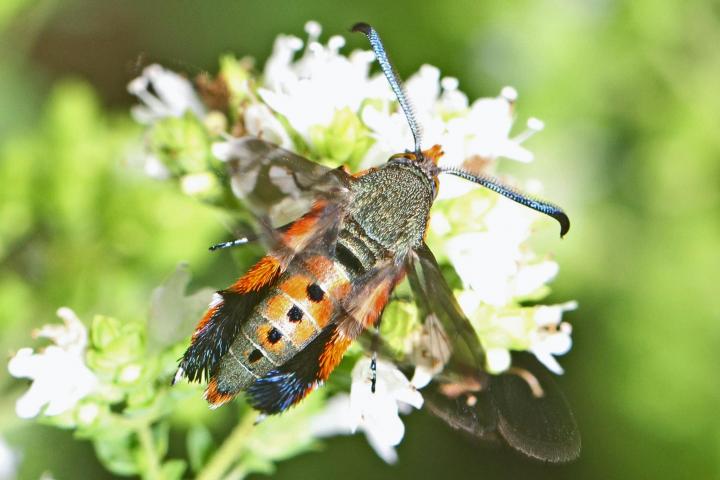
- Moths: The adult squash vine borer is a moth about 1/2 inch long. It has a gray or black body, marked with orange-red on its abdomen, legs, and head. The hind wings are transparent, and the front wings are metallic green.
Identifying Squash Vine Borer Damage
- First, the leaves of the plant will likely start to wilt inexplicably.
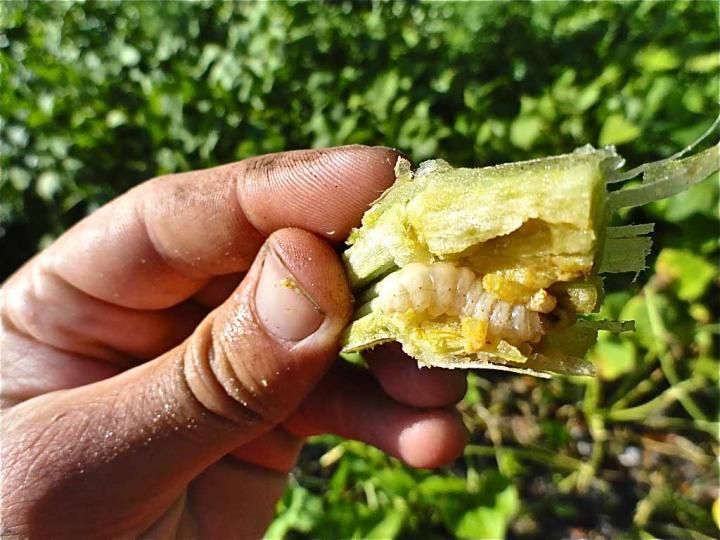
- Look for holes at the base of the plant and green or orange-yellow sawdust-like “frass,” which is fecal matter (poop!)
- Squash vine borer larvae feed on the material inside the stems of the plants. The stem will start to rot at the site of the feeding first.
Control and Prevention
How to Prevent Squash Vine Borers
As with most pests, prevention is key.
- Sometimes, the best solution is to start your squash as early as possible. This way, plants will be strong enough to withstand any midsummer attacks, and you may even be harvesting before squash vine borers become active. If you plant early, you may need to be prepared to cover your plants in case of late frost.
- Do not plant squash in the same area two years in a row. Squash vine borers overwinter in cocoons in the soil. Also, clean up and dispose of all plant debris in the fall.
- Dispose of the squash plants as soon as they are finished for the season. In the fall and spring, till the soil to get rid of overwintering pupae.
- Physical barriers can be an effective means of keeping squash vine borers at bay:
- Cover plants’ stems with a barrier, such as strips of nylon stockings or aluminum foil, to prevent egg laying.
- Before flowers appear on the plants, use row covers to keep squash vine borers away. The covers will need to be removed for pollinators, eventually. This will not only give you a head start over pests, but will help protect your plants from strong heat and frost.
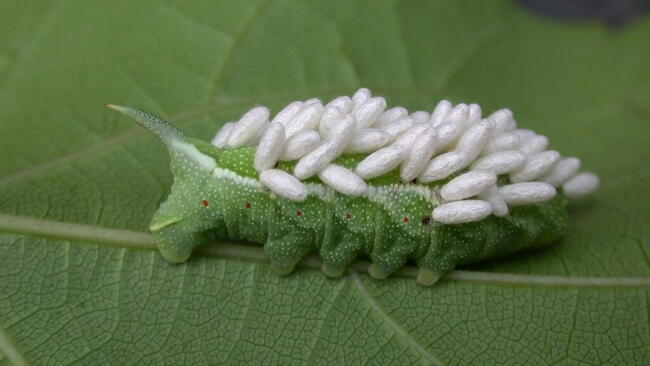
- Adding beneficial insects such as parasitic wasps to your garden prior to the vine borer’s egg stage can be helpful, as these wasps are the borers’ natural enemies.
- If you give up on zucchini, which is susceptible to vine borers, try growing a squash that’s more resistant. Butternut squash and Cucuzzi (Lagenaria siceraria)—also known as snake gourd—tend to be resistant to squash vine borer attacks.
- Plant extra squash for the pests! This pest is around for only 6 to 8 weeks and can only eat so much (or so we think), so making sure you have plenty of plants to spare can help you avoid a total loss for the season.
How to Get Rid of Squash Vine Borers
If you’re already seeing signs of squash vine borers, use the following methods to get rid of them or at least minimize their damage to your crops.
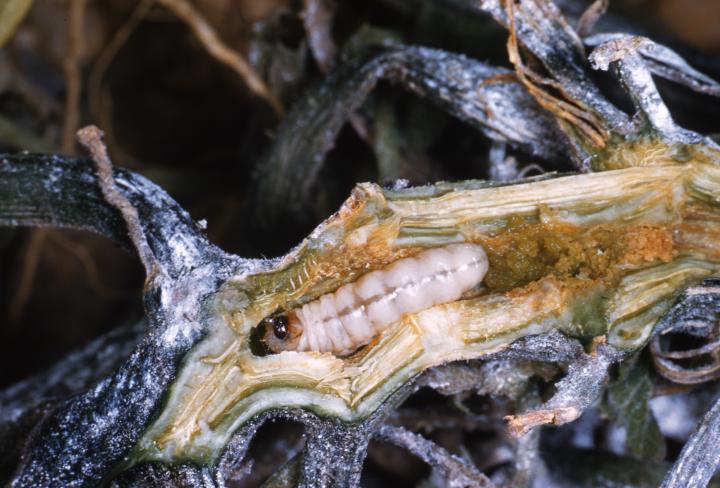
- If you catch them very early, you can manually remove the squash vine borer. Locate the entry point of the larvae, then slit the stem lengthwise with a fine, sharp knife to remove the larva by hand. One plant can house several larvae. Carefully remove the larvae without doing more damage to the plant. After removal, cover the slit stem section with moist soil above the point of injury to promote the formation of secondary roots. Also, extra rich soil near the vines helps to reroot.
- If you can find the entrance holes and “sawdust,” try inserting a wire and threading it through the stem for some distance to kill the larvae inside.
- Sprinkle diatomaceous earth around the stalks when the squash vines are small, or the threat of squash vine borers is high (early to mid-summer). Reapply after rain. Also, build up the soil around the vines. Or, sprinkle black pepper around the plants as a defense.
- If possible, catch and destroy the moths at twilight or in the early morning when they are resting on the upper leaves of the plants.
- There are insecticides that work too, but timing is critical; they are only truly effective when applied at the time when eggs are hatching.
- The bacteria Bacillus thuringiensis v. kurstaki (“Btk”) is a natural insecticide that can be injected into and applied to the squash stems.
- Insecticides containing the ingredients carbaryl (brand name: Sevin) or permethrin will work on squash vine borers, too. Always be sure to read labels and warnings carefully before application of any insecticide.
- Consult your local cooperative extension service for advice on appropriate chemical controls.
- Trap the adult orange moths with yellow sticky traps and yellow-colored bowls of soapy water.
- A trap crop of very early-planted Hubbard squash can be used to alleviate pest pressure on other squash.
- An old folk remedy from The Old Farmer’s Almanac in 1963 says that wood ashes were effective against the squash vine borer.
Learn about another main squash and zucchini predator: the squash bug.
Do you have any tips for controlling these pests? Let us know in the comments below!

More Like This
So sorry about your dad. Wish I heard of borers, but I see they have ruined my zucchini. This was my first attempt growing it. Well next time I will be on the lookout.
My condolences on losing your Dad. He was no doubt a wonderful father who enjoyed teaching you about the wonders of nature & love of seeing things grow. I still miss my Dad after 21 years.
We had a severe outbreak of cankerworms 5 years ago and I used bacillus thuringiensis (A brand name is DIPEL) to kill the larvae on our plants. I also used it on my squash plants. Sprayed it on stems and leaves. My theory is that when the moth lays the eggs onto the squash vine, the egg hatches and has to eat thru the outside of the vine to get to the core. If the vine has well sprayed, then it ingests the bacillus and within hours stops eating and its gut explodes. Spraying my vines with bacillus thuringiensis works well if I am consistent with the spraying. Kept them going for 10 weeks one summer--until I missed spraying for 2 weeks and then the borers had their way. The bacillus is harmless to humans and pets and is a form of natural control of borers. By the way, control of cankerworms is only achieved with glue-covered strips around the trees on your property that host the female moths that crawl up them to lay eggs.
I've been gardening in Connecticut for over 40 years and for the last 20, the vine borers are a yearly battle. I have tried every method of prevention and treatment mentioned in this article and all the replies, but those dang worms win! This year I tried the "bait crop" method. Plant squash, wait until you see signs of vine Borer damage, i.e frass and/or sudden wilted leaves and then dig the entire plant out, getting some of the dirt around the roots and either immediately burn it, or put the affected plants in a heavy duty trash bag and tie it tightly at the top. The concept is that the borers will be eliminated in the larva stage and the life cycle is broken. Since we had snow and freezing temps into late April this year, I had to start my bait crop inside. I planted the seedlings (yellow crookneck squash) out the 3rd week of May and on June 15th I found frass at the base of several stems. Dug the plants out and before they got tossed into my fire pit, I did some investigating and slit open the stems from several plants. I was not prepared for the sheer number of borers each plant contained. My biggest plant, contained 56, yes 56 individual borers ranging from just barely visible in size to well over an inch. Every stem had borers, even those showing no signs of frass or wilting so apparently they enter in numbers through one hole then spread out into the various stems. Not only were they near the frass, but throughout the hollow stems and I even found some when I split open the thick veins on the underside of the leaves. No wonder my prevention methods didn't work, once hatched, these borers go into every root, stem and leaf vein the plant has..After carefully dissecting the first 5 plants, taking care to kill every Borer found, all the plants went into my fire pit. I planted a second crop, in a location I never grew squash before. The plants are just big enough to have blossoms now. I have been carefully watching for the moths and doing the best I can to inspect for eggs and of course it happened again..... Today there were wilted leaves so I slit the stems down to the soil level and sure enough, Borer larva , the*&@#!!!!! things!
So despite planting a sacrificial crop early in the year, burning the entire crop once larva were found, the second crop planted at least 100 feet from the first, and planted where squash had never been grown before, the 2nd crop got attacked by the same thing. This also confirms that the cold North East states get 2 hatches per year.. So despite my longing for home grown organic yellow squash, crop #2 went into the fire pit today. I'm going to plant a 3rd crop and hope our fall is mild enough that I get squash.
By the way, I've spent time every day looking for the moths and never seen a single one, so these pests are very hard to prevent and control. Not sure what I'll try next, but I refuse to use chemicals and I refuse to give up!
I am not going to write too much because you never know if what you write is going to be published. First, there are many things to prolong the life of your plants that have been infected with squash vine borers. 1) Inject a homemade garlic insecticide into main stem of the plant with a syringe + needle. This worked for me when I injected every three days into zucchini plants that were infested. I do not think that the components of soap, garlic, and oil are going to poison me. They lived and produced fruit until the frost killed them. 2 ) For plants that spread out, such as pumpkin, cover each vine every two feet or less with soil and then water them heavily each time you cover a portion of the vine. Maybe do this once a week to correspond to your watering schedule. New roots will form at the locations where they were covered. The plant continues to thrive even if the plant dies at its original point of origin. This also helps if you have mildew emerging on the older leaves of the plant. Another option: How about breaking the cycle by planting only Cucurbita Moschata squash and pumpkins? If there are not many gardeners around you, this could be the trick. The squash vine borer can not survive inside the Moshcata family of squash because they have solid vines. I am trying this year Zucchini Rampicante (zucchini replacement), Waltham butternut squash, and Dickinson pumpkin (this a tan pumpkin like Waltham, but my kids will not care). All are Moschata and have solid vines. I do not know anyone else in my area that has a garden and plants squash. From experience, I do not believe any of the websites that say C. Maxima or some types of C. Pepo will survive the SVB onslaught. The only way they will flourish is by burying their vines every couple of feet or so and promote root growth at the buried vine. The following years I will plant different types so I can save their seeds.
I have been fighting those bugs for years and thought your idea of injecting directly into the stem great. I would like to try this method. Would you be able to email me your recipe?
Thank you
Cathy
Try tatume squash which is a good variety and isn't a host for the dreaded squash vine borer. It is a vining type so give it room or train it up a trellis. In the south there is still time to grow it.
Please send me the recipe for your homemade garlic insecticide to use in injecting into the stems. We are hoping to try to prolong the plants lives to get some squash this season. We have tried DE and soap sprayed on the plants and soil when plants were planted and through out but the borers still got them last yr as well as soap sprays with and without Neem, and with Kayolin clay. I was able to keep a few alive but they still died without producing as many squash as we hoped.
Thank you and I look forward to your reply.
Cassie
Dear Lisa,
Your experience with the vine borers has to be most discouraging. I have been gardening for over 50 years but usually have not grown squash. Many years ago I had some excellent results with zucchini w/o any problems. So this summer (2018) decided to try Acorn squash. The plants were most robust and healthy but the next day they were totally wilted and dead as if something cut them off at the root.
After reading your impossible to win war against the borer and how the larva can winter over in the soil and how you tried to remove the borer by burning all the infected plants causes me to think why not burn the soil in which you are planting the vines.
Of course I realize you cannot burn an entire garden of say 30' x 40' (that is size of my garden). However, if you grow the squash in raised beds of say 4' x 4' (as I am also doing) or in large half barrels the amount of soil burning would be contained to a small area.
Start with a large gas (not gasoline) burner. Do the immediate soil surface first. Then turn over about 3 to 5 inches of soil and repeat the process. Do this about four or five times. This might burn (kill) all the larva in the soil.
You probably have been in contact with your local state agriculture office for info. If not check in with them.
Also saw a suggestion of placing diatomaceous earth around the immediate area the squash plants. In case you don't know diatomaceous earth is a very fine powder composed of the shells left by tiny marine creatures. It is often used in filters, especially swimming pool filters. The powder is so fine that it gets into the breathing system of insects cause irritation and subsequent death. In other words they seem to choke to death.
I've been told that planting nasturtiums and garlic in your garden will deter the squash bugs. I will give it a try this year. They get my zucchini every year before I do.
- « Previous
- 1
- 2
- …
- 10
- Next »
📣The Gardening Club Just Got Better! 3 Deliveries, 10% Store Discount, and more!

Comments