Image Credit:
Wikimedia Commons
Identification
How to Identify Squash Vine Borers
- Eggs: The eggs are tiny, flat, oval, and brown. The eggs are laid around the bases of squash plants.
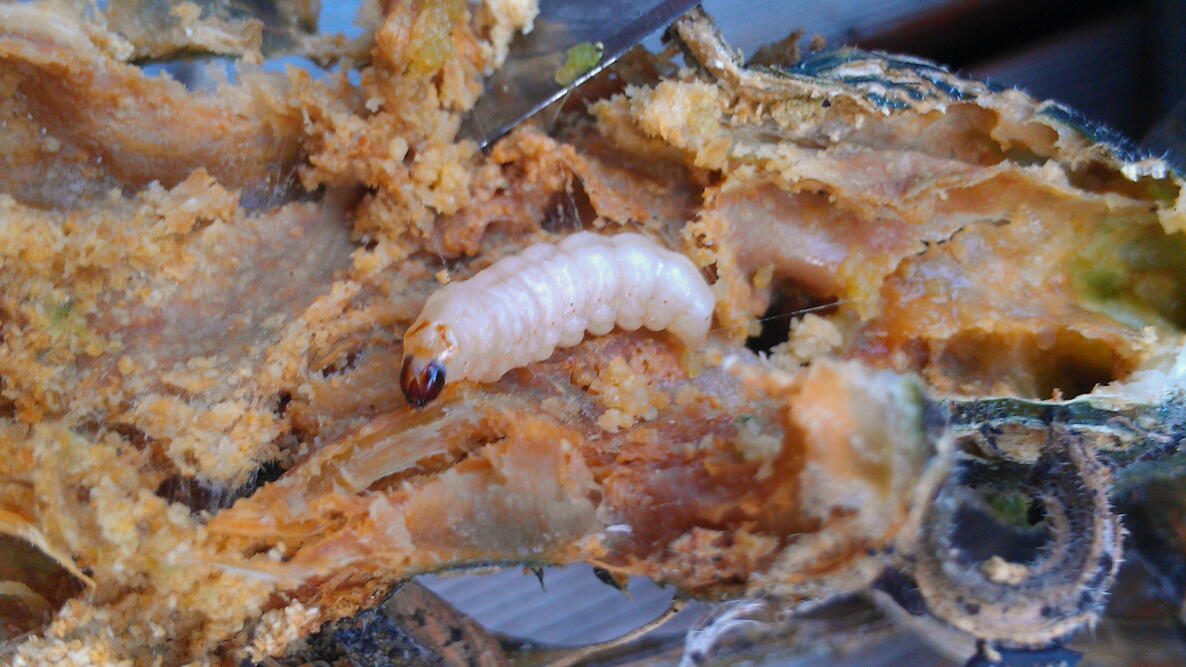
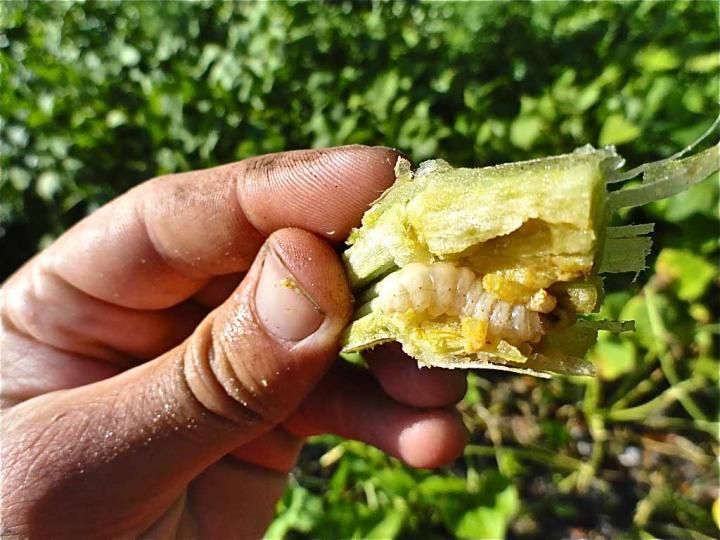
- Larvae: If you slit open a stem lengthwise with a fine, sharp knife, you will see the borer larva, which has a fat, white, wrinkled body and brown head; it can grow to about 1 inch long.
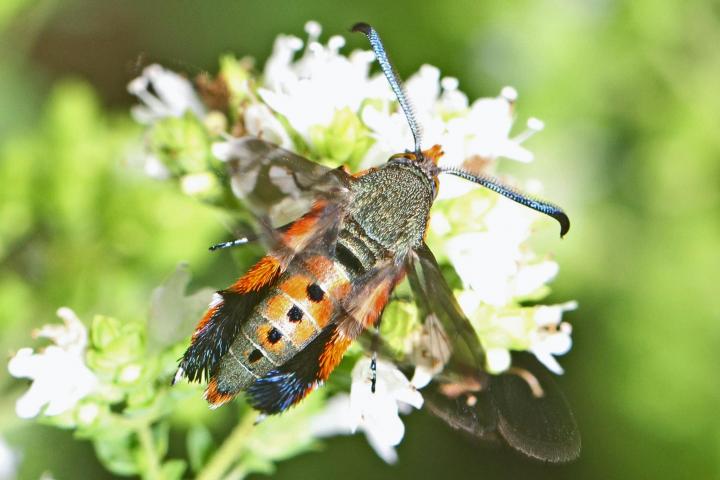
- Moths: The adult squash vine borer is a moth about 1/2 inch long. It has a gray or black body, marked with orange-red on its abdomen, legs, and head. The hind wings are transparent, and the front wings are metallic green.
Identifying Squash Vine Borer Damage
- First, the leaves of the plant will likely start to wilt inexplicably.
- Look for holes at the base of the plant and green or orange-yellow sawdust-like “frass,” which is fecal matter (poop!)
- Squash vine borer larvae feed on the material inside the stems of the plants. The stem will start to rot at the site of the feeding first.
Control and Prevention
How to Prevent Squash Vine Borers
As with most pests, prevention is key.
- Sometimes, the best solution is to start your squash as early as possible. This way, plants will be strong enough to withstand any midsummer attacks, and you may even be harvesting before squash vine borers become active. If you plant early, you may need to be prepared to cover your plants in case of late frost.
- Do not plant squash in the same area two years in a row. Squash vine borers overwinter in cocoons in the soil. Also, clean up and dispose of all plant debris in the fall.
- Dispose of the squash plants as soon as they are finished for the season. In the fall and spring, till the soil to get rid of overwintering pupae.
- Physical barriers can be an effective means of keeping squash vine borers at bay:
- Cover plants’ stems with a barrier, such as strips of nylon stockings or aluminum foil, to prevent egg laying.
- Before flowers appear on the plants, use row covers to keep squash vine borers away. The covers will need to be removed for pollinators, eventually. This will not only give you a head start over pests, but will help protect your plants from strong heat and frost.
- Adding beneficial insects such as parasitic wasps to your garden prior to the vine borer’s egg stage can be helpful, as these wasps are the borers’ natural enemies.
- If you give up on zucchini, which is susceptible to vine borers, try growing a squash that’s more resistant. Butternut squash and Cucuzzi (Lagenaria siceraria)—also known as snake gourd—tend to be resistant to squash vine borer attacks.
- Plant extra squash for the pests! This pest is around for only 6 to 8 weeks and can only eat so much (or so we think), so making sure you have plenty of plants to spare can help you avoid a total loss for the season.
How to Get Rid of Squash Vine Borers
If you’re already seeing signs of squash vine borers, use the following methods to get rid of them or at least minimize their damage to your crops.
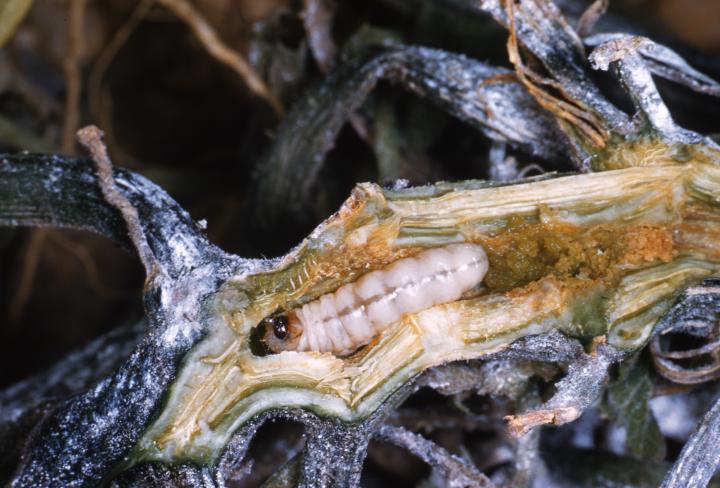
- If you catch them very early, you can manually remove the squash vine borer. Locate the entry point of the larvae, then slit the stem lengthwise with a fine, sharp knife to remove the larva by hand. One plant can house several larvae. Carefully remove the larvae without doing more damage to the plant. After removal, cover the slit stem section with moist soil above the point of injury to promote the formation of secondary roots. Also, extra rich soil near the vines helps to reroot.
- If you can find the entrance holes and “sawdust,” try inserting a wire and threading it through the stem for some distance to kill the larvae inside.
- Sprinkle diatomaceous earth around the stalks when the squash vines are small, or the threat of squash vine borers is high (early to mid-summer). Reapply after rain. Also, build up the soil around the vines. Or, sprinkle black pepper around the plants as a defense.
- If possible, catch and destroy the moths at twilight or in the early morning when they are resting on the upper leaves of the plants.
- There are insecticides that work too, but timing is critical; they are only truly effective when applied at the time when eggs are hatching.
- The bacteria Bacillus thuringiensis v. kurstaki (“Btk”) is a natural insecticide that can be injected into and applied to the squash stems.
- Insecticides containing the ingredients carbaryl (brand name: Sevin) or permethrin will work on squash vine borers, too. Always be sure to read labels and warnings carefully before application of any insecticide.
- Consult your local cooperative extension service for advice on appropriate chemical controls.
- Trap the adult orange moths with yellow sticky traps and yellow-colored bowls of soapy water.
- A trap crop of very early-planted Hubbard squash can be used to alleviate pest pressure on other squash.
- An old folk remedy from The Old Farmer’s Almanac in 1963 says that wood ashes were effective against the squash vine borer.
Learn about another main squash and zucchini predator: the squash bug.
Do you have any tips for controlling these pests? Let us know in the comments below!

More Like This
Comments
I have looked over many sites dealing with Controls for squash Vine borer. With a heavy infestation of these moths I have fought to protect squash using nearly all the suggested methods. Some work(complete netting of the plants) but are very labor intensive. Finally I watched the moths in the garden for many hours (letting them do their nasty work without disturbing them) and realized that they are extremely sensitive and careful when laying (THIS IS THE KEY TO CONTROL!!!!!). I then developed a much Less labor intensive method that seems to work Exceptionally well. Chopping hay in 2 to 4 inch lengths I let the hay lightly fall over the stalks, particularly the base, and even onto fruit to form a very open matrix. The moths will not land and lay, it appears to prevent landing of the moths. It's possible to walk through the garden and drop fluffy handfuls of chopped hay over any exposed vines every few days quickly and efficiently, apparently completely discouraging the egg laying. This is an organic method(Obviously) and takes relatively little time in a small home garden. If this approach is used Diligently it is nearly 100% effective. Anyone using the technique needs to make just a matrix of hay, Very open and loose, LIGHTLY ALLOWED TO DROP OPENLY, A HAND FULL AT A TIME (no need to put a lot) but with small enough gaps so that the moth is discouraged. The moths DO NOT LIKE CLOSED AREAS, THEY WANT OPEN ACCESS TO STALKS AND FRUIT - AGAIN, THIS ISTHE KEY). You don't have to pack in the chopped straw, just scatter it with most pieces looking like open "pick up sticks", that seems to be all that's needed. If you experiment with this method you will find it EXTREMELY effective and efficient. I've tried to spread the word on many garden sites but have not been successful, please share the idea. Call it the Mayo technique!
Any chance of a photo of this matrix of hay?I'm having trouble visualizing exactly how to do this. Thanks.
I would love to try this.... But the cost of cut hay or straw is definitely giving me pause. And it is a recurring expense because I can't gather it up and reuse it.
If you cut your own, which it sounds like you might, are you getting a bale and cutting it up or do you have a source for cut hay or straw before it is baled? Maybe next year, after I retire, I would have time to cut my own!!
I am trying covers and, as much as I don't like poison, I will try that as well this year.
I agree with many posts. SVB are wicked and I have tried many options to keep them out of my plants but I refuse to give up!
Can you post a photo of this?
I am really excited to try this. It has been too long since I've had a home grown squash!! Is it possible to post a pic of your protected plants? This sounds really interesting!
I am trying "The Mayo Technique" next year on my pumpkin vines! These stinking pests are a real problem in WV, and after many approaches to deter them, my pumpkins are a complete loss this summer...just ripped my vines out and bagged 'em up. Grrrrr. I used to grow 100 lbs pumkins in NE Ohio with no sign of them. Here's hoping it will help me to grow that one big pumpkin I'm dreaming of for my little girl! Thanks for the tip! :)
Squash Vine Borer, the Garden Pest from Hell
The Squash vine borer is the hardest pest to control in my garden. Excuse my seeming cynicism in these comments, because I am a little, No, a lot frustrated with failure year after year and the lack of effective methods and frankly some silly advice in much of the literature. These little worms have got our number. We can go to the Moon, and that was 45 years ago, and cure many cancers now but we cannot solve the borer problem. I have no agenda against the writer(s) of this article and sincerely hope whoever it is will not take my views personal. I am sure they are professional writer(s) and above any pettiness that might come from a disrespect of my views. The contents here include most all the common points found in the literature universe I am aware of. If the writer(s) do take issue you may never see this article or they might retaliate by correcting my spelling or grammar. If so, I have had it. They can only give you the material available. The best advice any have given up to now on this subject is of limited value if not total crap. If not clear by now, I have attempted to inject a little humor in what I say. If that is not obvious then I suck at something besides fighting vine borers.
This article is somewhat helpful but all stuff I have heard before. Reading this article, I noticed there are no photos of the eggs and little information on how to read the signs of their presence before the eggs get laid? Timing is going to vary by your climate and latitude. Being able to act early and knowing what to do is critical. This article could not be more correct on that point. They are spot on. So what er ya gonna do? Sounds like you best be doing the whole list, all the way up to everything short of making a moth voodoo doll. Will you have time to run the rest of your garden? Will you engage in an focused and intense battle with the borers only notice later it has been two weeks and everything else died form neglect.
No photo of the moth here either. I thought moths were those butterfly looking things that fly around the porch light in the summer. These things look more like a wasp. I have seen them before and I found it a moment of helpless feelings that either he/she or one of its nearby cousins has a plan to cause loss of my squash and anything else they might fancy. Trying to catch or trap the moth? Good luck with that one. I am sure you will get one here or there with the right trap. Stand around the plants at dusk and dawn and catch them lighting on the plants and kill them. How? A fly swatter or dish towel pop? Does LOL fit here? All it takes it one moth to lay eggs on every plant you have, unless you have a commercial crop then it might take two or three. Photos? I really think they would be helpful so you know what to look for so you know they are here/there…you know? You still might fail to stop them but you are not blindsided. Plant two crops, one early and another later, which is intended to be one for the worms and one for you? Ridiculous! Don't plant where the moth eggs might be in the ground. Hmm? The moth can fly, so zipping over to another spot in the garden a few feet away is not going to trouble him. Netting? Will work for the birds maybe. For the Moths? That is sort of goofy. It might serve to keep the worm in. These moths are tiny and can easily get around if not through netting. Netting with holes that small might impact vital sunlight the plant requires. Just one moth finding its way past the netting and oh well, you are in for it again. So, more than likely, netting is not a very effective method to stop them. My frustration, and I expect yours as well, is that all you get are these measures to take; that in aggregate, do not stop the problem. No pun intended but there are holes in about everything suggested. Maybe it slows them down a bit but what do you profit by taking all the measures when one moth in one day can lay enough eggs to destroy your crop. Even you mange to take out the locals there is a chance an outside hit-moth from the next door garden with show up. And, you if don't see the eggs in time, inside two weeks they have moved in and started on the buffet. Even if you see the eggs before they hatch, how do you get them off other than cut a hunk out of the stalk? What happens if you drop a few in the process? I wonder.
Once you see the hole and the frass/droppings they are in the stalk and the only hope you have is injecting Dipel BT liquid inside the stalk but it is hard to tell where to inject with your syringe. Plus it is hard to get to the base without breaking the plant. Unless careful, you will do more damage than the worms. slit the stalk, remove the worm and cover the cut with soil. Good for the one worm. What about the rest of the family further up? What about the idea of sticking a wire in the holes to attempt to skewer them? Samurai Gardner, Hieah! Well that might work sometimes. Often there are three and four of the worms in one plant and they are constantly moving. So bag one and the others to still get the job done. Once inside the stalk they will flatten the plant in a matter of days. Last year I started slitting one plant and by the time I finished the plant was shredded with cuts because you have to start at the hole and keep cutting until you find the little jerk. I would say giving one of these worms one day on your plant is enough to wilt it severely. There is really no one single best solution and I find that discouraging. The only absolute way to stop them is to not plant squash.
This year I have planted squash and again, I will do battle with these ugly little slim bags for the freedom to have squash on the table. Sadistic really but I want squash. I refuse to let a worm dictate my dietary choices. My plan, while not perfect, is to spray, spray, spray. I plan to mix liquid seven and Malathion a little stronger than recommended and spray the stalks from the ground up to as much as a foot and the ground around it 6-8 inches. Do not spray blooms is good advice offer in this article. Why spray the ground? I don't know. It makes me feel better. If the worm gets a taste of the poison and makes a run for it maybe he won't get far. I will spray once a week. More if it rains. I may try wrapping the stalk with foil but suspect that it will be hard to apply enough to cover everywhere they might lay eggs. Plus the moth could get behind foil enough to give the eggs a barrier from the poison. I may try foil anyway because it is reasonable prevention. I will watch for the holes in the stalk and inject BT into infested plants. I fully expect I will have some get in but hope I can have them check out early. I will inject high and plentiful until I see it running out of the entry hole.
After all of that is done, or maybe better if before, pray the poison spray works.
Billy Knight
05/17/2016
Thank You!
Its odd though~Years ago when we grew zucchini we had so much we couldn't give it away. And now~ Most of us are lucky if we even get any. I wonder why???
I have been gardening since I was 22 and I am now 59, never have I seen this problem like this before. Last year was the worst yet so far. My friend slit the stem and found two huge ones. I on the other hand have no patience and just uprooted and started over again. I did read if you take a rhubarb leaf and wrap it around the base of the plant, well that worked but I also think it worked because I killed most of the ones in my garden already. But I got some zucchini, not much but I did. No cucumbers at all. How did I kill them, eggs too, your going to think I'm nuts but I got a propane torch used for plumbing. I go out there and if I find anything that resembles a stink bug, wasp, even ants I burn the suckers. Eggs that are on the back of a leaf I break it off and burn the eggs. My neighbor and I bought nematodes about 30 million of them and let them loose, we couldn't really tell if it worked, not really with the gnats. The gnats and the vine borers killed my honeydew melon and they were beautifully plants. So, this year, we have many gnat traps, more nematodes, will try again the rhubarb leaves and the foil and I have some netting too when the seedlings are young. I will always use my trusty propane torch to burn beetles, June bugs, ants, leaf hoppers, you name it. The ants actually run from me anymore, lol... I light the torch as soon as I get into the garden early in the morning and I have burned a few while they were sitting on a leaf. They can't lay eggs if they are fried, they can't fly. I then pick them up and put them in the garbage and that's it. Oh, and this year we are tilling the garden. My neighbor likes to leave old dead plants from last year in the garden, but we got rid of them. No more big flat rocks or boards either. Don't know what happened that these bugs are just out of control and where did they come from. We need to have an immigration law against this bugs from hell, our food is at risk.
- « Previous
- 1
- 2
- …
- 10
- Next »
📣The Gardening Club Just Got Better! 3 Deliveries, 10% Store Discount, and more!

Oops, thanks for catching that, Hannah! We really appreciate it, and we're glad you've found the article helpful!