
Thousands of years ago, people spent hours gazing at the night sky. They found that by connecting the stars as if they were dots, patterns emerged that resembled animals, people, and things. Today, we call star patterns “constellations.”
Eventually, 88 of these star patterns were identified. The patterns helped people navigate on land and by sea and tell time, appearing in different parts of the sky depending on the day and year. (The stars don’t move. Earth moves, rotating on its axis once every 24 hours and revolving around the Sun once every year.)
Do you enjoy stargazing? Here’s help finding the different stars and constellations.
Finding The Big Dipper

The Big Dipper is actually not a constellation, but an asterism (a familiar group of stars located within a constellation).
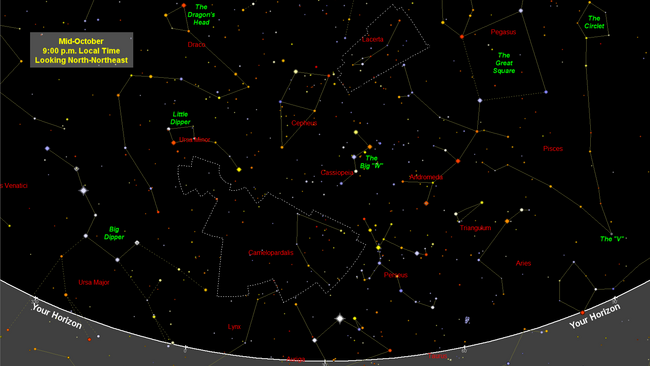
Look for seven major stars: four in the “bowl” and three in the “handle.” The two stars outside the bowl are called the “pointer” stars. They point to Polaris, a bright star that is also called the North Star because, with it, you can figure out which way is north.
To find north:
- Find the Big Dipper.
- Find the pointer stars.
- Find Polaris.
- Look straight up.
- Turn your body towards Polaris.
- Now, you’re facing north.

Ursa Major, the Great Bear
If you find the Big Dipper, you have found the Great Bear: The Dipper’s handle is the Bear’s tail.
Legends about the Great Bear abound. Ancient Greeks and Romans believed that a mythological king grabbed its tail, swung it around, and swung it into the sky to whirl around the North Pole forever. Some Native Americans believed that the three-tail stars were hunters chasing the Bear.

Ursa Minor, the Little Bear
Polaris will help you find the Little Dipper, also known as Ursa Minor or the Little Bear. Polaris is the star on the end of the Little Dipper’s handle.

Orion, the Hunter
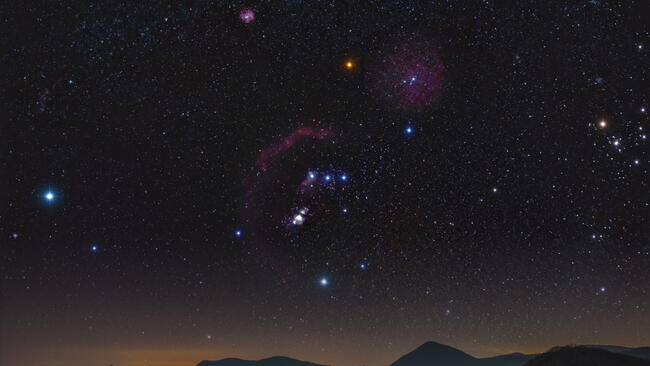
This is easiest to find in the winter. Look for three bright stars in a line—they represent Orion’s belt.
The two stars north of this are Orion’s shoulders. One of these is Betelgeuse (“BEETLE-juice”), which is a giant red star. The two brighter stars to the south are his legs.
Ancient people used Orion to predict the seasons: The grapes were ready to harvest if it appeared at midnight. If it appeared in the morning, summer was beginning. If it appeared in the evening, winter had arrived.
Read more about finding Orion.

Canis Major, the Great Dog
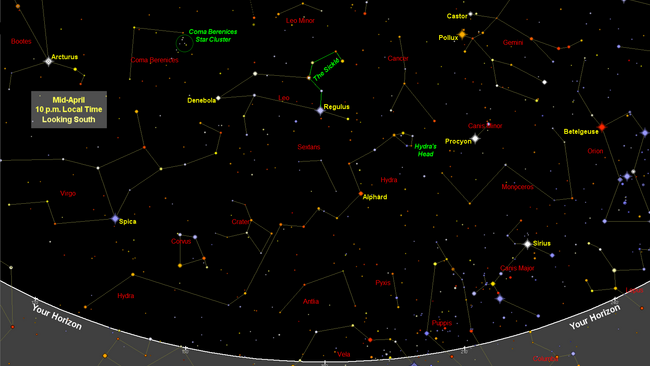
This constellation is named for the larger of Orion’s two hunting dogs (the other, Canis Minor, has only two stars).
To find Canis Major:
- Imagine a straight line through Orion’s belt.
- Move your eyes left (south) until you reach a very bright star—Sirius, the dog’s nose.
- Look farther south to find a triangle of stars that marks the dog’s hindquarters.
Ancient Egyptians called Sirius “the Nile Star” because it always appeared in the sky right before summer began and the waters of the River Nile began to flood. In medieval Europe, people thought that a combination of light from the Sun and Sirius caused the hot and humid “dog days” of summer.
On a clear and moonless night away from bright lights, you can see about 2,500 stars. Spend some time looking at the sky and connecting the stars!

More Like This



Good question. What the article means, though, is that what we normally notice each night and year, where stars rise and set, some stars move forward and backward relative to background celestial objects, and the constellation positions change over the months, is because the Earth is rotating on its axis and revolving around the Sun, changing our view.
However, you are right in that stars do move. For example, binary stars orbit around a common center of mass. Some stars slowly orbit around the center of their rotating galaxy; an example of this would be our own Sun, revolving around the center of the Milky Way galaxy (completing one orbit in about 225 million years).
Often, what looks like a red star is the planet Mars. The star Antares, in the constellation Scorpius, can also appear reddish. In fact, "Antares" means "rival of Mars," probably because it can look similar to the planet.
To find a sky map for your location, see:
http://www.wunderground.com/sky/index.asp
If I'm reading the map correctly (after putting in a zip code for Yonkers), it looks like around 1 am on December 20, Sirius will be just about due South (crossing meridian), a little up from the horizon when facing south.
- « Previous
- 1
- 2
- …
- 10
- Next »

Comments