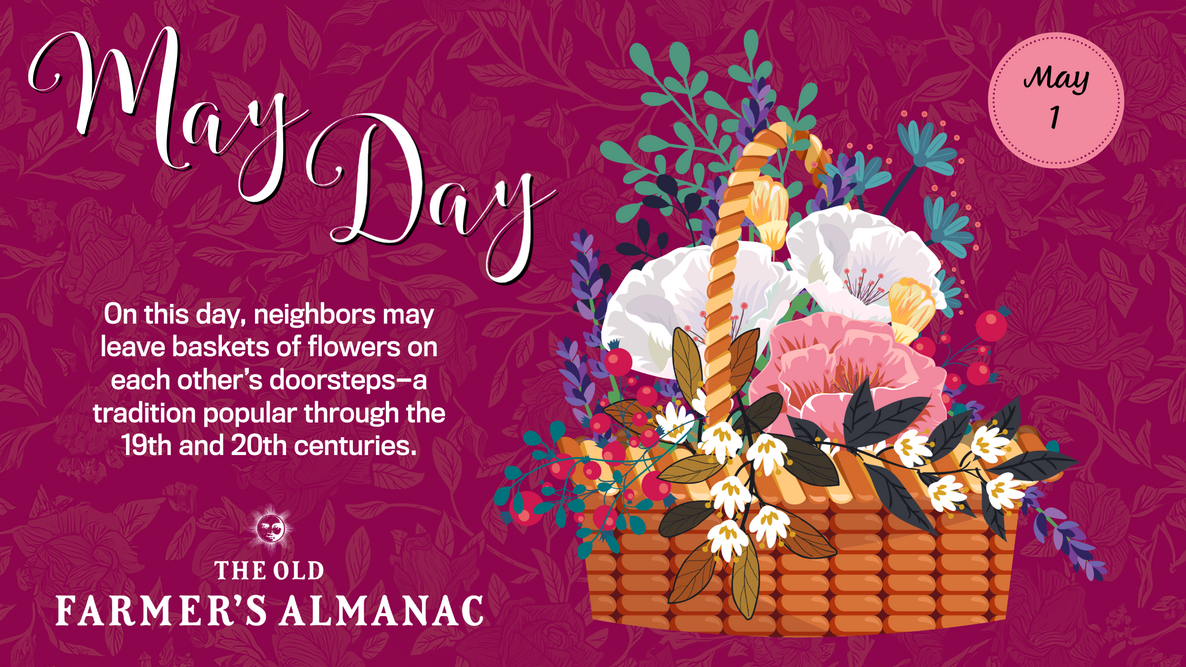
May Day (May 1) celebrates the return of spring! Learn about the origins of May Day and fun traditions, from surprise flower baskets to the maypole. Don’t forget to wash your face with morning dew on May 1 for good luck. Here are 10 ways to “bring in the May.”
The Origins of May Day
Did you know that May Day has its roots in astronomy? Traditionally, it was the halfway point between the spring equinox and the summer solstice! In ancient times, this was one of the Celtic cross-quarter days, which marked the midway points between the (four) solstices and equinoxes of the year.
As with many early holidays, May Day was rooted in agriculture. Springtime festivities filled with song and dance celebrated the sown fields starting to sprout. Cattle were driven to pasture, special bonfires were lit, and the doors of houses and livestock were decorated with yellow May flowers. In the Middle Ages, the Gaelic people celebrated the festival of Beltane, which means “Day of Fire.” People created large bonfires and danced at night to celebrate.
May Day has a long history and tradition in England, some of which eventually came to America. Children would dance around the maypole, holding onto colorful ribbons. People would “bring in the May” by gathering wildflowers and green branches, weaving floral hoops and hair garlands, and crowning a May king and queen.
When Is May Day?
This one is easy to remember: May Day occurs annually on May 1! See which day of the week May Day falls on in the upcoming years:
| Year | May Day |
|---|---|
| 2026 | Friday, May 1 |
| 2027 | Saturday, May 1 |
| 2028 | Monday, May 1 |
| 2029 | Tuesday, May 1 |
The Maypole Dance
Did you ever dance around the maypole as a child? Wrapping a maypole with colorful ribbons is a joyous tradition that still exists in some schools and communities.
- Initially, the maypole was a living tree chosen from the woods with much merrymaking. Ancient Celts danced around the tree, praying for the fertility of their crops and all living things! For younger people, there was the possibility of courtship. If a young woman and man paired by sundown, their courtship continued so that the couple could get to know each other and, possibly, marry 6 weeks later on June’s Midsummer’s Day. This is how the “June wedding” became a tradition.
- In the Middle Ages, all villages had maypoles. Towns would compete to see who had the tallest or best maypole. Over time, this Old English festival incorporated dance performances, plays, and literature. People would crown a “May Queen” for the day’s festivities.
The strict Puritans of New England considered the celebrations of May Day to be licentious and pagan, so they forbade its observance, and the springtime holiday never became an important part of American culture as it was in many European countries.
Interestingly, from the late 19th century through the 1950s, the maypole dance and festivities became a rite of spring at some U.S. colleges. Seen as a wholesome tradition, this celebration often included class plays, Scottish dancing, Morris dancing, a cappella concerts, and cultural dancing and music displays.
In the 1960s and 1970s, interest waned; the May Queen and her court became more of a popularity contest. Today, the maypole dance is mainly celebrated in schools (from elementary through college) as a fun spring activity.

Making a May Basket
Ever heard of the May baskets? People would leave a paper basket or cone containing spring flowers and sweets on each other’s doorsteps, usually anonymously.
This tradition was popular through the 19th and 20th centuries, especially with children or sweethearts. The custom was to knock on the door, yell, “May basket!” and then run. If the recipient caught the giver, he or she was entitled to a kiss.
Louisa May Alcott wrote about May Basket Day in the late 1800s. In the 1920s, some bold schoolchildren hung a May basket for First Lady Grace Coolidge on the White House door.
The May Day basket is still a cherished tradition for some Americans, although it’s not well known today. To make a simple May basket, fold a piece of colored paper into the shape of a cone. Then fill it with wildflowers! If you don’t have colored paper, roll up and secure (with tape or a staple) a paper plate. Draw on the plate with spring colors and fill it with flowers!
You could also fill a real basket with little gifts such as flower seed packets, baked cookies, candies, and pretty trinkets. If you don’t have a basket, an empty milk carton or seed pot would also do the trick. Just cover it in colored paper or pretty streamers and fill it with tissue paper!

10 Ways to Celebrate May Day
Why not celebrate May Day? Here are some joyful May Day traditions marking the return of spring and the renewed gift of life.
- Among the many superstitions associated with May Day was the belief that washing the face with dew on the morning of May 1 would beautify the skin and bring good luck. We say go ahead! Walk outside and sprinkle your face with morning dew (or snow!).
- On May 1, people in Britain welcome spring by “Bringing in the May,” or gathering cuttings of flowering trees for their homes. Bring in branches of forsythia, magnolia, redbud, lilac, or other flowering branches in your region!

Make that May Day basket of flowers! Get the kids involved. We like this little fellow’s homemade basket, which he’s probably leaving for Mom (shhh!).

Credit: Suzanne Tucker. - May 1 in Hawaii is called “Lei Day,” and people make pretty leis. Leis are garlands or wreaths that are often made with native Hawaiian flowers and leaves. These days, leis are given as a symbol of greeting, farewell, affection, celebration, or honor—all in the spirit of aloha. Make a lei or a garland for yourself or your mother!
- Kids would go barefoot on May Day for the first time. Whatever your age today, walk barefoot in the morning dew (or snow?). Encourage the kids to do the same!
- In parts of Ireland, people would make a May bush; typically, this was a thorn bush or branch decorated with flowers and ribbons. Create your own May bush or tree! Just decorate with colored ribbons!

- Beekeepers traditionally moved bees on May 1. Want to get involved in beekeeping? Check out our series on starting a honeybee hive!
- Fishermen expect to catch fish on May Day. Find our Best Fishing Days here.
- Traditionally, farmers planted turnips on this day. Other folklore has it that, to protect cucumbers from insects, they should be planted on May 1. For best results, they should be planted naked! Clothed or not, see our Planting Calendar to find planting dates for your area.
- The Kentucky Derby starts off the month of May (the first Saturday of the month).

What Does “Mayday!” Mean?
Here’s a fun fact: The term “Mayday!” is not related to the “May Day” spring festival but instead comes from the French phrase “M’aidez!,” which means “Help me!” If you hear “Mayday!” repeated three times, realize that it is an urgent distress call. (To signal that you need help but are not in a life-threatening situation, repeat the phrase “Pan-pan!” three times when calling for assistance.)
So, now you know all about May Day! As colts and calves kick up their heels, seedlings seek the Sun, and birds call for mates, we humans may join their revels for one day: during spring’s “May Day” festival! Even serious-minded folks can put work aside to enjoy Nature’s exuberance!
Do you celebrate May Day? Share your traditions in the comments below.



- « Previous
- 1
- 2
- …
- 10
- Next »

Comments