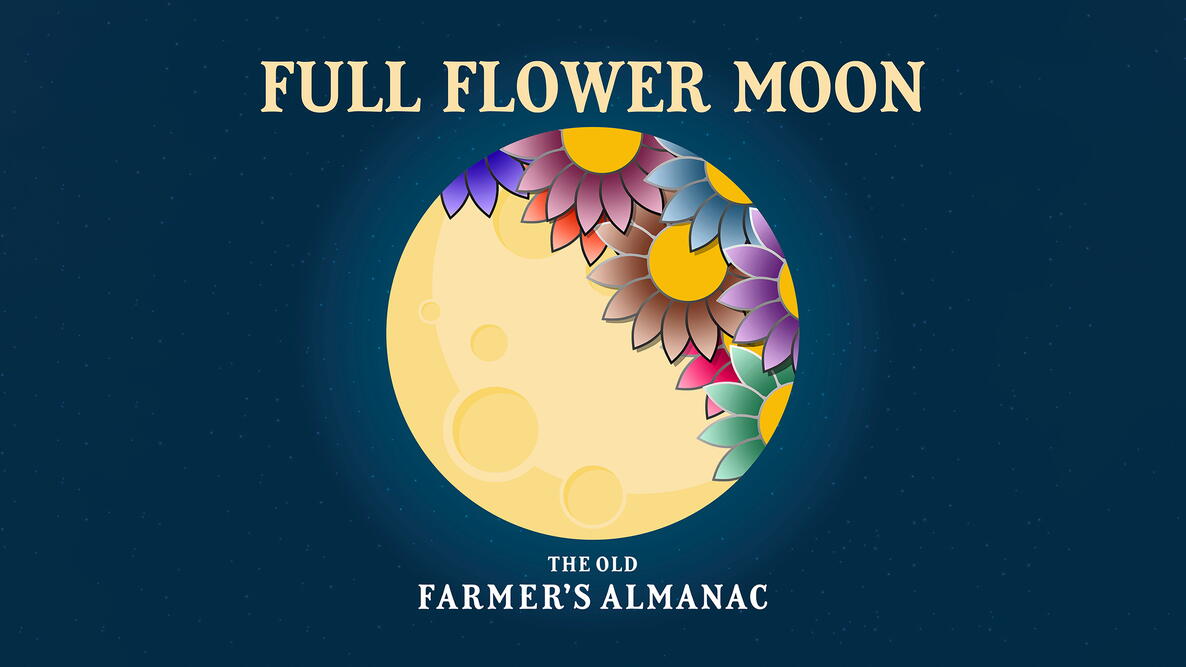
There will be not one, but two, Full Moons in May! The first Moon, the Full Flower Moon, reaches its peak on Friday, May 1, while the second Moon, the Blue Moon (which is also a Micromoon), peaks on Sunday, May 31. Find out the meaning of the Flower Moon, the Full Moon of May.
When to See the Full Moons in May 2026
May 1: The Flower Moon
May’s first Full Moon, the Flower Moon, reaches peak illumination at 1:23 P.M. (EDT) on Friday, May 1. How fitting to have the Flower Moon arrive on May Day!
May 31: The Blue Moon
In May, a second Full Moon, a Blue Moon, will make an appearance. The term Blue Moon is most commonly used when we have two Full Moons in a single month. On Sunday, May 31, the Full Moon will peak at 4:45 A.M. EDT.
Find a location with unobstructed views of the horizon, if possible. See what time the moon will be visible in your area with our Moonrise and Moonset Calculator.
The Blue Micromoon
This month also brings a Micromoon. Curious about how it compares to a Supermoon? The Full Moon on May 31, 2026, occurs just before reaching apogee on June 1.
Apogee refers to the point when the Moon is farthest from Earth. When the Full Moon occurs near this point, it’s classified as a “Micromoon”—the opposite of a Supermoon, so it will appear slightly smaller and dimmer than usual.
Why does the Moon’s distance vary? The Moon orbits Earth in an elliptical path, with one side closer and the other farther. While this affects its size and brightness, the difference is too subtle to notice with the naked eye. What often makes the Moon appear larger is the “Moon illusion”—an optical effect that occurs when it’s near the horizon. Since this Micromoon will be high in the sky, it likely won’t appear as large or imposing as a Full Moon closer to the horizon.
Why Is It Called the Flower Moon?
The Full Moon names used by The Old Farmer’s Almanac come from many places, including Native American, Colonial American, and European sources. Traditionally, each Full Moon name was applied to the entire lunar month in which it occurred, not solely to the Full Moon.
The Flower Moon
May’s Flower Moon name should be no surprise; flowers spring forth across North America in abundance this month!
- “Flower Moon” has been attributed to Algonquin peoples, as confirmed by Christina Ruddy of The Algonquin Way Cultural Centre in Pikwakanagan, Ontario.
- May’s Moon was also called the “Month of Flowers” by Jonathan Carver in his 1798 publication, Travels Through the Interior Parts of North America: 1766, 1767, 1768 (pp. 250-252), as a likely Dakota name. Carver stayed with the Naudowessie (Dakota) over a period of time; his expedition covered the Great Lakes region, including the Wisconsin and Minnesota areas.
- Henry David Thoreau sparked the Native American Moon names as well, referencing the Flower Moon and Carver when he wrote about Native Americans.
Alternative May Moon Names
May’s Moon names tend to speak to the arrival of spring and all that it entails!
The Cree names Budding Moon and Leaf Budding Moon celebrate the awakening of local flora, which really begins to leaf out now in many areas. Similarly, Planting Moon (Dakota, Lakota) marks the time when seeds should be started for the farming season ahead.
The activities of animals marked spring’s arrival, too, which is highlighted by the Cree names Egg Laying Moon and Frog Moon, as well as the Oglala term Moon of the Shedding Ponies. All three names indicate that warmer weather is on the way!
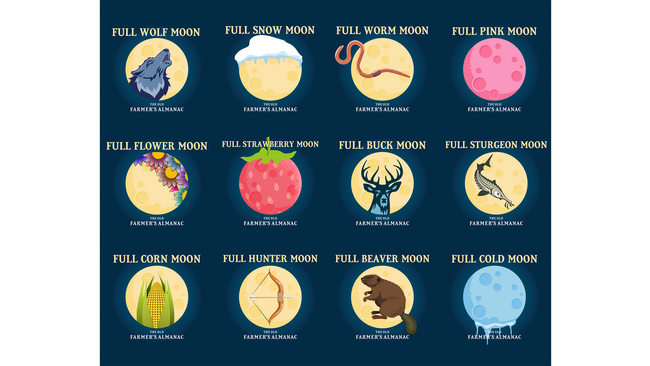
→ See all 12 months of Full Moon names and meanings.
Moon Phases for May 2026

All dates and times are EDT. See our Moon Phase Calendar for times in your location.
.png) | Full Moon: May 1, 1:23 P.M. EDT |
.png) | Last Quarter: May 9, 5:10 P.M. EDT |
.png) | New Moon: May 16, 4:01 P.M. EDT |
.png) | First Quarter: May 23, 7:11 A.M. EDT |
| Full Moon: May 31, 4:45 A.M. EDT |
→ When is the next Full Moon? Find out in our Full Moon Dates chart.
Full Flower Moon Video
Each month, we will explain the traditional names of the Full Moon along with some Moon facts. Click below to watch the video and learn about May’s Full Flower Moon.
Best Days in May 2026
Below are the best days for activities, based on the Moon’s sign and phase in May.
For Gardening:
- Planting aboveground crops: 1, 2, 29, 30
- Planting belowground crops: 20, 21
For Setting Eggs:
- 8, 9, 17, 18
For Fishing:
- 1-12, 26-31
→ See the Best Days for more activities.
Full Moon Folklore
- Clothes washed for the first time in the Full Moon will not last long.
- The Full Moon is an ideal time to accept a proposal of marriage.
Share your thoughts about the May Moon below!

More Like This

Comments