Planting
Cauliflower should be grown in a spot that gets full sun (6 to 8 hours of sunlight per day). Lack of sunlight may produce thin, leggy plants and subpar heads. In summer, shade plants from the hot sun, if necessary.
Soil needs to be very rich in organic matter; mix aged manure and/or compost into the bed before planting. As an alternative, apply 5-10-10 fertilizer to the planting site. Fertile soil helps to prevent heads from buttoning.
When to Plant Cauliflower
- Cauliflower grows best as a fall crop (cool weather is best for head formation), but can be grown in spring, too.
- We suggest buying cauliflower seedlings (aka “transplants”) versus starting them from seed, as cauliflower can be finicky.
- Spring Planting:
- If you start from seed, sow seeds indoors 4 to 5 weeks before the last spring frost date.
- Plant seedlings outdoors 2 to 4 weeks before the last spring frost date.
- Fall Planting:
- Plant a fall crop 6 to 8 weeks before the first fall frost date, but after daytime temperatures are regularly below 75°F.
How to Plant Cauliflower
- Sow seeds in rows 3 to 6 inches apart and up to ½ inch deep.
- Set plants 18 to 24 inches apart with 30 inches between rows.
- In early spring, be ready to protect plants from frost by covering them with old milk jugs, if necessary. Extreme cold can halt growth and/or form buttons.
- Water consistently during germination and growth. Add mulch to conserve moisture.

Types
- ‘Graffiti’: purple; tends to be milder and sweeter than the white varieties.
- ‘Snowball’: smooth, white, medium 6-inch heads; a good yield throughout the growing season.
- Orange varieties, such as ‘Cheddar’ and ‘Flame Star’, are creamier and sweeter than white varieties, with more vitamin A.

Credit: Wendy Hagen.

More Like This

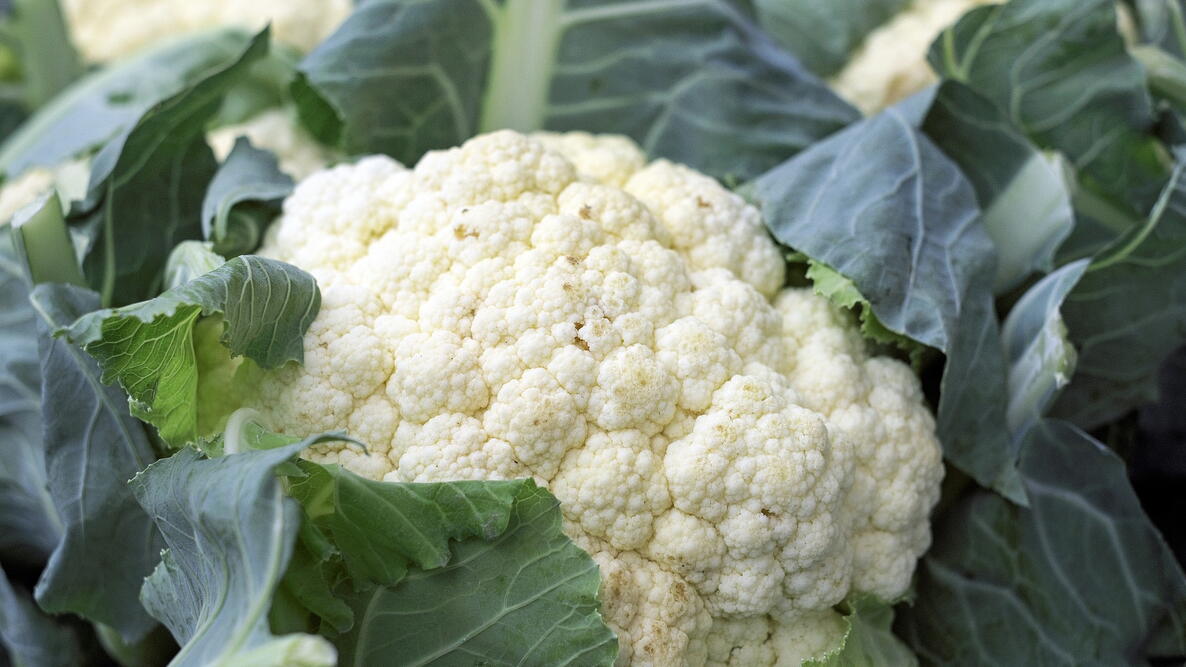
Most likely this is frass (poop) from a cabbage looper or other caterpillar pest. It should be fine to eat the cauliflower if you first wash it properly. First, soak the cauliflower head for one to two minutes in cold water, then rinse. Then, use a vegetable brush to scrub the crevices in the cauliflower head, rinse again, and pat dry with a paper towel. After this, you might also try rinsing the head in a solution of 1/2 cup white vinegar to 2 cups water, then rinse with fresh water and pat dry with a paper towel. This can help eliminate some more bacteria.
For more information about washing produce, see:
http://www.ext.colostate.edu/pubs/foodnut/09369.html
http://umaine.edu/publications/4336e/
Several diseases and problems cause black or brown specks. Black rot may show up as V-shape yellow areas on the leaves that point to a vein. It may spread into the stems, which when cut may show a brown discoloration. The head may have many black specks, discoloration, and black veins. This is caused by bacteria that overwinter on plant debris, or reside in infected seeds. It can survive in the soil for 2 years. High temperatures and humidity help it to spread, and is easily transmitted by garden tools, insects, wind, splashing water, etc. If you suspect this is black rot, do not plant cole crops in that area for 2 or 3 years. Remove all plant debris each season, keep up with weeding, and buy certified disease-free seeds.
Black speck is a physiological disorder, not related to a bacteria, fungus, or virus. In this, tiny black specks appear in the interior of the curd, on the stems and flower stalks. You can see it when you break open the head, but they are not on the outer top of the head. Black speck can appear in warm weather during rapid growth, and may be related to a nutrient deficiency.
Downy mildew can also discolor heads. Sometimes cauliflower will develop black specks just as a part of aging, indicating that the head is past its prime.
Long, hot days will cause red-purple discoloration in cauliflower. Certain varieties (one is Snow Crown) are more vulnerable to this than others, especially in hot weather. Try a bit raw and see if you like it.
- « Previous
- 1
- 2
- …
- 10
- Next »

Comments